Asian Cities Word Search
Click and drag to select words
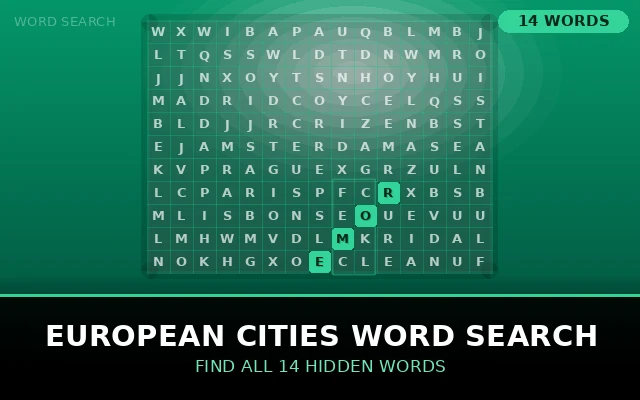
Paris, Rome, Berlin and more hidden in the grid. Play our European Cities word s...
Play Now
Pyramids, Colosseum, Great Wall and more. Play our Seven Wonders word search and...
Play Now
Vesuvius, Etna, Fuji and more. Play our Famous Volcanoes word search and discove...
Play NowTokyo, Beijing, Mumbai and more. Play our Asian Cities word search and explore the continent major urban hubs. Free online puzzle no sign-up needed.
Paris, Rome, Berlin and more hidden in the grid. Play our European Cities word search and test your geography skills. Free online no registration needed.
Play Now
Pyramids, Colosseum, Great Wall and more. Play our Seven Wonders word search and explore the world iconic landmarks. Free online no sign-up needed.
Play Now
Vesuvius, Etna, Fuji and more. Play our Famous Volcanoes word search and discover the world most iconic peaks. Free online puzzle no sign-up needed.
Play NowAsian Cities Word Search Guides & Articles
Asian Cities Word Search
Introduction
Welcome to our free Asian Cities word search! This fun puzzle is all about Asian cities, and you can play it right here online at no cost. Whether you are a student studying geography, a teacher planning a lesson, or just someone who loves word games, this asian cities word search is a great way to learn new names while having fun. Search the grid, find every hidden word, and test how much you really know.
More than half of every human being alive today lives somewhere in Asia. That single fact makes the continent almost impossible to summarize in any tidy way it's simultaneously home to some of the world's oldest continuous civilizations and some of its newest, fastest-growing skylines. Our free Asian Cities Word Search hides fourteen of the continent's most significant urban centers inside a single letter grid, from megacities holding tens of millions of residents to a tiny nation that happens to also be a single city.
Free to play right now, no sign-up required. Fourteen names, one continent, and a scale of urban life that genuinely dwarfs every other region on the planet.
About This Puzzle
This Asian Cities word search hides 14 carefully chosen words related to Asian cities. The It wordsearch puzzle is set at a medium difficulty level, which means it is challenging enough to keep things interesting but still easy enough for most players to finish without frustration. Kids, students, teachers, and adults will all enjoy working through this grid. Beyond being fun, this puzzle has real educational value: it helps players memorize names, recognize spelling patterns, and build a stronger picture of Asian cities in a playful, low-pressure way.
Capital Cities Aren't Always the Biggest Cities
One pattern worth noticing before you even start scanning the grid: several countries on this list have a political capital that isn't actually their largest or most economically dominant city. BEIJING governs China, but SHANGHAI outpaces it in sheer population and financial muscle. NEWDELHI serves as India's seat of government, while MUMBAI dominates as the country's financial and entertainment capital, home to a film industry that produces more movies annually than any other country on Earth. This split between political power and economic power isn't unique to Asia, but the scale of the gap here is unusually dramatic, with cities like Mumbai and Shanghai growing into some of the largest urban economies in the world despite technically playing second fiddle to their capitals on the political map.
The Cities That Don't Fit a Simple Category
A handful of names on this list resist easy classification entirely. SINGAPORE is genuinely unusual not just a city, but an entire independent country consisting of a single urban center, one of only a few true city-states remaining anywhere in the modern world. ISTANBUL carries its own distinct claim to fame: it's the only major city on Earth that physically straddles two continents, with a section sitting in Europe and another in Asia, separated by a narrow strait that ships pass through constantly. DUBAI, meanwhile, represents a different kind of exception altogether a city that transformed itself in a matter of decades from a modest trading port into a globally recognized skyline defined by some of the tallest structures ever built.
The Rest of the List, Region by Region
East Asia brings together TOKYO, BEIJING, SHANGHAI, and SEOUL four cities anchoring some of the world's largest and most technologically advanced economies. Tokyo alone holds the distinction of being the most populous metropolitan area anywhere on the planet, a title it has maintained for decades despite intense competition from rapidly growing cities elsewhere. Seoul, meanwhile, has become a global cultural exporter in its own right, with its entertainment and technology industries reaching audiences far beyond Korea's own borders in a way few cities of its size have managed to replicate.
Southeast Asia contributes BANGKOK, JAKARTA, MANILA, HANOI, and SINGAPORE, a region defined by rapid modernization layered over deep historical and religious traditions, with each capital reflecting its own particular blend of colonial history, indigenous culture, and twenty-first-century growth. Jakarta in particular has grown at a pace that's placed real strain on its infrastructure, prompting Indonesia to begin relocating its capital functions to a newly built city elsewhere on the archipelago — a rare, large-scale example of a country choosing to start a new capital nearly from scratch rather than continue expanding an already-stretched metropolis.
South Asia is represented by MUMBAI and NEWDELHI, both anchoring a country whose population now rivals or exceeds any other nation on Earth, making its two largest cities genuinely globally significant by scale alone.
West Asia and the crossroads close out the list with DUBAI and ISTANBUL, both cities that have leaned heavily into their roles as connectors between continents, cultures, and global trade routes, one through ultramodern architecture and finance, the other through thousands of years of continuous strategic importance.
KUALALUMPUR, Malaysia's capital, sits comfortably within Southeast Asia's broader story of rapid twentieth and twenty-first century development, known for architecture that blends traditional Islamic design with strikingly modern skyscrapers.
From Fishing Villages to Global Skylines
Few continents have transformed their skylines as dramatically or as quickly as Asia has over the past half-century. Cities like Shanghai and Dubai were, within living memory, far more modest settlements a river port and a pearl-diving and trading outpost, respectively before rapid economic growth and deliberate large-scale investment turned them into some of the most recognizable skylines on Earth. Singapore followed a similarly compressed timeline, moving from a smaller colonial trading post to one of the world's wealthiest and most meticulously planned city-states within a few short decades of independence. This pace of transformation stands in sharp contrast to cities like Istanbul and Beijing, whose skylines instead layer centuries of continuous history beneath their modern additions, giving each city a genuinely different rhythm and feel even when standing just blocks apart from a gleaming new tower. That contrast between compressed, rapid reinvention and slow, centuries-deep continuity is part of what makes traveling across this list of fourteen cities feel less like visiting a single continent and more like moving through several entirely different eras of urban history in the space of a single trip.
Solving This Grid
Read the full word list before scanning the letters knowing exactly what you're hunting for saves real time compared to searching blind. Words in this puzzle run horizontally, vertically, and diagonally, so check the grid in multiple directions rather than assuming a single pass will catch everything. The longest entries here, particularly KUALALUMPUR, SINGAPORE, and ISTANBUL, are actually easier to spot first, since their length narrows down where they could possibly fit. Shorter names like SEOUL and HANOI tend to blend more easily into the surrounding letters, so save those for a slower, closer look once the longer words are checked off.
The Fourteen Cities, One by One
Tokyo — Japan's capital and the most populous metropolitan area in the world, blending ultramodern technology with deep-rooted cultural tradition.
Beijing — China's capital, home to centuries of imperial history alongside rapid modern development.
Seoul — South Korea's capital, a major global center for technology, entertainment, and design.
Bangkok — Thailand's capital, known for its ornate temples alongside a fast-paced, modern urban core.
Mumbai — India's largest city and financial hub, home to one of the world's largest film industries.
Shanghai — China's largest city by population, a major global center for finance and international trade.
Singapore — A city-state and major financial center in Southeast Asia, unusual for functioning as both a city and an entire independent nation.
Jakarta — Indonesia's capital, one of the largest and most densely populated urban areas in Southeast Asia.
Manila — The Philippines' capital, a historic port city shaped by centuries of trade and colonial influence.
Hanoi — Vietnam's capital, known for blending French colonial architecture with deep Vietnamese cultural roots.
Dubai — A major city in the United Arab Emirates, globally recognized for its rapid transformation and record-setting skyscrapers.
Istanbul — A major Turkish city uniquely positioned across two continents, with a history stretching back thousands of years as a strategic crossroads.
Kualalumpur — Malaysia's capital, known for its striking modern skyline layered atop a diverse cultural and religious heritage.
Newdelhi — India's capital, serving as the country's political center alongside centuries of layered Mughal and colonial-era history.
Numbers Worth Sitting With
Asia holds the title of largest continent on Earth by both area and population, a scale so enormous it's genuinely difficult to grasp through numbers alone. Tokyo's metropolitan area is home to tens of millions of residents, more than many entire countries combined into a single urban region. Istanbul stands alone as the only major city in the world split physically across two continents, with ferries and bridges connecting its European and Asian sides every single day. Singapore remains one of just a handful of true city-states left anywhere in the modern world, a status it shares with only a small number of other places on Earth. Mumbai's film industry produces a genuinely staggering number of films each year, frequently outpacing Hollywood's annual output by a wide margin, even if individual budgets tend to run considerably smaller. And Dubai's tallest structures have repeatedly broken world height records over the past two decades, part of a broader regional trend of using architecture as a deliberate statement of rapid economic ambition.
Related Puzzles:
- African Capitals Word Search
- Seven Wonders Word Search
- World Deserts Word Search
- Famous Volcanoes Word Search
- European Cities Word Search
- South American Cities Word Search
- Famous Landmarks Word Search
- World Oceans and Seas
- Mountain Ranges Word Search
- US States and Capitals
- Rivers of the World
Conclusion
Fourteen cities, four regions, and a continent so vast it holds more people than every other continent combined. Whether you're drawn to Tokyo's sheer scale, Istanbul's continent-straddling geography, or Singapore's rare status as a city that's also an entire country, this puzzle offers a genuinely compact window into the scale and diversity that makes Asia impossible to summarize in a single sentence. It's worth remembering, too, that these fourteen names represent only a small slice of a continent home to dozens of countries and thousands of years of overlapping history, trade, and culture. Solve the grid, then take a moment to appreciate just how much of humanity's daily life unfolds across these fourteen names alone.