12 Days of Christmas Word Search
Click and drag to select words
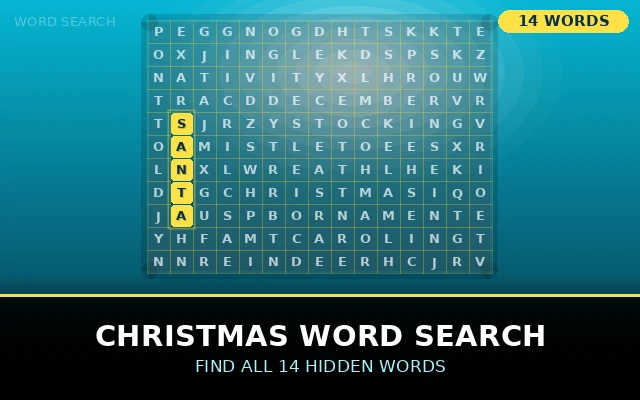
Santa, reindeer, snowflakes and more. Play our Christmas Word Search and enjoy t...
Play Now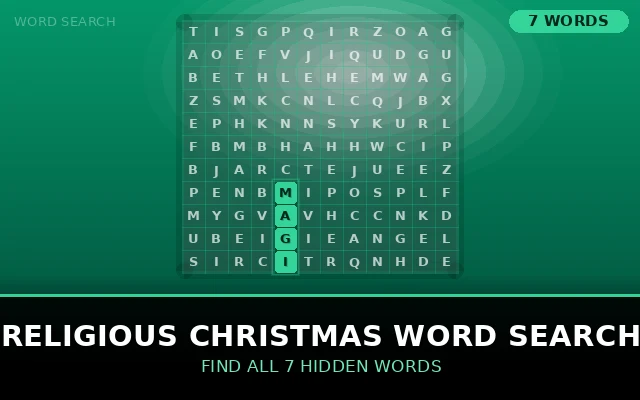
Play our free Religious Christmas Word Search featuring Bethlehem, Manger, Sheph...
Play Now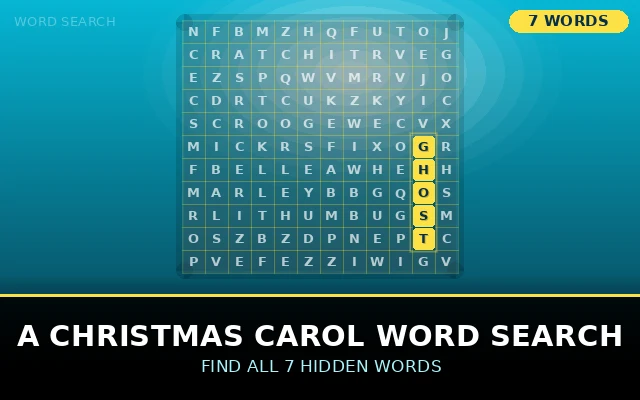
Play our free A Christmas Carol Word Search with Scrooge, Marley, Cratchit and m...
Play NowFind every gift from the classic carol in our free 12 Days of Christmas Word Search. Partridges, drummers, swans and more hidden in one festive puzzle.
Santa, reindeer, snowflakes and more. Play our Christmas Word Search and enjoy the festive holiday fun. Free online puzzle for kids and families no sign-up.
Play Now
Play our free Religious Christmas Word Search featuring Bethlehem, Manger, Shepherd, Nativity and more. A faith-filled holiday puzzle for kids and families.
Play Now
Play our free A Christmas Carol Word Search with Scrooge, Marley, Cratchit and more. A fun puzzle inspired by Dickens' beloved holiday tale.
Play Now12 Days of Christmas Word Search Guides & Articles
12 Days of Christmas Word Search: Turning a 240-Year-Old Song Into a Countdown Puzzle
"The Twelve Days of Christmas" first appeared in print in an English children's book in 1780, listed as a memory-and-forfeits game the kind where players recite an ever-growing list and pay a penalty the moment they stumble. Nearly two and a half centuries later, the same escalating list of gifts still trips people up at karaoke nights and school concerts, which is probably why it translates so naturally into a 12 Days of Christmas word search.
This article gets into where the song actually came from, clears up one persistent myth about it, and walks through a way to turn the puzzle into something more than a single sheet of paper a proper 12-day countdown.
A Memory Game Before It Was a Carol
Long before it was treated as a carol to be sung reverently, "The Twelve Days of Christmas" functioned as a party game. One person would recite the first line, the next player would add a line and repeat everything before it, and the game continued until someone forgot a gift or got the order wrong at which point they owed a small forfeit, often a kiss or a sweet. That structure explains why the song builds cumulatively rather than simply listing twelve unrelated gifts: the whole point was to make it progressively harder to recall.
The It wordsearch puzzle inherits this same cumulative logic. Because each verse repeats every gift that came before it, the words a solver has already found in verse three reappear in verse four, five, and onward, which is part of why this particular puzzle theme has a rhythm to it that a random Christmas word list does not.
Debunking the "Secret Catechism" Myth
If you search for the song's meaning online, you will likely run into a popular claim that it was written as a coded catechism for Catholics in England during a period when practicing the faith openly was dangerous with "eight maids a-milking" supposedly standing in for the Beatitudes, and "five golden rings" representing the first five books of the Old Testament.
Music historians and folklorists have largely dismissed this theory. There is no documented evidence connecting the song to religious code-teaching, and the earliest printed versions of the song show no sign of this symbolic framework. It appears to be a modern legend that spread widely once it started circulating online, rather than a historical fact. It is worth knowing this before repeating it in a classroom, since it gets presented as established history far more often than the evidence actually supports.
What the Puzzle Actually Hides
Setting the myths aside, the puzzle itself is straightforward: partridge, doves, hens, birds, rings, geese, swans, maids, ladies, lords, pipers, and drummers make up the twelve gifts, and a full version of the puzzle hides all of them somewhere in the grid. Simpler versions built for younger children often trim the list down to the first six or seven gifts, since the descriptive terms that go with the later gifts "leaping," "milking," "piping" add a layer of vocabulary that is more useful for older students.
Turning One Puzzle Into Twelve
Here is where this particular word search theme can do something a standard Christmas puzzle cannot: because the song itself unfolds gift by gift over twelve verses, the puzzle can unfold the same way over twelve days.
Rather than handing out one completed grid, some classrooms and families build a small countdown out of it starting on December 14th, a new mini puzzle appears each day featuring just that day's new gift, right up through Christmas Day, when the final puzzle includes all twelve. A partridge-only puzzle on day one, hens added on day three, geese by day six, and so on. By Christmas morning, the full set forms a complete sequence a child can look back through, verse by verse, gift by gift.
This turns a single worksheet into something closer to an actual advent calendar, and it solves a practical problem too a full 12-gift puzzle can be genuinely difficult for a young child, while a single new gift each day keeps the challenge manageable and gives the activity somewhere to go every day rather than being finished in one sitting.
Where the Puzzle Fits in a Music Classroom
Elementary music teachers already use this song to teach counting, sequencing, and cumulative memory, so the puzzle slots in naturally as a companion activity rather than something bolted on. A common approach: play the recording, pause after each new verse, and have students find that verse's new gift in the grid before moving to the next one turning listening and searching into the same activity rather than two separate ones.
The Real-World Price Tag Behind the Song
There is one more piece of trivia that rarely makes it into a classroom but is worth knowing anyway: a major U.S. bank has tracked the actual retail cost of buying all twelve gifts from the song every year since the mid-1980s, treating it as a lighthearted companion to standard inflation measures. Pricing out a partridge, a pear tree, live turtle doves, hired dancers, and drummers each December has become its own small annual tradition, and the total has climbed into the tens of thousands of dollars in recent years, with performers and gold rings usually driving the biggest swings from one year to the next.
It is a fun detail to mention alongside the puzzle, especially with older students, since it turns a silly, exaggerated gift list into a genuine (if tongue-in-cheek) economics lesson about how the cost of goods and live entertainment changes year over year.
Why This One Still Gets Requested Every December
Unlike a lot of seasonal songs that fade in and out of popularity, "The Twelve Days of Christmas" has stayed near-universally known largely because of its game-like structure — people enjoy testing whether they can still recall the full list without help. That same instinct is most of why the word search version keeps getting requested year after year: it scratches the same itch as trying to sing the whole thing from memory, just on paper instead of out loud.
Conclusion
A 12 Days of Christmas word search carries more history in it than it first appears to a party game turned carol, a myth that refuses to die, and a structure built for repetition. Used as a single puzzle or stretched into a 12-day countdown, it gives the song's escalating list of gifts a second life on paper, one verse at a time.