Art Movements Word Search
Click and drag to select words
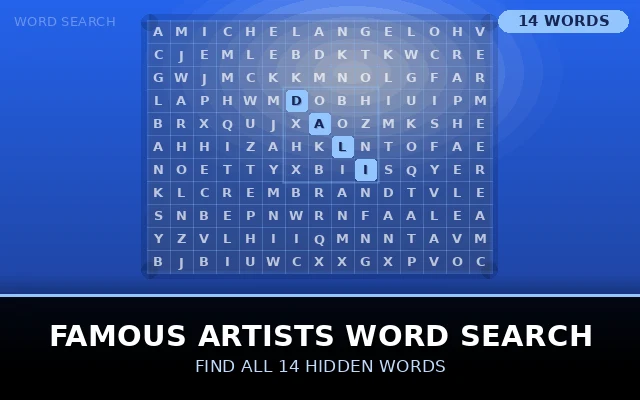
Da Vinci, Picasso, Monet and more hidden in the grid. Play our Famous Artists wo...
Play Now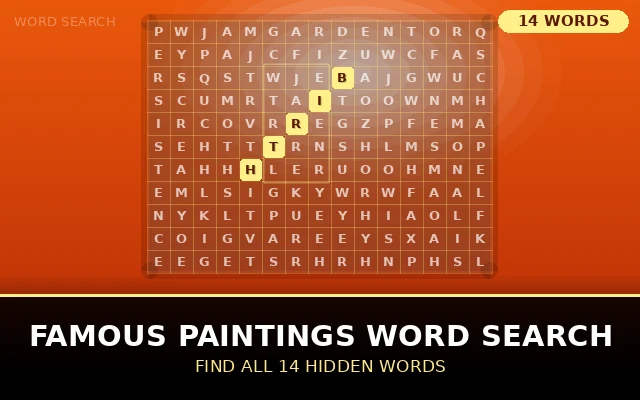
Mona Lisa, Starry Night, The Scream and more. Play our Famous Paintings word sea...
Play Now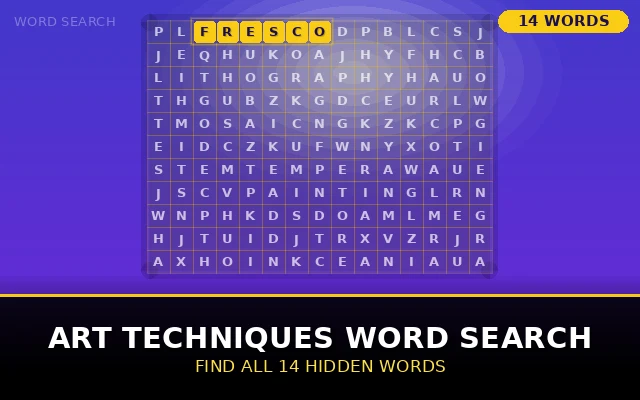
Shading, blending, stippling and more. Discover creative vocabulary in our Art T...
Play NowImpressionism, Cubism, Surrealism and more. Play our Art Movements word search and explore history greatest styles. Free online puzzle no sign-up needed.
Da Vinci, Picasso, Monet and more hidden in the grid. Play our Famous Artists word search and test your art history knowledge. Free online no sign-up needed.
Play Now
Mona Lisa, Starry Night, The Scream and more. Play our Famous Paintings word search and explore iconic masterpieces. Free online puzzle no registration needed.
Play Now
Shading, blending, stippling and more. Discover creative vocabulary in our Art Techniques word search. Free puzzle for students and art lovers play online now.
Play NowArt Movements Word Search Guides & Articles
Art Movements Word Search: Travel Through Centuries of Creative Revolution
Introduction
Art has never stood still. Every few decades, a fresh generation of painters, sculptors, and thinkers has rebelled against the rules that came before them, giving birth to a brand-new visual language. That is exactly what our free Art Movements Word Search invites you to explore. Hidden inside a simple letter grid are fourteen of the most influential art movements ever recorded from the classical rebirth of the Renaissance to the rule-breaking chaos of Dadaism. This puzzle is more than a way to pass fifteen quiet minutes; it is a compact, playable timeline of how human creativity has evolved, reinvented itself, and pushed boundaries again and again.
Whether you are a student preparing for an art history exam, a teacher looking for an engaging warm-up activity, or simply someone who enjoys the quiet satisfaction of spotting a hidden word, this puzzle is built for you. It requires no download, no account, and no payment just open it in your browser and start scanning the grid. And because every word represents a real turning point in art history, you will walk away from the puzzle knowing a little more than when you started.
Why Art Movements Matter
Understanding art movements is like learning the chapters of a very long, very visual book. Each movement reflects the politics, science, philosophy, and emotions of its era. The Renaissance emerged from a renewed fascination with classical antiquity and human potential. Impressionism was, in many ways, a reaction to the invention of photography — painters no longer needed to record reality with perfect precision, so they began chasing light, mood, and fleeting moments instead. Cubism arrived alongside a century that was rapidly industrializing and fracturing old certainties about time and space. Surrealism grew out of a fascination with psychology and the subconscious mind following the trauma of the First World War.
When you play a word search built around these movements, you are not just memorizing labels. You are tracing the emotional and intellectual journey of humanity across roughly six centuries. That context makes the puzzle far more rewarding than a simple vocabulary drill it becomes a doorway into deeper study.
About This Puzzle
This Art Movements Word Search contains fourteen carefully chosen terms, each hidden somewhere in the grid reading horizontally, vertically, or diagonally, and sometimes even backwards depending on the puzzle's difficulty setting. It sits at a medium difficulty level, which makes it approachable for middle schoolers just beginning art history lessons while still offering enough challenge to keep high schoolers and adult puzzle enthusiasts engaged.
Teachers frequently use puzzles like this as a five-minute warm-up before a lecture, a cool-down activity at the end of a unit, or a sneaky way to review terminology before a test without it feeling like studying. Because the puzzle can be completed directly in a browser, it works equally well as a classroom projector activity or an individual assignment on a tablet or laptop.
How to Play
Playing the Art Movements Word Search is simple, even if you have never solved one before:
- Start by reading through the list of fourteen movement names positioned beneath or beside the puzzle grid.
- Scan the grid methodically many solvers find it easier to check rows first, then columns, then diagonals, rather than jumping around randomly.
- Once you spot a word, click and drag across the letters (or tap and swipe if you are on a phone or tablet) to lock it in.
- Confirmed words are highlighted and automatically crossed off your remaining list.
- The puzzle is complete once every one of the fourteen movements has been located.
If you get stuck, most versions of this puzzle offer a hint system, so there's no need to abandon the challenge halfway through.
Word List and What Each Movement Represents
Renaissance — Spanning roughly the fourteenth through seventeenth centuries, this era marked Europe's return to classical ideals of proportion, realism, and humanism after the Middle Ages. It gave the world linear perspective and anatomical accuracy in painting.
Baroque — Following the Renaissance, Baroque art embraced drama, exaggerated motion, and strong emotional intensity, often using dramatic lighting to heighten the theatrical effect of a scene.
Romanticism — Emerging in the early 1800s, this movement turned away from strict order and reason, favoring raw emotion, untamed nature, and the power of individual imagination.
Realism — A mid-nineteenth-century reaction against Romantic idealism, Realism sought to depict everyday people and ordinary life exactly as they appeared, without exaggeration or flattery.
Impressionism — Born in France in the 1870s, this style prioritized the fleeting effects of natural light and color over fine detail, often painted quickly, outdoors, in a single sitting.
Expressionism — Rather than depicting the world accurately, Expressionist artists distorted color, form, and line to communicate raw inner emotion and psychological tension.
Fauvism — A short-lived but explosive early-twentieth-century movement defined by wild, non-naturalistic color choices used purely for emotional impact rather than realism.
Cubism — Pioneered in the early 1900s, Cubism shattered traditional single-viewpoint perspective, presenting subjects from multiple angles simultaneously through fragmented, geometric shapes.
Futurism — An Italian movement that glorified speed, machinery, industry, and the restless energy of the modern, mechanized world.
Dadaism — A deliberately anti-rational, anti-establishment movement that emerged as a protest against the horrors of World War I, embracing absurdity, chance, and nonsense as artistic tools.
Surrealism — Drawing heavily on Freudian psychology, Surrealist artists explored dreams, the subconscious, and irrational, dreamlike imagery that defied logical explanation.
Abstract — Rather than representing recognizable objects, abstract art focuses purely on color, line, shape, and composition as the subject itself.
Modernism — A sweeping, umbrella term describing the broad rejection of traditional academic art rules in favor of experimentation, innovation, and new visual vocabularies throughout the twentieth century.
Minimalism — Emerging in the mid-twentieth century, Minimalism strips art down to its simplest essential elements clean lines, limited color palettes, and geometric restraint.
The Bigger Picture: How These Movements Connect
One of the most interesting things about studying art movements side by side is noticing how each one reacts to the one before it. Realism rebelled against the idealized emotion of Romanticism. Impressionism rebelled against the polished precision of Realism. Cubism rebelled against the soft atmosphere of Impressionism. Dadaism rebelled against the seriousness of nearly everything that came before it. Art history, in this sense, behaves almost like a long-running argument passed from one generation of artists to the next and this puzzle lets you hold all fourteen sides of that argument in view at once.
This is also why word searches focused on art movements work so well as educational tools. Rather than memorizing dates in isolation, players start to notice patterns: movements often cluster around major historical events, technological shifts, or scientific breakthroughs. Recognizing these connections turns a simple vocabulary puzzle into a framework for understanding centuries of cultural change.
Tips for Solving Faster
If you want to improve your solving speed, try focusing first on the longest words in the list, since they are statistically easier to spot in a crowded grid a fourteen-letter word like "Impressionism" has far fewer places it could realistically hide compared to a short four-letter word. It also helps to scan for uncommon letter combinations first, such as double consonants or unusual pairings, since these tend to stand out visually against a background of random letters.
Many solvers also find it useful to work in short, focused bursts rather than staring at the grid continuously. A brief pause and a fresh look at the puzzle can help your eyes catch patterns that fatigue may have caused you to miss.
Related Puzzles:
Conclusion
The Art Movements Word Search offers a rare combination: it is relaxing enough to enjoy on a quiet afternoon, yet substantial enough to leave you with real, usable knowledge about how art has evolved across six centuries. Whether you complete it in five focused minutes or return to it slowly over a lazier stretch of time, you will finish having reinforced fourteen major milestones in art history from the classical order of the Renaissance to the stripped-back calm of Minimalism. It is a small puzzle with a genuinely big story hidden inside it, and it rewards anyone curious enough to look closely.