Finance Terms Word Search
Click and drag to select words

Supply, demand, inflation and more hidden in the grid. Play our Economics word s...
Play Now
Shares, dividends, portfolio and more. Play our Stock Market word search and lea...
Play Now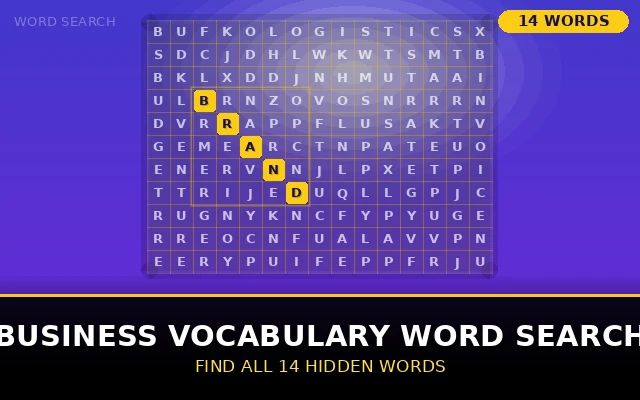
Revenue, strategy, profit and more hidden in the grid. Boost your business vocab...
Play NowBudget, interest, equity and more. Play our Finance Terms word search and build essential money vocabulary. Free online puzzle for students and professionals.
Supply, demand, inflation and more hidden in the grid. Play our Economics word search and sharpen your financial knowledge. Free online no registration needed.
Play Now
Shares, dividends, portfolio and more. Play our Stock Market word search and learn key investing terms. Free online puzzle for finance fans play now.
Play Now
Revenue, strategy, profit and more hidden in the grid. Boost your business vocabulary with this fun word search. Free to play online no sign-up needed.
Play NowFinance Terms Word Search Guides & Articles
Finance Terms Word Search: Build Real Money Vocabulary While You Play
Introduction
Money touches every part of daily life, yet so many people go through school and even careers without ever learning the specific vocabulary that describes how it actually works. Our free Finance Terms Word Search was built to close that gap in the most relaxed way possible: fourteen essential money and banking terms hidden inside a single letter grid, waiting for you to track them down. This is not a textbook chapter disguised as homework it's a genuinely enjoyable puzzle that happens to leave you fluent in the language banks, employers, and financial news outlets use every day.
Whether you're a student encountering budgeting and interest for the first time, a young professional trying to make sense of your first payslip deductions, or simply someone who wants to feel more confident reading financial headlines, this puzzle meets you exactly where you are. It's completely free, requires no sign-up, and works instantly on any device with a browser.
Why Financial Vocabulary Is a Life Skill, Not Just a School Subject
There's a quiet but real cost to not understanding financial terminology. Someone who doesn't know the difference between an asset and a liability may struggle to read their own bank statement with confidence, or understand how a poor credit score can raise the cost of borrowing later on. Someone unfamiliar with how interest works may not realize how quickly debt can grow, or how powerfully compounding can work in their favor when saving early which is also why financial experts so often recommend building an emergency fund before taking on new debt. Financial literacy isn't a niche academic subject it directly shapes decisions about loans, savings, taxes, and long-term security.
This is exactly why building financial vocabulary through something as low-pressure as a word search works so well. Instead of memorizing terms from a glossary under exam stress, you absorb them naturally while scanning a grid for hidden letters and the definitions stick because you associate each word with the small satisfaction of finding it.
About This Puzzle
This Finance Terms Word Search in It wordsearch hides fourteen fundamental money-related words inside a 15x15 grid. It is set at an easy-to-medium difficulty level, with every word placed horizontally or vertically, making it approachable for younger students while still offering genuine value to adult learners brushing up on core concepts. It's a natural fit for commerce and economics classrooms, personal finance workshops, or simply a quiet solo study session.
How to Play
- Start by reading through the list of fourteen finance terms shown beside the grid.
- Scan methodically from left to right, then top to bottom, to make sure no row or column goes unchecked.
- Click and drag, or tap and swipe on a touchscreen, from the first letter of a word to its last letter to select it.
- Each correctly identified word will highlight and automatically disappear from your remaining list.
- The puzzle is complete once all fourteen terms have been found.
Word List and What Each Term Really Means
Budget — A structured plan outlining exactly how income will be spent, saved, or allocated over a specific period, forming the foundation of nearly every sound financial decision.
Interest — The additional cost paid on borrowed money, or the reward earned on money saved or invested, calculated as a percentage over time.
Asset — Anything of value owned by a person or business, such as cash, property, or investments, that can generate future economic benefit.
Liability — A financial obligation or debt that a person or business owes to another party, which must eventually be settled.
Equity — The portion of ownership value remaining in a property or company after subtracting any debts or liabilities against it.
Revenue — The total income a business generates from selling goods or services before any expenses are subtracted.
Expense — Money spent to cover the costs of daily living, running a household, or operating a business.
Profit — The financial gain remaining after all business costs and expenses have been subtracted from total revenue.
Loss — The financial shortfall that occurs when total expenses exceed total revenue over a given period.
Invoice — A formal document sent to a customer requesting payment for goods delivered or services rendered.
Tax — A mandatory financial contribution collected by government authorities from individuals and businesses to fund public services.
Savings — Money deliberately set aside from current income for future needs, emergencies, or long-term goals.
Loan — A sum of money borrowed from a lender that must be repaid over time, typically with interest added.
Dividend — A portion of a company's profits distributed to its shareholders, usually paid out on a regular schedule.
How These Terms Connect to Everyday Life
It's worth pausing to notice how tightly these fourteen words weave together in real financial situations, and how they connect to the broader idea of personal finance that most people encounter daily. A budget determines how much of your revenue goes toward expenses, savings, and debt repayment and once someone starts tracking this consistently, it naturally leads into financial planning for bigger goals like a house or retirement. If your expenses exceed your income, you experience a loss; if income exceeds expenses, you generate a profit. Borrowing money creates a liability, and that borrowed money almost always comes with interest attached, which is also where the idea of compound interest becomes so powerful over time small amounts saved early can grow far more than the same amount saved later in life. Meanwhile, anything you own of financial value a car, a savings account, a house becomes an asset, and the portion of that asset you truly own outright, after subtracting debt, is your equity, a figure closely tied to a person's overall net worth.
Businesses operate on the same logic at a larger scale. A company sends an invoice to request payment, tracks revenue and expenses to calculate profit and manage its cash flow, and may distribute part of that profit to shareholders as a dividend. Governments, meanwhile, collect tax to fund public infrastructure and services, drawing directly from the economic activity generated by these very transactions.
- Business Vocabulary Word Search
- Stock Market Word Search
- Economics Word Search
- Marketing Terms Word Search
Fun Facts About Money and Finance
The word "finance" itself traces back to the Latin term "finis," meaning "end" riginally referring to the settling or closing of a debt, a fitting origin for a field entirely built around balancing what is owed and what is owned. Paper currency has an unexpectedly long history too; China introduced the world's first paper money during the Tang Dynasty, more than a thousand years before it became common in Europe. Despite how central banking feels to modern life, roughly 1.4 billion adults worldwide still lack access to a formal bank account, a gap that underscores just how much financial literacy and access still vary across the globe. And on a more personal note, studies consistently show that people who learn core financial vocabulary early in life are significantly less likely to fall into unmanageable debt later on.
Tips for Solving This Puzzle Quickly
Since all fourteen words in this puzzle run only horizontally or vertically, focus your first pass on scanning complete rows from left to right, then repeat the process scanning columns from top to bottom this two-pass method covers the entire grid systematically without wasted effort. Longer words like "liability" and "dividend" tend to be easier to spot first since they have fewer possible placements, so tackle those before hunting for shorter four- or five-letter terms like "tax" or "loan."
Conclusion
The Finance Terms Word Search proves that financial literacy doesn't have to feel intimidating or dry. By the time you locate all fourteen hidden words, you'll have reinforced the exact vocabulary that underpins budgeting, borrowing, saving, and everyday money management knowledge that pays off well beyond the puzzle itself. Whether you're a student building your first financial foundation or an adult simply sharpening what you already know, this quick, satisfying challenge leaves you with something far more valuable than a completed grid: real, usable financial confidence.