Marketing Terms Word Search
Click and drag to select words
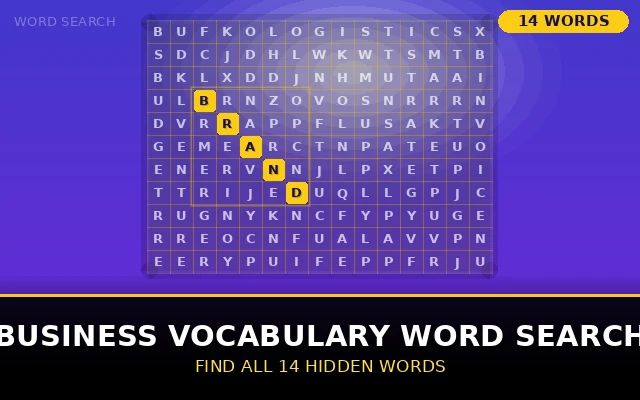
Revenue, strategy, profit and more hidden in the grid. Boost your business vocab...
Play Now
Shares, dividends, portfolio and more. Play our Stock Market word search and lea...
Play Now
Supply, demand, inflation and more hidden in the grid. Play our Economics word s...
Play NowBranding, SEO, campaigns and more. Play our Marketing Terms word search and master essential marketing vocabulary. Free online puzzle no sign-up needed.
Revenue, strategy, profit and more hidden in the grid. Boost your business vocabulary with this fun word search. Free to play online no sign-up needed.
Play Now
Shares, dividends, portfolio and more. Play our Stock Market word search and learn key investing terms. Free online puzzle for finance fans play now.
Play Now
Supply, demand, inflation and more hidden in the grid. Play our Economics word search and sharpen your financial knowledge. Free online no registration needed.
Play NowMarketing Terms Word Search Guides & Articles
Marketing Terms Word Search: Learn the Vocabulary Behind Every Great Brand
Introduction
Behind every catchy slogan, viral post, and successful ad campaign is a specific set of strategic vocabulary that marketers use to plan, measure, and refine their work. Our free Marketing Terms Word Search hides fourteen essential marketing and advertising words inside a single letter grid, turning the process of learning this vocabulary into something genuinely enjoyable. Whether you're a business student, an aspiring entrepreneur, or simply someone curious about how brands capture attention, this puzzle offers a relaxed, satisfying way to build real marketing knowledge.
Completely free to play, requiring no sign-up or download, this puzzle works instantly across desktop, tablet, and mobile. It's a natural fit for classrooms covering advertising and branding, self-study sessions for anyone entering the marketing field, or a quick mental break that happens to leave you more fluent in the language of modern business.
Why Marketing Vocabulary Matters in Today's World
Marketing has evolved dramatically over the past two decades, shifting from print ads and billboards to search engines, social media, and data-driven campaigns. This evolution has brought an entirely new vocabulary with it terms like SEO, conversion, and engagement didn't exist in everyday business language a generation ago, yet today they are essential for anyone working in advertising, brand management, or digital strategy.
Understanding this vocabulary isn't just useful for marketing professionals. Business owners need it to communicate effectively with agencies and freelancers. Students need it to succeed in business coursework. Even everyday consumers benefit from understanding marketing terminology, since it reveals the strategy behind the advertisements, emails, and social posts they encounter every single day.
About This Puzzle
This Marketing Terms Word Search in It wordsearch hides fourteen key marketing and advertising words inside a 15x15 letter grid, set at an easy-to-medium difficulty level with words placed both horizontally and vertically. It's an excellent fit for students and young professionals building foundational marketing knowledge, and marketing teachers frequently use it as a quick classroom warm-up or revision activity before diving into more advanced coursework.
How to Play
- Review the list of fourteen marketing terms shown beside the puzzle grid.
- Scan the grid methodically from left to right, then top to bottom, to cover the entire puzzle.
- Click and drag, or tap and swipe on mobile, from a word's first letter to its last to select it.
- Correctly found words will highlight and automatically be crossed off your list.
- The puzzle is complete once all fourteen terms have been located.
Word List and What Each Term Means in Practice
Branding — The strategic process of creating a distinct name, image, and identity for a product or company that sets it apart in the minds of consumers.
Campaign — A coordinated series of marketing activities and messages designed to promote a specific product, service, or cause over a defined period.
Target — The specific group of consumers a business identifies and focuses its marketing efforts toward reaching.
Audience — The broader group of people a marketing message, campaign, or piece of content is designed to reach and engage.
Promotion — Activities specifically designed to raise awareness of a product or service and encourage increased sales.
Content — Information, media, or creative material produced specifically to attract, inform, or engage an audience.
SEO — Search Engine Optimization, the practice of improving a website's visibility and ranking within search engine results.
Viral — Content that spreads rapidly and extensively across the internet, often driven by high engagement and sharing.
Funnel — The staged journey a potential customer moves through, from first becoming aware of a brand to ultimately making a purchase.
Conversion — The moment a visitor or lead takes a specific desired action, such as making a purchase or signing up for a service.
Niche — A narrowly defined, specific segment of a larger market characterized by particular needs, interests, or preferences.
Slogan — A short, memorable phrase used to capture the essence of a brand or product and reinforce its identity.
Analytics — Data and statistical measurements used to track, evaluate, and improve marketing performance over time.
Engagement — The level and quality of interaction an audience has with a brand's content, campaigns, or messaging.
Seeing These Terms Work Together in a Real Campaign
Consider how these fourteen words interact in a typical marketing scenario. A company begins by defining its target and broader audience through careful market segmentation, then builds a distinctive branding strategy to stand out, often supported by a memorable slogan. It launches a coordinated campaign combining promotion and engaging content, distributed across channels optimized through SEO and supported by digital marketing tactics like a strong call to action (CTA) to reach the right people at the right time.
If the content resonates strongly, it may even go viral, dramatically expanding its reach beyond the original audience a result many brands now chase through deliberate influencer marketing partnerships. As potential customers move through the marketing funnel from first noticing the brand to seriously considering a purchase the company tracks conversion rates to measure how many actually complete a purchase or sign-up. Throughout the entire process, analytics provide the data needed to refine strategy and calculate return on investment (ROI), while ongoing engagement reveals how actively the audience is interacting with the brand. Many successful campaigns even target a specific niche audience rather than trying to appeal to everyone at once, since focused messaging often performs far better than generic, broad appeals.
Fun Facts About Marketing
The average person today is exposed to somewhere between six thousand and ten thousand advertisements every single day, spanning social media, billboards, product packaging, and beyond a staggering figure compared to just a few decades ago. Despite the rise of flashy digital advertising, email marketing continues to deliver one of the strongest returns of any marketing channel, with businesses earning an average of thirty-six units of return for every single unit spent. The word "brand" itself has a surprisingly rugged origin, tracing back to the Old Norse word "brandr," meaning "to burn," since farmers once literally burned identifying marks onto livestock to signal ownership a practice that eventually evolved into the modern concept of branding. And with more than 4.9 billion people now using social media platforms worldwide, this single channel has become the largest and most influential marketing space in human history.
- Business Vocabulary Word Search
Tips for Solving This Puzzle Efficiently
Since all fourteen words in this grid run either horizontally or vertically, the most efficient approach is a two-pass scan: check every row from left to right first, then scan every column from top to bottom to catch anything missed. Longer words such as "engagement," "analytics," and "conversion" tend to stand out earlier since they occupy more space in the grid, so tackle those first before hunting for shorter terms like "SEO," "niche," or "viral."
Conclusion
The Marketing Terms Word Search turns the strategic language of branding, advertising, and digital campaigns into something genuinely fun to learn. By locating all fourteen hidden words, you'll come away with a clearer understanding of how businesses build brands, reach audiences, and measure success vocabulary that's valuable whether you're studying marketing, launching your own business, or simply trying to understand the strategy behind the ads you scroll past every day. It's proof that even complex professional vocabulary can be learned in a way that actually feels enjoyable.