Solar System Word Search
Click and drag to select words
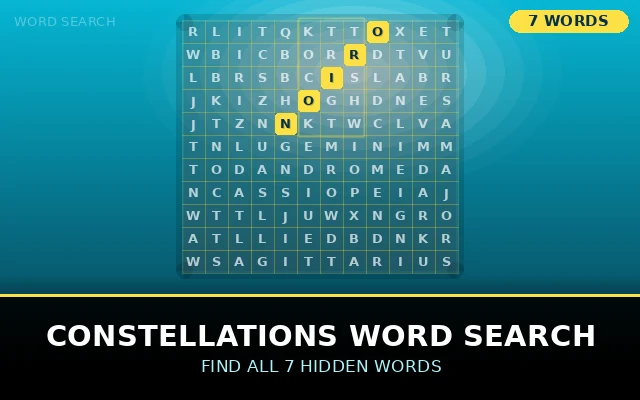
Find Orion, Gemini, Scorpius and more with our Constellations Word Search. A per...
Play Now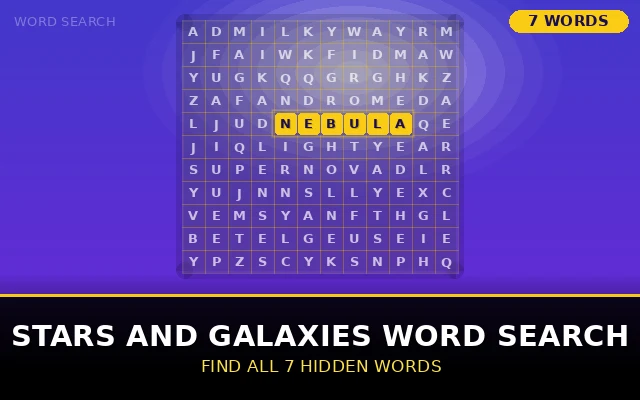
Explore stars, black holes and galaxies with our Stars and Galaxies Word Search....
Play Now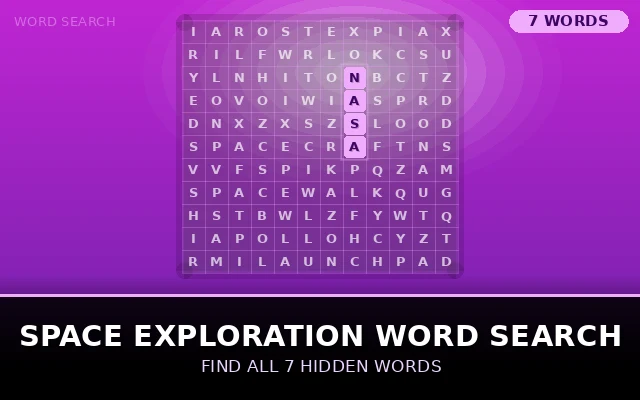
Blast off with our Space Exploration Word Search. Discover astronauts, rockets, ...
Play NowMercury, Saturn, asteroid and more. Play our Solar System word search and explore planets and space vocabulary. Free online puzzle, no sign-up needed.
Find Orion, Gemini, Scorpius and more with our Constellations Word Search. A perfect puzzle for stargazers and astronomy lovers.
Play Now
Explore stars, black holes and galaxies with our Stars and Galaxies Word Search. Fun for students and space lovers of all ages.
Play Now
Blast off with our Space Exploration Word Search. Discover astronauts, rockets, NASA missions and spacecraft in this fun space puzzle.
Play NowSolar System Word Search Guides & Articles
Solar System Word Search: Explore Space One Word at a Time
Welcome to the ultimate Solar System word search puzzle! If you have ever looked up at the night sky and wondered about the planets, moons, and stars floating in the darkness above, this puzzle is made for you. Our free Solar System word search lets you discover the names of planets, space objects, and astronomy terms all in one exciting grid. Whether you are a curious kid, a student preparing for a science test, or a teacher looking for a fun classroom activity, this puzzle is completely free to play online no sign-up, no download, no fuss.
The Solar System word search is one of the most popular science-themed puzzles on our site It wordsearch, and it is easy to see why. Space is endlessly fascinating, and learning the vocabulary of our solar system is an important part of understanding the universe we live in. So dive in, start searching, and see how many words you can find!
About This Solar System Word Search Puzzle
This Solar System word search contains 14 carefully chosen words hidden inside a letter grid. Each word is directly related to our solar system from the eight planets to moons, asteroids, and key astronomy terms. The puzzle is set at a medium difficulty level, which means words can be hidden horizontally, vertically, diagonally, and even backwards, giving you a real challenge without being overwhelming.
This puzzle is perfect for students in grades 3 through 8, science teachers who want an engaging warm-up activity, kids who love space, and adults who enjoy a satisfying word game. Beyond the entertainment value, this Solar System word search has strong educational benefits. It reinforces the spelling of planet names, introduces astronomy vocabulary, and builds the kind of focused attention that helps students remember what they learn. Research shows that learning through play improves memory retention, and a word search is one of the simplest and most effective ways to make that happen.
How to Play the Solar System Word Search
Playing this puzzle is simple and fun. Here is how to get started:
- Scan the grid carefully from left to right and top to bottom to get familiar with the letters.
- Look at the word list below the grid and pick a word to search for first.
- Click and drag across the letters to select a word once you spot it in the grid.
- Words can be hidden horizontally, vertically, diagonally, and backwards so check every direction.
- Found words are automatically highlighted and crossed off your list so you can track your progress.
- Keep going until every word on the list has been found and the puzzle is complete!
-
Heavens Crossword Puzzle
Word List with Definitions
Here are the 14 words hidden inside this Solar System word search, along with simple definitions to help you learn as you play:
- MERCURY: The smallest planet and the one closest to the Sun in our solar system
- VENUS: The hottest planet in the solar system, covered in thick toxic clouds
- EARTH: The third planet from the Sun and the only known planet with life
- MARS: The red planet, fourth from the Sun, with the tallest volcano in the solar system
- JUPITER: The largest planet in the solar system, known for its giant storm called the Great Red Spot
- SATURN: The sixth planet, famous for its stunning system of rings made of ice and rock
- URANUS: The seventh planet, which rotates on its side unlike any other planet
- NEPTUNE: The eighth and farthest planet from the Sun, known for its deep blue color
- ASTEROID: A rocky object smaller than a planet that orbits the Sun
- COMET: A ball of ice and dust that travels through space and forms a bright tail near the Sun
- GALAXY: A massive system of stars, gas, and dust held together by gravity
- ORBIT: The curved path that a planet or moon follows as it travels around another object
- NEBULA: A giant cloud of gas and dust in space where new stars are often born
- SOLARSYSTEM: The Sun and everything that travels around it, including all eight planets
The Solar System: A Closer Look
Our solar system is a breathtaking collection of planets, moons, rings, and countless smaller objects, all held together by the gravitational pull of a single star — our Sun. Understanding the solar system is one of the most exciting parts of learning science, and this Solar System word search is a great first step into that journey.
The Sun: The Heart of Our Solar System
The Sun sits at the center of our solar system and accounts for about 99.8 percent of all the mass in the entire system. It is a massive ball of hot plasma that generates energy through a process called nuclear fusion, converting hydrogen into helium and releasing an enormous amount of heat and light. Without the Sun, there would be no warmth, no light, and no life on Earth. Every planet in our solar system orbits the Sun at a different distance, and that distance plays a huge role in determining temperature, atmosphere, and whether life could exist there.
The Inner Planets
The four planets closest to the Sun Mercury, Venus, Earth, and Mars are called the inner planets or terrestrial planets. They are made mostly of rock and metal, and they are much smaller than the outer planets.
Mercury is the smallest planet and has almost no atmosphere, which means its temperature swings wildly burning hot during the day and freezing cold at night. Venus is the brightest object in the night sky after the Moon and is actually hotter than Mercury despite being farther from the Sun, because its thick atmosphere traps heat. Earth is the only planet we know of that supports life, thanks to liquid water, a breathable atmosphere, and just the right temperature range. Mars has fascinated humans for centuries, and scientists are actively exploring whether life may have once existed there.
The Outer Planets
Beyond the asteroid belt lie the four outer planets or gas giants Jupiter, Saturn, Uranus, and Neptune. These planets are enormous compared to the inner planets and are made mostly of gas and liquid rather than solid rock.
Jupiter is so large that all the other planets in the solar system could fit inside it. Its Great Red Spot is a storm that has been raging for over 350 years. Saturn is instantly recognizable because of its magnificent rings, which are made up of billions of pieces of ice and rock. Uranus is unique because it rotates on its side, meaning its poles take turns pointing toward the Sun. Neptune, the farthest planet, has the strongest winds of any planet, reaching speeds of over 2,000 kilometers per hour.
Moons, Asteroids, and Comets
Our solar system contains far more than just planets. There are more than 200 moons orbiting various planets, with Jupiter and Saturn each having dozens. Earth has just one Moon, but it plays a crucial role in stabilizing our planet's tilt and controlling ocean tides.
Asteroids are rocky objects left over from the formation of the solar system, and most of them are found in the asteroid belt between Mars and Jupiter. Some asteroids are tiny, while others are hundreds of kilometers wide. Comets are made of ice, dust, and gas, and when they travel close to the Sun, the solar heat causes them to release material that forms a glowing tail stretching millions of kilometers through space.
Why Learning Solar System Vocabulary Matters
Every subject has its own language, and science is no different. When students learn words like orbit, nebula, and galaxy, they are building the vocabulary they need to understand science lessons, read textbooks, and engage with the wider world of astronomy. A Solar System word search makes this vocabulary learning feel natural and enjoyable rather than like a chore.
Teachers often use word search puzzles as warm-up activities because they activate the brain, build focus, and introduce key terms before a lesson begins. Parents can use this Solar System word search at home to support school learning or simply to satisfy a child's natural curiosity about space.
Fun Facts About the Solar System
Here are four amazing facts about our solar system that might surprise you:
- The Sun is so large that approximately 1.3 million Earths could fit inside it.
- A day on Venus is longer than a year on Venus it takes longer to rotate once on its axis than to complete one orbit around the Sun.
- Saturn would float on water if there were an ocean large enough to hold it, because it is less dense than water.
- The Voyager 1 spacecraft, launched in 1977, is the farthest human-made object from Earth and has now traveled beyond our solar system into interstellar space.
- Heaven Crossword
Conclusion
The universe is full of wonders, and our solar system is the perfect place to start exploring. This free Solar System word search is a fun, educational, and completely free way to learn about planets, space objects, and astronomy vocabulary all at once. Challenge yourself to find every hidden word, then share this puzzle with your classmates, students, or family members and see who finishes first. The cosmos is calling start searching!