Stars and Galaxies Word Search
Click and drag to select words
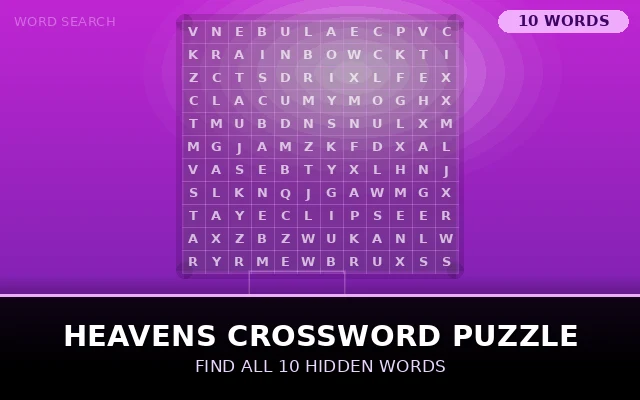
Quasar, Apollo, zenith and more. Play our Heavens Crossword puzzle and explore a...
Play Now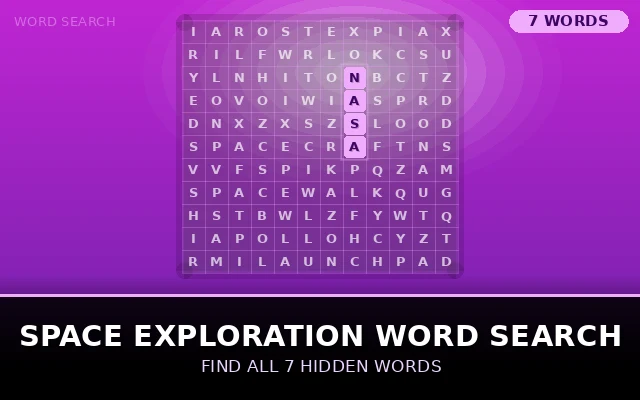
Blast off with our Space Exploration Word Search. Discover astronauts, rockets, ...
Play Now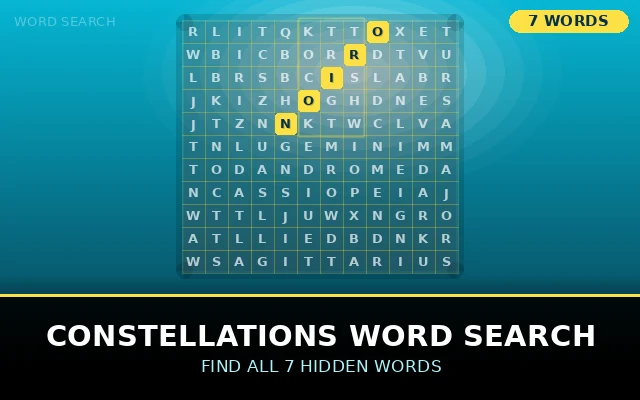
Find Orion, Gemini, Scorpius and more with our Constellations Word Search. A per...
Play NowExplore stars, black holes and galaxies with our Stars and Galaxies Word Search. Fun for students and space lovers of all ages.
Quasar, Apollo, zenith and more. Play our Heavens Crossword puzzle and explore astronomy and celestial mythology. Free online no sign-up needed.
Play Now
Blast off with our Space Exploration Word Search. Discover astronauts, rockets, NASA missions and spacecraft in this fun space puzzle.
Play Now
Find Orion, Gemini, Scorpius and more with our Constellations Word Search. A perfect puzzle for stargazers and astronomy lovers.
Play NowStars and Galaxies Word Search Guides & Articles
Stars and Galaxies Word Search: A Fun Way to Explore the Cosmos
Look up at a clear night sky and you will see thousands of tiny lights scattered across the darkness. Some of those lights are stars burning billions of miles away, and some are entire galaxies containing billions of stars of their own. A stars and galaxies word search puzzle brings that vast universe down to a simple page, letting kids, students, and space lovers of every age hunt for cosmic words hidden among rows of letters. It is a puzzle that teaches while it entertains, and that combination is exactly why it has become such a popular activity in classrooms, homes, and astronomy clubs.
Why a Stars and Galaxies Word Search Is More Than Just a Game
At first glance, a It wordsearch looks like simple entertainment, a grid of letters with a list of words tucked somewhere inside it. But when the theme is stars and galaxies, the puzzle becomes a doorway into real science. As players scan the grid looking for words like Supernova, Nebula, Milky Way, or Andromeda, they are also absorbing vocabulary that describes actual objects and events happening in space right now. This kind of learning through play is known to help with memory retention because the brain connects the word to an image, a search process, and a small sense of achievement when it is found.
For teachers, a stars and galaxies word search is a ready-made lesson supplement. It fits perfectly into an astronomy unit, a science fair activity, or even a quiet indoor recess activity during a rainy day. For parents, it is screen-free entertainment that still feels productive, since children are reading, spelling, and thinking about space rather than passively watching a show.
What Makes a Good Stars and Galaxies Word Search Puzzle
Not every puzzle is created equal. A well-designed stars and Heavens Crossword Puzzle should have a few key qualities. First, the words should be accurate and relevant to the theme, covering real astronomical terms rather than vague or unrelated fillers. Second, the difficulty level should match the intended audience. A puzzle for young children might include short, simple words such as Sun, Moon, Star, and Sky, while a puzzle designed for older students or adults can include more advanced vocabulary such as Constellation, Galaxy Cluster, Black Hole, or Light Year.
Third, the grid size matters. A smaller grid, such as ten by ten squares, works well for beginners, while a larger grid of fifteen by fifteen or twenty by twenty squares offers a much bigger challenge for experienced puzzle solvers. Finally, a good puzzle should have words placed in multiple directions, horizontally, vertically, diagonally, and sometimes even backwards, to keep the search genuinely engaging rather than predictable.
Common Words Found in a Stars and Galaxies Word Search
If you are creating or solving a stars and galaxies word search, you will likely come across a familiar set of terms. These often include Star, Galaxy, Milky Way, Andromeda, Nebula, Supernova, Comet, Asteroid, Meteor, Orbit, Solar System, Sun, Moon, Planet, Universe, Cosmos, Constellation, Black Hole, Light Year, and Telescope. Each of these words represents a real concept in astronomy, which means solvers are not just filling time, they are quietly reinforcing scientific literacy with every letter they circle.
Some puzzle makers also like to include lesser known but fascinating terms such as Quasar, Pulsar, Dwarf Star, Red Giant, White Dwarf, and Spiral Galaxy. These additions are perfect for older audiences or dedicated space enthusiasts who want a puzzle that goes beyond the basics and touches on more advanced areas of stellar science.
The Educational Value Behind a Stars and Galaxies Word Search
Word search puzzles are often underestimated as purely recreational, but research into learning methods consistently shows that games involving pattern recognition and vocabulary reinforcement support cognitive development. When a stars and galaxies word search is used in a classroom setting, it can support several learning goals at once. It builds vocabulary related to space science, strengthens visual scanning and pattern recognition skills, and encourages patience and focus since finding hidden words requires careful, methodical searching rather than random guessing.
For younger learners, this type of puzzle can be an entry point into a lifelong interest in astronomy. Many people who grow up to study physics, engineering, or space science recall early fascination sparked by simple activities like puzzles, picture books, or backyard stargazing. A stars and galaxies word search may seem like a small thing, but it plants a seed of curiosity about what lies beyond our planet.
How to Solve a Stars and Galaxies Word Search Efficiently
Solving these puzzles quickly and accurately comes down to a few simple strategies. Start by scanning the grid for the first letter of each word on your list, since spotting that starting point narrows your search dramatically. Next, check all eight possible directions around that letter, up, down, left, right, and the four diagonals, because words in these puzzles are rarely limited to a single direction.
It also helps to look for uncommon letters first. Words containing letters like Q, X, Z, or J are much easier to spot in a crowded grid than words made entirely of common letters like A, E, S, or T. Additionally, breaking longer words into smaller recognizable chunks, such as searching for "Gal" before finding the rest of "Galaxy," can speed up the process considerably.
Many solvers also find it useful to cross off found words immediately and to work through the list in an order that starts with the shortest words first, since short words are statistically easier to spot early in the search before the puzzle becomes cluttered with marked letters.
Who Enjoys a Stars and Galaxies Word Search
This kind of puzzle appeals to an incredibly wide audience. Elementary school teachers use it to introduce basic space vocabulary in a fun, low-pressure format. Middle and high school science teachers use it as a warm-up activity before diving into more complex topics like stellar evolution or the life cycle of stars. Homeschooling parents often turn to these puzzles as a break from textbook learning while still keeping the subject matter educational.
Beyond the classroom, hobbyist astronomers and space enthusiasts enjoy these puzzles simply because they love the subject matter. Puzzle books aimed at adults frequently include astronomy themed word searches alongside crosswords and sudoku, recognizing that space remains one of the most universally fascinating topics regardless of age.
Bringing the Universe to Paper
There is something quietly poetic about a stars and Solar System Word Search. The real universe is unimaginably vast, filled with billions of galaxies each containing billions of stars, distances so large they can only be measured in light years, and phenomena so extreme that a single supernova can outshine an entire galaxy for a brief moment. Yet all of that grandeur can be condensed into a small paper grid that a child can complete in ten minutes.
This contrast is part of the charm. A word search does not try to explain the physics of nuclear fusion inside a star or the gravitational forces that shape a galaxy's spiral arms. Instead, it simply introduces the names and terms, letting curiosity do the rest. Many people who complete one of these puzzles find themselves searching online afterward to learn more about a word they encountered, whether it is Pulsar, Nebula, or Andromeda, turning a simple game into the first step of genuine scientific curiosity.
Conclusion: Stars and Galaxies Word Search Puzzles
Whether used as a teaching tool, a quiet solo activity, or a fun group challenge, a Heaven Crossword word search offers something rare: an activity that is simultaneously relaxing and intellectually enriching. It requires no special equipment beyond a pencil and a printed page, yet it opens a small window into one of the biggest subjects humanity has ever tried to understand. For anyone who has ever looked up at the night sky and wondered what is really out there, solving a stars and galaxies word search is a small but meaningful way to engage with that wonder.