Breakfast Foods Word Search
Click and drag to select words
Discover a variety of dishes hidden in the grid. Play our Types of Food word sea...
Play Now
Carrot, broccoli, spinach and more hidden in the grid. Play our Vegetables word ...
Play Now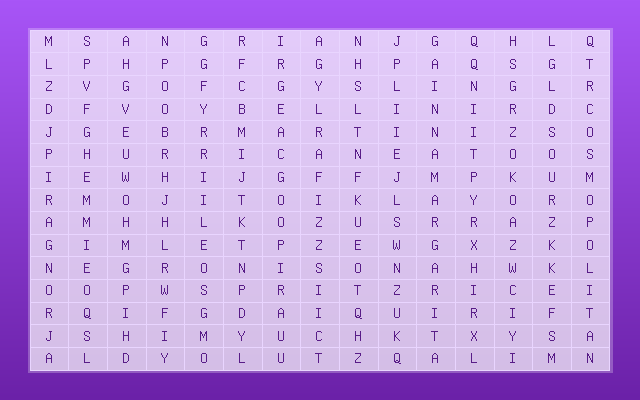
Mojito, Martini, Margarita and more. Play our Cocktails word search and find cla...
Play NowPancakes, bacon, cereal and more. Play our Breakfast Foods word search and find morning favourites hidden in the grid. Free online no sign-up needed.
Discover a variety of dishes hidden in the grid. Play our Types of Food word search and test your culinary vocabulary. Free online no sign-up needed.
Play Now
Carrot, broccoli, spinach and more hidden in the grid. Play our Vegetables word search and boost your healthy vocabulary. Free online no sign-up needed.
Play Now
Mojito, Martini, Margarita and more. Play our Cocktails word search and find classic drink names hidden in the grid. Free online no sign-up needed.
Play NowBreakfast Foods Word Search Guides & Articles
Breakfast Foods Word Search
The idea of breakfast as a sweet, cereal-and-pastry-centered meal is largely a Western, and specifically American, invention much of the world eats breakfasts that look far more like lunch or dinner, built around rice, soup, or savory dishes rather than anything resembling sugar. The very word "breakfast" literally describes breaking an overnight fast, a linguistic root shared across many languages, even though what actually breaks that fast varies enormously depending on where in the world someone happens to wake up. A breakfast foods word search hides words like Pancake, Cereal, Bacon, Omelet, and Waffle in a grid, but that particular lineup reflects one specific cultural breakfast tradition among many genuinely different ones practiced worldwide.
How Cereal Became a Breakfast Staple (It Started as a Health Crusade)
Breakfast cereal wasn't originally marketed as a convenient, kid-friendly food it began as part of a 19th-century health reform movement. John Harvey Kellogg, a physician who ran a sanatorium in Battle Creek, Michigan, developed corn flakes in the 1890s as a bland, easily digestible food intended to curb what he and other reformers of the era believed were unhealthy urges linked to rich, heavily spiced breakfasts. His brother, Will Keith Kellogg, later added sugar to the recipe against John Harvey's wishes and turned it into a mass-market commercial product, laying the foundation for the modern cereal industry meaning one of breakfast's most iconic foods began as a medical intervention before becoming a supermarket staple.
Why Breakfast Got Sweet in the First Place
Sugar wasn't always considered a normal breakfast ingredient. Historically, in much of Europe and colonial America, breakfast tended to be a modest, often savory meal — bread, cheese, cold meat eaten quickly before a full day of physical labor began. The shift toward sweeter breakfasts in the United States accelerated in the 20th century alongside rising sugar availability, aggressive cereal and pastry marketing aimed specifically at children, and a cultural association between morning meals and quick energy. This is part of why American breakfast staples like pancakes, waffles, and sugary cereal can look genuinely unusual to visitors from cultures where breakfast remains a savory, meal-like occasion rather than a dessert-adjacent one, and it's a shift that happened within roughly a single century, not across ancient tradition.
What Breakfast Actually Looks Like Around the World
A more global breakfast word list would look dramatically different from a typically American one. In Japan, a traditional breakfast might include steamed rice, miso soup, grilled fish, and pickled vegetables a full savory meal rather than anything resembling a pastry. In Turkey, breakfast, or "kahvaltı," is often an elaborate spread of cheeses, olives, tomatoes, cucumbers, honey, and bread, sometimes lasting well over an hour as a social occasion rather than a quick meal. In parts of India, breakfast might include dosa, a fermented rice-and-lentil crepe, or idli, steamed rice cakes, served with spiced chutneys and sambar. In England, the "full English breakfast" eggs, bacon, sausage, baked beans, grilled tomato, and toast remains one of the more famous savory Western breakfast traditions, closer in spirit to many of these global examples than to a typical sugary American cereal bowl.
The Pancake's Surprisingly Ancient History
Pancakes, in some form, are one of the oldest prepared foods in human history, predating most of what we'd recognize as modern cuisine. Archaeological evidence suggests early humans were grinding grains and cooking simple flatcakes over open fires thousands of years ago, long before written history. Ancient Greeks made a version called "tagenites," cooked on a griddle and sweetened with honey, while ancient Romans had their own version flavored with milk and eggs. The core concept grain, liquid, and heat, cooked flat has remained remarkably stable across thousands of years and countless cultures, even as toppings and exact ingredients evolved dramatically from region to region.
Eggs: The One Breakfast Food That's Nearly Universal
While sweet versus savory breakfast traditions vary enormously by culture, eggs are one of the few genuinely global breakfast ingredients, appearing across an enormous range of culinary traditions in different preparations omelets in France, shakshuka (eggs poached in spiced tomato sauce) across the Middle East and North Africa, tamagoyaki (a rolled, slightly sweet omelet) in Japan, and simple fried or boiled eggs in countless other traditions. Nutritionally, eggs are relatively cheap, widely available across most climates and economies, and nutritionally dense, which likely explains their near-universal presence at breakfast tables across cultures that otherwise share very little else in common regarding morning food traditions.
Coffee's Role in Redefining What "Breakfast" Even Means
In many cultures, breakfast is defined as much by what's drunk as what's eaten, and coffee culture has shaped breakfast customs in ways that vary dramatically by region. In much of continental Europe, a "continental breakfast" tradition emerged around a light meal bread, butter, jam paired with strong coffee, deliberately smaller than the heavier, protein-forward English or American breakfast. In Vietnam, cà phê sữa đá, strong drip coffee sweetened with condensed milk, often accompanies breakfast dishes like bánh mì or phở, reflecting the French colonial coffee tradition adapted into distinctly Vietnamese morning customs. The relative emphasis on drink versus food at breakfast is itself a meaningful cultural marker, not just a beverage preference.
Congee and the Logic of a Savory, Soupy Start to the Day
Congee, a rice porridge eaten across much of East and Southeast Asia for breakfast, represents a completely different philosophy of morning food than anything typically found on a Western breakfast table. Made by simmering rice in a large amount of water or broth until it breaks down into a soft, soupy consistency, congee is often served with savory toppings like preserved egg, shredded chicken, pickled vegetables, or fried dough sticks. Its gentle, easily digestible texture has also made it a traditional food for the sick or elderly across many Asian cultures, meaning the same dish functions both as an everyday breakfast staple and as comfort food specifically associated with recovery and care.
Why Waffles and Pancakes Split Into Two Separate Foods
Waffles and pancakes share nearly identical batter in most recipes, yet somehow evolved into two distinct breakfast categories with different cultural associations. The key difference lies in cooking method rather than ingredients: waffle batter is poured into a hinged iron press, creating a grid pattern of deep pockets specifically designed to trap butter and syrup, while pancake batter is poured directly onto a flat griddle, spreading into a soft, uniform disc. Belgian waffles, distinguished by their notably deeper pockets and lighter, yeast-leavened batter, became particularly associated with American breakfast culture after being popularized at the 1964 New York World's Fair, where a vendor selling "Bel-Gem waffles" introduced many Americans to the format for the first time, eventually reshaping what most Americans picture when they hear the word "waffle."
Toast's Deceptively Simple Chemistry
Toast might be the simplest item on any breakfast word list, but the browning process that turns pale bread into golden toast is the same Maillard reaction responsible for the crust on a seared steak or a baked cookie a chemical reaction between amino acids and sugars triggered specifically by dry heat above roughly 300 degrees Fahrenheit. This is part of why toast browns unevenly if bread slices vary in thickness or moisture content, and why toasting bread that's slightly stale, having lost some surface moisture already, often produces a crisper, more evenly browned result than toasting perfectly fresh bread straight from the bag.
Breakfast Meats and the Preservation Logic Behind Bacon and Sausage
Bacon and sausage, both common fixtures of Western breakfast plates, share a historical origin rooted in meat preservation rather than breakfast-specific culinary tradition. Curing pork with salt, and later smoking it, developed as a practical method of preserving meat before refrigeration existed, allowing families to store pork for months after a single slaughter. Sausage-making served a similar preservation function, using ground trimmings, fat, and seasoning stuffed into casings, often smoked or dried, to make full use of an animal and extend its usable shelf life. Neither food was originally conceived as a "breakfast" item specifically; their morning association developed later, largely tied to the traditional farmhouse breakfast, where preserved, high-calorie meat provided sustained energy for a full day of physical agricultural labor ahead.
A 19th-century health crusade that accidentally invented modern cereal, a pancake recipe barely changed across millennia, a rice porridge that doubles as both breakfast and medicine, a waffle format popularized almost by accident at a World's Fair a breakfast foods word search hides a genuinely wide range of cultural logic behind its short, familiar-looking words, each one representing a different answer to the same basic question every culture eventually has to solve: how to start the day.
Related Puzzles:
Cocktails Word Search
Types of Cheese Word Search
Street Food Word Search
Types of Tea Word Search
Vegetables Word Search
Asian Food Word Search
Types of Food Word Search
Cooking Terms Word Search
Types of Drinks Word Search
World Cuisines Word Search
Desserts Word Search
Healthy Foods Word Search
Fast Food Word Search
Spices and Herbs Word Search
Conclusion
Wake up and play the free Breakfast Foods Word Search today! Find all 14 hidden morning food words and share this fun puzzle with your family or classroom. Start playing now it is the most important puzzle of the day!