Types of Food Word Search
Click and drag to select words
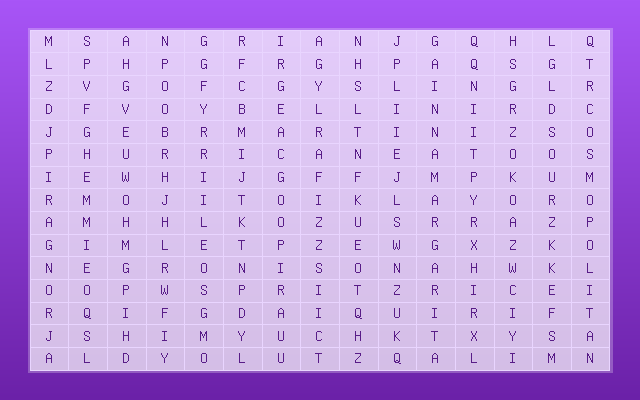
Mojito, Martini, Margarita and more. Play our Cocktails word search and find cla...
Play Now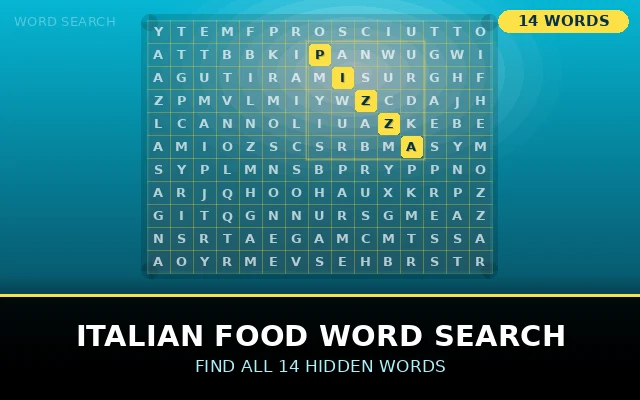
Pizza, pasta, risotto and more. Play our Italian Food word search and explore de...
Play Now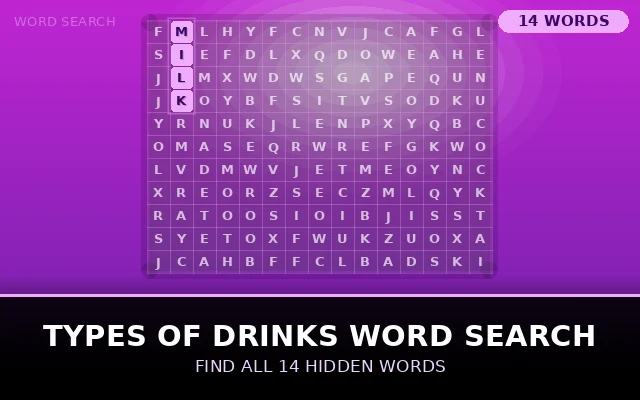
Juice, soda, smoothie and more hidden in the grid. Play our Types of Drinks word...
Play NowDiscover a variety of dishes hidden in the grid. Play our Types of Food word search and test your culinary vocabulary. Free online no sign-up needed.
Mojito, Martini, Margarita and more. Play our Cocktails word search and find classic drink names hidden in the grid. Free online no sign-up needed.
Play Now
Pizza, pasta, risotto and more. Play our Italian Food word search and explore delicious dishes hidden in the grid. Free online puzzle no sign-up needed.
Play Now
Juice, soda, smoothie and more hidden in the grid. Play our Types of Drinks word search and test your beverage knowledge. Free online no sign-up needed.
Play NowTypes of Food Word Search Guides & Articles
Types of Food Word Search
"Superfood" is a marketing term, not a scientific or regulatory one no government health agency, including the FDA, formally defines or certifies any food as a "superfood," which means the word appearing on packaging is essentially unregulated branding rather than a verified nutritional claim, a gap between marketing language and actual science that runs through much of how food gets categorized and sold. A types of food word search hides words like Grain, Dairy, Protein, Fruit, and Legume in a grid, and untangling which of these words represent genuinely stable nutritional science versus a food pyramid that's been redrawn several times is more complicated than the tidy category suggests.
Why "Food Group" Systems Keep Changing
The food pyramid most adults over 30 grew up learning has actually been replaced multiple times. The original USDA food pyramid, introduced in 1992, organized food into a strict hierarchy with grains at the base and fats, oils, and sweets at the tip, implying grains should form the bulk of a person's diet. This was replaced in 2005 by MyPyramid, a more flexible, less hierarchical model, and then again in 2011 by MyPlate, which abandoned the pyramid shape entirely in favor of a plate divided into proportional sections for vegetables, fruits, grains, and protein. Each revision reflected shifting nutritional science and public health priorities, meaning the "food groups" a word search draws from aren't a fixed, timeless scientific fact they're a snapshot of a specific era's nutritional guidance.
Macronutrients: The Three Words Doing the Real Work
Behind more visible words like "Grain" or "Dairy," three less obvious terms Protein, Carbohydrate, and Fat represent the actual chemical categories nutrition science is built around. Protein, made of amino acid chains, is essential for building and repairing muscle and tissue. Carbohydrates, broken down into glucose, serve as the body's primary and most readily available energy source. Fat, often unfairly treated as purely negative in diet culture, is essential for hormone production, vitamin absorption, and long-term energy storage. Nearly every specific food in a word list Chicken, Rice, Butter is really just a delivery vehicle for some combination of these three underlying macronutrients, plus water, fiber, vitamins, and minerals.
Why "Grain" Covers Foods That Don't Look Related
The word "Grain" in a food word search typically covers wheat, rice, oats, corn, and barley plants that look completely different but share one key trait: they're all cultivated grasses whose edible seeds can be harvested, dried, and stored for long periods without spoiling. This storability is a major reason grains became foundational to nearly every major agricultural civilization in human history; unlike most fresh produce, dried grain can be kept through winter or drought, providing a stable calorie source that made large, settled populations possible in the first place, from ancient Mesopotamia's barley fields to early rice cultivation in the Yangtze River valley.
Legumes: The Category That Quietly Does Double Duty
Beans, lentils, and peas grouped under "Legume" occupy an unusual nutritional middle ground, containing meaningfully more protein than most vegetables while also providing substantial fiber and complex carbohydrates, which is part of why legumes are often highlighted separately from both the vegetable and protein categories in more detailed nutritional models. Agriculturally, legumes also perform a unique ecological function: their roots host bacteria capable of converting atmospheric nitrogen into a form plants can use, naturally enriching soil fertility which is why farmers have rotated legume crops with grain crops for centuries specifically to replenish soil between more nutrient-demanding harvests.
The Dairy Category's Genetic Backstory
"Dairy," covering milk, cheese, and yogurt, hides one of the more interesting stories in human genetics. Most mammals, including most adult humans historically, lose the ability to digest lactose milk sugar after weaning from breast milk in early childhood. The ability for adults to continue digesting dairy, called lactase persistence, is actually a relatively recent genetic mutation in human evolutionary terms, believed to have spread specifically among populations that historically relied heavily on cattle, sheep, or goat herding, particularly in parts of Europe, the Middle East, and East Africa. This is why lactose intolerance rates vary dramatically by ancestry worldwide dairy consumption as a normal adult food is, genetically speaking, a relatively recent adaptation rather than a universal human trait.
Why "Processed Food" Is a Far Blurrier Category Than It Sounds
Nutrition guidance increasingly warns against "processed food," but the category is genuinely difficult to define with any precision, since almost all food humans eat has been processed to some degree — even something as simple as washing and chopping a vegetable technically counts. Nutrition scientists have increasingly turned to a more specific classification system called NOVA, which sorts food into four groups based on the degree and purpose of processing, from unprocessed or minimally processed foods up through "ultra-processed" foods, industrially formulated products typically containing ingredients rarely used in home cooking, like specific emulsifiers or artificial flavoring agents. This more granular system reflects growing recognition that lumping all "processed food" together obscures a meaningful difference between, say, frozen vegetables and a heavily engineered snack food.
Fiber's Quiet Reclassification Over the Past Few Decades
Fiber was historically considered a minor, largely indigestible component of plant food, of little direct nutritional interest since the human body can't actually break it down and absorb it the way it does other carbohydrates. Nutritional science has since dramatically reevaluated fiber's importance, recognizing its critical role in feeding beneficial gut bacteria, regulating blood sugar absorption, and supporting digestive health, even though the body technically can't "use" fiber for energy in the traditional sense. This shift is part of why fiber content has moved from a footnote on nutrition labels to a headline consideration in dietary recommendations over the past several decades, despite the actual chemical nature of fiber itself never having changed at all.
Why Eggs Have Bounced Between "Healthy" and "Risky" for Decades
Few individual foods illustrate shifting nutritional consensus as clearly as the egg. For much of the late 20th century, eggs were widely discouraged due to their cholesterol content, based on research linking dietary cholesterol to heart disease risk. More recent research has substantially walked back this concern, finding that dietary cholesterol has a much smaller effect on blood cholesterol levels for most people than saturated fat does, leading major nutritional guidelines to relax their previous strict limits on egg consumption. This reversal doesn't mean the earlier research was fabricated or dishonest it reflects how nutritional science genuinely refines its understanding over time as better, larger studies become available, even when that means contradicting decades of prior official guidance.
The Vitamin Alphabet Wasn't Discovered in Order
Vitamins are named with letters largely in the order they were scientifically identified rather than by any logical biological grouping, which is part of why the vitamin naming system can feel oddly inconsistent there's no vitamin F or G in common use, since substances originally given those provisional names were later reclassified as something other than true vitamins once their chemistry was better understood. Vitamin B, meanwhile, isn't a single substance at all but a group of eight chemically distinct compounds, numbered B1 through B12 with several numbers skipped, each performing different biological functions, a naming quirk that traces back to early 20th-century nutritional research gradually discovering multiple distinct compounds within what scientists initially assumed was a single substance.
Sugar's Many Aliases on an Ingredient Label
"Sugar" as a single word obscures a genuinely wide range of related ingredients that food manufacturers use somewhat interchangeably, including high-fructose corn syrup, dextrose, maltose, and dozens of other sweeteners with different names but broadly similar effects on the body. This naming variety has drawn criticism from nutrition advocates, who argue that spreading sugar content across multiple differently named ingredients on a label can make a product appear to contain less added sugar than it actually does, since no single sweetener name necessarily stands out as the dominant ingredient even when the combined sugar content is substantial. Regulatory changes in several countries have since required labels to disclose total "added sugars" as a single combined figure, specifically to close this labeling loophole.
A food pyramid redrawn multiple times, a genetic mutation behind adult dairy digestion, a fiber reclassified in importance without changing its chemistry at all, an egg that swung from dietary villain back to nutritious staple within a single generation of research a types of food word search hides a more unsettled classification system behind its simple category words than the comforting simplicity of the puzzle suggests, each word representing a scientific consensus that's shifted at least once within living memory.
Related Puzzles:
Cocktails Word Search
Types of Cheese Word Search
Street Food Word Search
Types of Tea Word Search
Vegetables Word Search
Asian Food Word Search
Types of Food Word Search
Cooking Terms Word Search
Types of Drinks Word Search
World Cuisines Word Search
Desserts Word Search
Healthy Foods Word Search
Fast Food Word Search
Spices and Herbs Word Search
Conclusion
Eat, learn, and play with the free Types of Food Word Search! Find all 14 hidden food words and share this puzzle with your students, kids, or friends. Start playing now and discover the delicious world of food categories!