Colors Word Search
Click and drag to select words
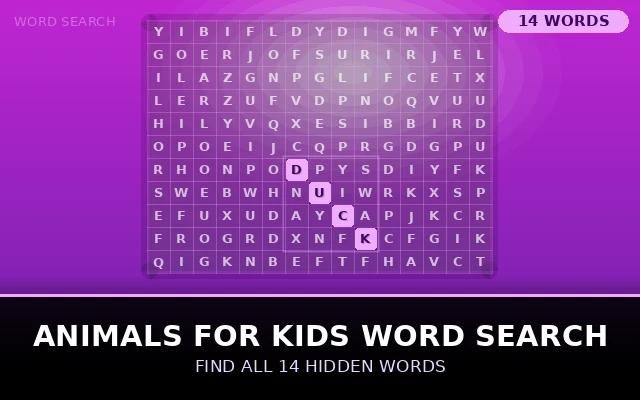
Our free Animals for Kids Word Search hides fourteen familiar animal names insid...
Play Now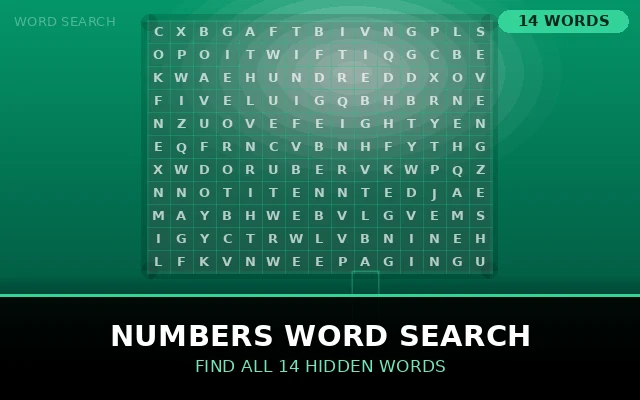
Our free Numbers Word Search takes that early counting instinct and pairs it wit...
Play Now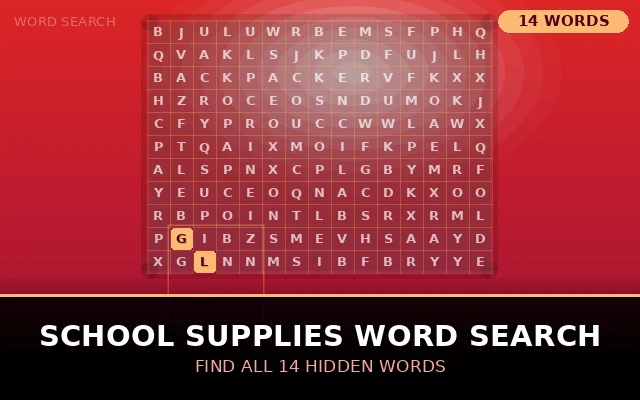
Our free School Supplies Word Search hides fourteen common classroom items insid...
Play NowOur free Colors Word Search hides fourteen common color words inside a single letter grid, giving young learners a fun, hands-on way to connect the colors they already know with the written words that represent them.
Our free Animals for Kids Word Search hides fourteen familiar animal names inside a single letter grid, giving young learners a fun, easy way to build early reading skills around one of their absolute favorite subjects.
Play Now
Our free Numbers Word Search takes that early counting instinct and pairs it with early reading practice, hiding fourteen number words inside a single letter grid for young learners to discover.
Play Now
Our free School Supplies Word Search hides fourteen common classroom items inside a single letter grid, giving young learners a fun, familiar way to practice early reading skills using the exact vocabulary they'll be using every single day at school.
Play NowColors Word Search Guides & Articles
Colors Word Search for Kids
Long before children learn to read full sentences, they're already noticing and naming the colors all around them the red of a fire truck, the yellow of the sun, the green of the grass in the backyard. Colors are one of the very first categories of vocabulary young children master, which makes them a natural, exciting theme for early reading practice. Our free Colors Word Search hides fourteen common color words inside a single letter grid, giving young learners a fun, hands-on way to connect the colors they already know with the written words that represent them.
This colors word search for kids is completely free to play, requires no download or sign-up, and works instantly in any browser on a computer, tablet, or phone. It's a perfect early literacy activity for preschool, kindergarten, and early elementary classrooms, as well as parents looking for a simple, engaging reading activity to do together at home.
Why Color Words Make Such a Great Early Reading Topic
Color recognition is typically one of the very first cognitive skills toddlers develop, often well before they can recognize letters or numbers. By the time most children reach preschool age, they can already point to a red ball, a blue sky, or a green leaf with total confidence, even if they can't yet read or spell the word for that color. This existing familiarity is exactly what makes a color-themed word search such an effective early literacy tool children aren't being asked to learn a brand-new concept from scratch, only to connect a concept they already deeply understand with its corresponding written word.
This connection between existing knowledge and new written vocabulary is a foundational principle in early childhood education. When new learning builds directly on something a child already knows well, that new information tends to stick far more easily than vocabulary introduced completely out of context. A colors word search in It wordsearch for kids takes full advantage of this principle, turning simple, familiar concepts into an accessible bridge toward genuine reading fluency.
Meet the Fourteen Colors Hidden in the Grid
Red — A bold, warm color often associated with fire trucks, apples, and stop signs, and typically one of the very first color words children learn.
Blue — A cool, calming color commonly seen in a clear sky or the ocean, among the most familiar and frequently used color words for young children.
Green — The color of grass, leaves, and many vegetables, closely associated with nature and one of the earliest colors children learn to identify.
Yellow — A bright, cheerful color often connected to the sun, bananas, and sunflowers, a naturally exciting word for young learners.
Orange — A vibrant color that shares its name with the fruit, sitting visually between red and yellow on the color spectrum.
Purple — A rich color often associated with grapes, flowers, and royalty, a favorite among many young children for its bold, playful appearance.
Pink — A soft, light color often connected to flowers and sweets, a gentle and popular color choice among young learners.
Black — A deep, dark color often seen in night skies and many familiar animals, an important early color word for contrast and description.
White — A bright, light color often associated with clouds, snow, and milk, frequently paired with black in early color-matching lessons.
Brown — An earthy color commonly seen in tree trunks, soil, and many familiar animals, a practical everyday color word for young children.
Gray — A neutral color between black and white, often seen in clouds before rain or the fur of certain familiar animals.
Gold — A shimmering, warm color often associated with treasure, stars, and sunshine, adding a touch of sparkle and excitement to this word list.
Silver — A cool, shiny color often connected to the moon, coins, and metal objects, a naturally fascinating word for curious young learners.
Violet — A color closely related to purple, often seen in flowers and associated with one of the colors found in a rainbow.
The Surprising Depth Behind Simple Color Words
It might seem like color vocabulary is about as simple as early learning gets, but there's actually a surprising amount of depth hiding behind these fourteen everyday words. Colors carry meaning far beyond simple visual description they show up constantly in idioms, emotional expressions, and cultural associations that children will keep encountering as they grow. A child who learns the word "blue" as a color today might later encounter the phrase "feeling blue" to describe sadness, or "green with envy" to describe jealousy, expressions that only make sense once the basic color vocabulary is firmly in place. Building this foundational color vocabulary early, through a genuinely enjoyable activity like this word search, sets children up with the basic building blocks they'll need for these more figurative, advanced language uses later on.
Colors also play a surprisingly important role in early scientific thinking. Understanding that yellow and blue combine to make green, or that red and white combine to make pink, introduces young children to basic cause-and-effect reasoning and simple experimentation, skills that extend well beyond art class into broader scientific curiosity. A colors word search like this one, especially when paired with hands-on color-mixing activities, quietly plants the seeds for this kind of early scientific thinking, all wrapped inside a simple, enjoyable reading activity that never feels like a formal science lesson.
Ocean Animals for Kids
Feelings and Emotions Word Search
Easy ABC Words
Colors Word Search
Numbers Word Search
Shapes Word Search
Animals for Kids Word Search
School Supplies Word Search
Playground Word Search
Fairy Tales Word Search
How to Play the Colors Word Search
This colors puzzle is simple enough for even young beginners to enjoy with minimal guidance:
- Look over the list of fourteen color words shown next to the puzzle grid.
- Scan the grid carefully, checking each row from left to right, then each column from top to bottom.
- Once a word is spotted, click and drag across the letters, or tap and swipe on a touchscreen device, to select it.
- Correctly found color words will highlight and disappear automatically from the remaining list.
- The puzzle is complete once all fourteen colors have been found.
For younger children, it helps enormously to have a set of crayons, colored pencils, or even simple colored objects nearby while playing. Holding up the actual red crayon while searching for the word RED creates a powerful, multi-sensory connection between the physical color a child already recognizes and its corresponding written word, reinforcing the lesson far more effectively than the word search alone.
Turning Color Recognition Into Reading Confidence
For many young children, this colors word search represents one of their very first experiences successfully reading and recognizing full words rather than just individual letters. Because color words are so deeply familiar from years of everyday conversation "Can you pass me the blue crayon?" or "I love your green shirt!" children often bring a strong head start of oral vocabulary into this puzzle, even before they've mastered formal reading skills.
This head start makes color word searches an especially confidence-building early reading activity. A child who successfully spots and selects the word PURPLE experiences a genuine, tangible moment of reading success, often one of their very first such moments. That early taste of reading confidence matters enormously for how a child approaches future, more challenging reading tasks, helping build the belief that reading is something they're capable of, rather than something intimidating or difficult.
Pairing This Puzzle With Hands-On Color Activities
Because colors are such a visual, hands-on concept, this word search pairs beautifully with a wide range of simple color-based learning activities. After completing the puzzle, consider asking your child to find something in the room that matches each color word they discovered, turning the digital word search into a broader color scavenger hunt around the house or classroom. Simple art activities, like painting or coloring a picture using each of the fourteen colors from the puzzle, extend the learning even further, reinforcing the same color vocabulary through a completely different creative outlet.
Teachers running color-themed units in preschool or kindergarten classrooms often find this puzzle works well alongside color sorting activities, color mixing experiments, or simple picture books that focus specifically on colors. Layering multiple activities around the same core vocabulary colors, in this case helps ensure that new words move from simple short-term recognition into genuine long-term vocabulary mastery.
Why This Puzzle Works for a Wide Age Range
One of the genuinely useful features of this colors word search is how naturally it scales across different early childhood age groups. A three or four-year-old who isn't yet reading independently can still participate meaningfully with an adult's help, pointing at each letter as it's read aloud and gradually building letter-sound association. A five or six-year-old who is just beginning to read independently can attempt the puzzle largely on their own, building genuine reading fluency with familiar, comfortable vocabulary. Even a seven or eight-year-old who has already mastered basic reading can enjoy the puzzle as a quick, satisfying challenge, particularly if encouraged to complete it against a timer for an added layer of fun, or challenged to spell each color word aloud from memory once it's been found in the grid.
This flexibility makes the colors word search a genuinely useful tool for mixed-age settings too, such as a family with siblings of different ages, or a classroom with students at varying reading levels. Everyone can meaningfully participate in the same activity, simply engaging with it at whatever level matches their current stage of reading development, without anyone feeling left out or under-challenged by a single shared puzzle.
Introducing Less Common Colors Alongside the Familiar Ones
While most children already know basic colors like red, blue, and green from a very young age, this puzzle also includes a few slightly less common color words like gold, silver, and violet that offer a gentle vocabulary stretch for children ready for a bit more challenge. These additional colors introduce useful new vocabulary while still staying firmly within a familiar, comfortable overall theme, making them far less intimidating than introducing an entirely unrelated new topic.
Parents and teachers can use these slightly more advanced color words as a natural opportunity to extend the conversation further. Ask a child what other objects might be described as gold or silver, or explore how violet relates to purple, gently building a richer, more nuanced color vocabulary beyond just the eight or so basic colors most children already know by heart.
Conclusion
This free Colors Word Search for Kids transforms one of the very first categories of vocabulary children ever master into a genuinely rewarding early reading activity. From familiar favorites like red, blue, and yellow to slightly more advanced words like gold, silver, and violet, all fourteen hidden color words give young learners a natural, confidence-building bridge between spoken vocabulary they already know and the written words that represent it. Whether played at home with a box of crayons close by or used as part of a classroom color unit, this puzzle turns everyday color recognition into a genuinely joyful early step on every child's reading journey, one bright, familiar word at a time.