Playground Word Search
Click and drag to select words
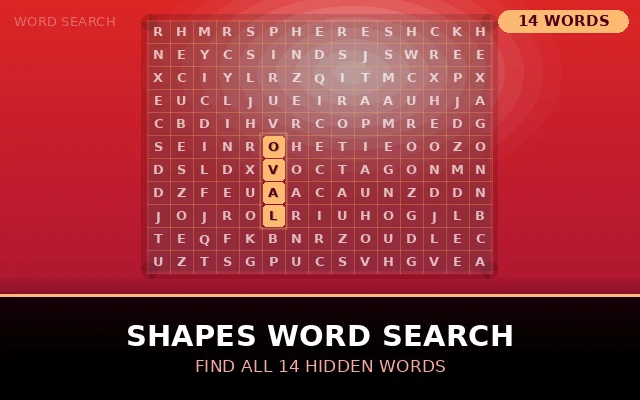
Our free Shapes Word Search hides fourteen common shape words inside a single le...
Play Now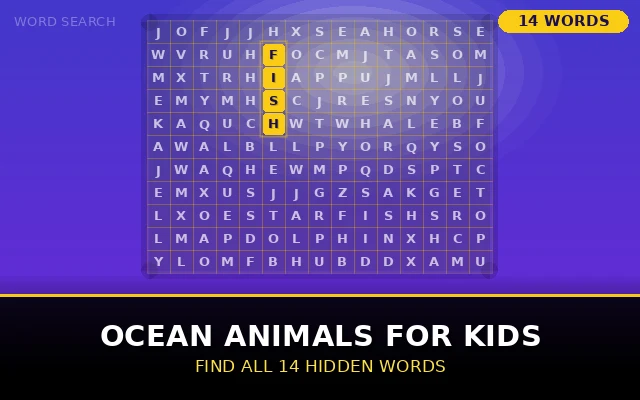
Our free Ocean Animals for Kids Word Search brings fourteen of these amazing sea...
Play Now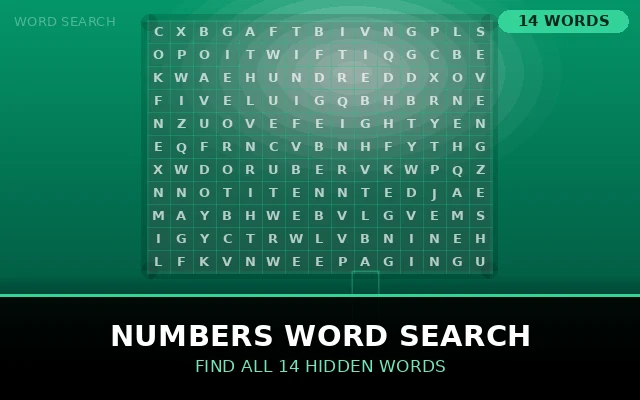
Our free Numbers Word Search takes that early counting instinct and pairs it wit...
Play Now
Our free Shapes Word Search hides fourteen common shape words inside a single letter grid, giving young learners a fun, engaging way to connect the shapes they already recognize with the written words that describe them.
Play Now
Our free Ocean Animals for Kids Word Search brings fourteen of these amazing sea creatures together in one fun, easy-to-play puzzle, perfect for young learners who love the beach, aquariums, or simply anything that lives underwater.
Play Now
Our free Numbers Word Search takes that early counting instinct and pairs it with early reading practice, hiding fourteen number words inside a single letter grid for young learners to discover.
Play NowPlayground Word Search Guides & Articles
Playground Word Search for Kids
Recess is often the most eagerly anticipated part of a young child's school day, and it's easy to see why running, climbing, swinging, and laughing with friends is exactly the kind of joyful energy childhood is made of. Our free Playground Word Search hides fourteen familiar playground words inside a single letter grid, giving young learners a fun, active-themed way to practice early reading skills using vocabulary tied directly to one of their favorite parts of the school day.
This playground word search in It wordsearch for kids is completely free to play, requires no download or sign-up, and works instantly in any browser on a computer, tablet, or phone. It's a wonderful early literacy activity for preschool, kindergarten, and early elementary classrooms, as well as families looking for a fun, energetic learning activity to enjoy together at home.
Why Playground Vocabulary Resonates So Strongly With Kids
Few vocabulary themes carry as much natural excitement and positive emotional association for young children as playground words. Unlike more abstract or academic vocabulary, playground words are directly tied to some of a child's most joyful, active memories the thrill of going down a slide, the rhythmic back-and-forth of a swing, the satisfaction of successfully crossing a set of monkey bars for the very first time.
This strong emotional connection makes playground vocabulary an unusually motivating theme for early reading practice. Children searching for words like SLIDE, SWING, and SEESAW aren't just practicing letter recognition and spelling they're also recalling genuinely happy memories connected to each word, which tends to boost both engagement and long-term retention. Educational content built around a child's own lived experiences and interests consistently proves more effective than vocabulary presented in a purely abstract, disconnected way.
Meet the Fourteen Playground Words Hidden in the Grid
Slide — A smooth, sloped playground structure children climb up and slide down, one of the most popular and universally recognized playground features.
Swing — A hanging seat that moves back and forth, offering one of the most classic and beloved playground experiences for children of all ages.
Seesaw — A long, balanced board that two children sit on opposite ends of, taking turns going up and down together.
Sandbox — A contained area filled with sand, offering a favorite spot for digging, building, and imaginative outdoor play.
Monkeybars — A horizontal ladder-like structure children swing across hand over hand, building upper body strength and coordination.
Ball — A round object used for a wide variety of playground games, from simple bouncing to organized sports.
Jumprope — A rope used for jumping over rhythmically, often accompanied by chants and rhymes during group play.
Bench — A long seat found on playgrounds, often used by children resting between activities or by parents supervising nearby.
Climb — An action word describing the act of moving upward, commonly associated with playground structures like ladders and rock walls.
Chase — An action word describing a fast-paced running game, often central to popular playground games like tag.
Fence — A structure surrounding many playgrounds, helping keep the play area safely enclosed.
Grass — The soft, green ground covering found on many playgrounds and parks, often used for running and group games.
Friend — Referring to the playmates children spend time with during recess, an essential part of the overall playground experience.
Recess — The scheduled break time during a school day dedicated to outdoor play, exercise, and socializing with classmates.
How Playground Words Connect to Physical Development
Nearly every word in this puzzle connects directly to an important physical skill young children are actively developing during their early years. Climbing monkey bars builds upper body strength and grip. Balancing on a seesaw develops coordination and an early sense of physics and gravity. Running during a game of chase builds cardiovascular fitness and speed. Even something as simple as jumping rope helps children develop rhythm, timing, and full-body coordination all at once.
This connection between vocabulary and physical development gives the playground word search a value that extends well beyond simple reading practice. As children search for and recognize each word, they're also being reminded, even if only subconsciously, of the specific physical skill or movement each word represents. Early childhood physical education specialists frequently emphasize just how important this kind of active, movement-based vocabulary is for supporting a child's overall physical literacy, the general term used to describe a child's confidence and competence in physical movement and play. A word search built around playground vocabulary offers a small but meaningful way to reinforce that physical literacy, even during an otherwise quiet, screen-based moment of learning.
Ocean Animals for Kids
Feelings and Emotions Word Search
Easy ABC Words
Colors Word Search
Numbers Word Search
Shapes Word Search
Animals for Kids Word Search
School Supplies Word Search
Playground Word Search
Fairy Tales Word Search
How to Play the Playground Word Search
This lively, playground-themed puzzle is simple enough for young beginners to enjoy, whether played independently or alongside a parent or teacher:
- Look over the list of fourteen playground words shown next to the puzzle grid.
- Scan the grid carefully, checking each row from left to right, then each column from top to bottom.
- Once a word is spotted, click and drag across the letters, or tap and swipe on a touchscreen device, to select it.
- Correctly found playground words will highlight and disappear automatically from the remaining list.
- The puzzle is complete once all fourteen words have been found.
For younger children, it helps to physically act out each word while searching for it. If a child is looking for the word SWING, gently pretending to swing back and forth adds a fun, energetic, multi-sensory connection between the written word and the real playground activity it represents.
Connecting Reading Practice to Physical Play
One of the genuinely unique aspects of this playground word search is how naturally it bridges quiet, screen-based reading practice with the very active, physical world of outdoor play. Many early literacy activities are, by necessity, fairly still and screen-focused, which can feel like a mismatch for naturally energetic young children who would rather be running around outside. This puzzle helps close that gap by using vocabulary so directly tied to physical movement and outdoor fun that even the reading practice itself feels connected to active play.
Consider extending this connection even further by playing the word search right before or after actual outdoor playground time. Playing it beforehand builds anticipation and pre-teaches vocabulary your child will encounter and use during play, while playing it afterward offers a great opportunity to reflect on the specific playground equipment and games they just experienced firsthand, reinforcing the exact same vocabulary through a real, memorable physical experience.
Building Social Vocabulary Through Playground Themes
Beyond simply naming playground equipment, this puzzle also touches on important social vocabulary connected to recess and outdoor play, including words like FRIEND and RECESS. Recess time is often one of the most socially significant parts of a young child's school day, offering crucial opportunities to practice sharing, taking turns, cooperative play, and forming early friendships.
Including social vocabulary alongside equipment-focused words gives this puzzle a slightly broader educational value than a purely object-focused word list might offer. After finding the word FRIEND, for example, consider asking your child to share a happy memory about playing with a friend at recess, gently encouraging early language development around social experiences and emotional connections, not just physical objects and playground equipment.
Using This Puzzle Before and After Recess
Teachers can use this playground word search as a natural pre- or post-recess classroom activity, helping transition students between quiet classroom learning and more active outdoor play time. Playing the puzzle just before heading outside for recess can serve as a calm, focused activity that helps settle a classroom before the excitement and energy of outdoor free play begins.
Alternatively, using the puzzle just after recess offers a gentle way to help children transition back into a calmer, more focused classroom mindset, while still keeping the fun, positive energy of recess fresh in their minds. Many teachers find that playground-themed vocabulary activities like this one help ease these daily classroom transitions more smoothly than a completely unrelated activity might.
Encouraging Outdoor Play Through Familiar Vocabulary
In an era when many children spend increasing amounts of time on screens, activities that gently encourage outdoor play and physical activity carry real, added value beyond pure literacy practice. While this word search itself is a screen-based activity, its playground theme naturally points children's attention and enthusiasm back toward outdoor play, physical movement, and time spent with friends rather than more sedentary entertainment.
Parents looking to encourage a healthy balance between screen time and outdoor activity might use this puzzle as a natural bridge between the two — a short, engaging screen-based activity that ultimately builds excitement and vocabulary readiness for genuine outdoor play, rather than simply serving as another form of passive screen entertainment.
Tips for Parents and Teachers Using This Puzzle
Consider pairing this word search with an actual trip to a local playground, encouraging your child to point out and name each piece of equipment they find in real life that matches a word from the puzzle. This kind of direct, real-world connection between written vocabulary and physical experience helps cement playground words far more effectively than the word search alone.
For classrooms, this puzzle also works well as a partner activity, with students discussing their favorite playground equipment and games as they search for each word together. This kind of social, conversational element adds an extra layer of engagement, turning a simple vocabulary exercise into a genuine opportunity for classroom bonding and shared excitement about recess time.
Conclusion
This free Playground Word Search for Kids transforms one of childhood's most joyful, energetic experiences into a genuinely enjoyable early reading activity. From classic equipment like SLIDE, SWING, and SEESAW to important social vocabulary like FRIEND and RECESS, all fourteen hidden words give young learners plenty of built-in excitement and motivation to keep searching and learning. Whether played right before heading outside or as a calm reflection activity afterward, this puzzle proves that even quiet reading practice can capture the joyful, active spirit of recess, connecting early literacy directly to the outdoor play and physical movement every child needs and loves.