Christmas Word Search: A Deep Dive Into the Holiday Puzzle
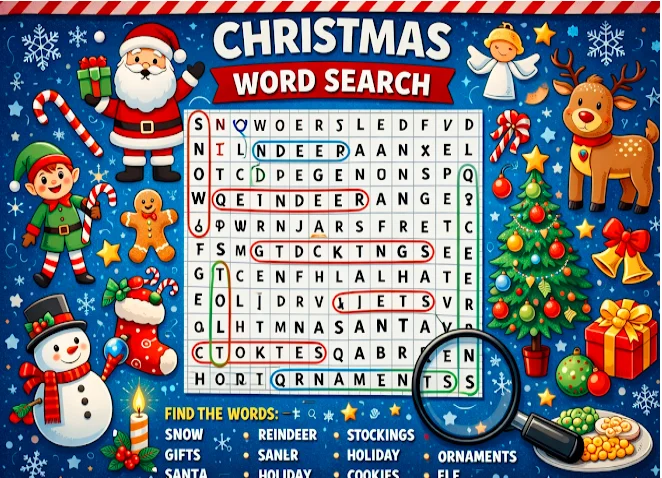
Christmas Word Search: A Deep Dive Into the Holiday Puzzle That Has Stood the Test of Time
Every December, something
quietly magical happens in homes, classrooms, care facilities, and community
halls across the globe. Families gather around kitchen tables. Teachers pin
fresh sheets to bulletin boards. Grandparents reach for reading glasses and sharpen
pencils. The occasion? The annual Christmas word search that deceptively
simple grid of letters concealing a hidden world of festive vocabulary waiting
to be discovered.
What makes this humble puzzle
so enduring? Why does a pastime that requires nothing more than a printed sheet
and an observant eye continue to captivate children and adults alike, year
after year, generation after generation? The answer lies not just in the
mechanics of the puzzle, but in the rich history behind it, the science of why
puzzle-solving feels so satisfying, and the surprising ways the Christmas word
search has evolved in the digital age.
This is the story of the Christmas word search where it came from, why it works, how to get the most out of it, and what makes it so much more than just a holiday time-filler.
The Origins of Word Search
Puzzles: A History Worth Knowing
To appreciate the Christmas
word search, it helps to understand the broader history of the word search
puzzle itself. The format was invented in 1968 by Norman E. Gibat, a puzzle
creator from Oklahoma who published the first known word search in the Selenby
Digest a local publication he produced himself. Gibat originally created the
puzzle as a way to engage younger readers, offering an alternative to the more
complex crossword puzzles that dominated puzzle pages at the time.
What began as a modest regional
experiment quickly spread. Teachers recognized the educational potential.
Children loved the treasure-hunt quality of scanning grids for hidden words.
Publishers started including word searches in magazines, newspapers, and
activity books throughout the 1970s and 1980s. By the time the holiday season
became a target for themed puzzles, the word search had already cemented its
place in popular culture.
The Christmas word search
specifically emerged as the format expanded beyond neutral vocabulary into
themed, seasonal applications. Puzzle creators recognized that holiday
vocabulary with its rich mixture of religious terms, winter imagery, cultural
traditions, and beloved characters was ideally suited to the word search
grid. Words like FRANKINCENSE, MYRRH, and BETHLEHEM were long enough to thread
satisfyingly across a grid, while shorter festive words like ELF, JOY, and STAR
provided quick wins for less experienced solvers.
Today, the Christmas word
search is a genuine cultural institution. It appears in school holiday packets,
office party packs, church bulletins, and digital apps. It is printed in
magazines, sold in puzzle books, and downloaded millions of times from the
internet each November and December. Its longevity is not accidental it
reflects something deep and consistent about what humans find enjoyable during
the holiday season.
The Psychology Behind Why
Christmas Word Searches Feel So Good
There is actual science behind
the satisfaction you feel when you circle a hidden word in a Christmas word
search grid. Understanding the psychological mechanisms at play helps explain
why this simple activity has never lost its appeal, even as entertainment
options have multiplied exponentially.
The Reward System and
Pattern Recognition
The human brain is a
pattern-recognition machine. We are wired to scan our environment for
meaningful signals a survival mechanism that served our ancestors well when spotting
predators or finding food. When you scan a Christmas word search grid looking
for REINDEER or SNOWFLAKE, you are engaging that same ancient neural circuitry,
but in a completely safe and pleasurable context.
Each time you spot a hidden
word, your brain releases a small hit of dopamine the neurotransmitter
associated with reward, motivation, and pleasure. This is the same chemical
response triggered by completing a task, solving a problem, or achieving a
goal. The Christmas word search essentially gamifies the act of reading, making
it neurologically rewarding in a way that feels effortless and fun.
Flow States and the Holiday
Brain
Psychologist Mihaly
Csikszentmihalyi famously described the concept of 'flow' a mental state of
complete absorption in an activity that is challenging enough to be engaging
but not so difficult as to cause frustration. Christmas word searches are
brilliantly designed to induce flow states, particularly when matched to the
appropriate difficulty level for the solver.
The holiday season itself can
be cognitively and emotionally overwhelming packed schedules, social
obligations, financial pressures, and the weight of expectations. A Christmas
word search offers a rare opportunity to step outside that noise. The puzzle demands
just enough focused attention to quiet internal chatter, providing a meditative
mental break disguised as a game.
Nostalgia and Emotional
Association
For many adults, Christmas word
searches carry a powerful layer of nostalgic association. If you spent
childhood Decembers completing these puzzles at school, with family, or on
Christmas morning, the act of picking up a fresh one as an adult can trigger a
cascade of warm memories. This emotional resonance is part of why the Christmas
word search has a multigenerational appeal that purely digital entertainment
often struggles to match.
Christmas Word Search as an
Educational Tool: More Than Just Fun
Teachers and educators have
long recognized that Christmas word searches do more than simply keep students
occupied during the final weeks before the winter break. Used thoughtfully,
they are legitimate educational instruments with measurable cognitive benefits.
Vocabulary Reinforcement
and Spelling
The act of searching for a word
in a grid requires the solver to hold its spelling in working memory
repeatedly checking each letter against the corresponding position in the grid.
This process reinforces spelling retention in a way that passive reading does
not. Research in cognitive psychology suggests that active retrieval practice,
the effort of recalling and applying specific knowledge, strengthens memory far
more effectively than passive exposure.
For younger students learning
festive vocabulary ADVENT, NATIVITY, FRANKINCENSE, EPIPHANY a Christmas
word search provides structured rehearsal of challenging spellings in a context
that feels playful rather than academic. For English language learners, the
format offers an accessible entry point into holiday vocabulary without
requiring full reading fluency.
Visual Scanning and
Attention Skills
Scanning a word search grid
develops systematic visual attention skills. Effective solvers learn to move
methodically across rows and columns, maintain focus without losing their
place, and switch between global scanning (looking for overall word shapes) and
local analysis (checking individual letter sequences). These are precisely the
visual tracking skills that underpin fluent reading.
Occupational therapists and
literacy specialists sometimes incorporate word searches into developmental
programmes for children who struggle with reading, precisely because the format
builds these foundational visual skills in an engaging, low-pressure environment.
Cross-Curricular Christmas
Word Searches
Innovative teachers have taken
the Christmas word search far beyond simple vocabulary lists. History-themed
versions might hide terms related to Victorian Christmas traditions or the
origins of Christmas customs. Science-themed puzzles could incorporate
vocabulary related to winter astronomy, the physics of snowflakes, or the
biology of reindeer. Music teachers use song-themed grids to introduce carol
vocabulary. The humble Christmas word search, it turns out, can serve as a
gateway into almost any curricular subject when designed with educational
intent.
The Art and Science of
Designing a Great Christmas Word Search
Creating a Christmas word
search might seem like a simple task generate a grid, hide some words, fill
in the blank spaces. But the difference between a forgettable puzzle and a
genuinely satisfying one comes down to a series of deliberate design decisions.
Choosing the Right Words
The word list is the soul of
any Christmas word search. The best lists balance familiarity with challenge,
mixing instantly recognizable words (STAR, TREE, GIFT) with less common terms
(WASSAIL, EPIPHANY, CHRISTINGLE) that introduce solvers to new vocabulary. The
words should also vary in length a mix of short 3-4 letter words and longer
8-10 letter words creates a satisfying variety of solving experiences within a
single puzzle.
Theme coherence matters too. A
puzzle focused on the nativity story should not suddenly include pop-culture
references, and a movie-themed Christmas word search works best when the
vocabulary is tightly curated around specific films rather than being a generic
grab-bag of holiday terms. Coherent themes give the puzzle meaning beyond mere
letter-hunting.
Grid Size and Density
Grid size dramatically affects
the puzzle experience. A 10x10 grid with 15 hidden words creates a relatively
open field words are easier to spot because the surrounding filler letters
are sparser. A 20x20 grid with 50 words creates a much denser challenge, where
filler letters cluster more tightly and deliberate letter combinations are used
to mislead solvers.
Professional puzzle designers
also think carefully about word placement direction. Puzzles with only
horizontal and vertical words are significantly easier than those that include
diagonal placement. Backward words hidden from right to left or bottom to top
add another layer of difficulty. The best Christmas word searches for
mixed-age groups use predominantly horizontal and vertical placements with a
handful of diagonals thrown in as a gentle stretch.
The Role of Filler Letters
Those blank spaces between
hidden words are not as random as they appear. Skilled puzzle designers fill
unused grid spaces with letters that create plausible-looking letter sequences,
deliberately misleading the solver's eye. A poorly designed puzzle will accidentally
create extra words sometimes inappropriate ones in the filler spaces.
Professional word search generators use algorithms to minimize accidental word
formation while maximizing grid density.
Christmas Word Searches
Across Cultures and Languages
One of the most striking
aspects of the Christmas word search tradition is how naturally it crosses
cultural and linguistic boundaries. While the puzzle format originated in
English, it has been enthusiastically adopted in languages and cultural contexts
around the world.
Spanish-language Christmas word
searches featuring vocabulary like NAVIDAD (Christmas), VILLANCICO (carol),
BELÉN (nativity scene), and REGALOS (gifts) are widely used in Latin American
classrooms and bilingual educational settings across the United States. French
puzzles introduce NOËL, RENNE (reindeer), and MAGIE (magic). Italian versions
bring BABBO NATALE (Father Christmas) and PRESEPE (nativity scene) into the
grid.
These multilingual versions do
more than translate vocabulary they carry cultural nuance. A Spanish-language
Christmas word search might include POSADA (the traditional Mexican Christmas
procession) or TURRÓN (a Spanish nougat confection associated with Christmas).
These culturally specific terms transform the puzzle into a small window into
another community's holiday traditions.
In the United Kingdom,
Christmas word searches often include distinctly British vocabulary that
puzzles American solvers: CRACKER (the paper tube you pull to reveal a small
gift), BOXING DAY (the day after Christmas), MINCE PIE (a small pastry filled
with spiced fruit), and PUDDING (the dense steamed Christmas dessert). These
regional variations make the Christmas word search an unexpectedly rich
artefact of cultural identity.
Digital Christmas Word
Searches: Tradition Meets Technology
The internet age has
transformed rather than diminished the Christmas word search tradition. Digital
versions have opened up new possibilities that printed puzzles simply cannot
match.
Interactive online Christmas
word searches allow solvers to highlight words by clicking and dragging across
the grid words illuminate in festive colors when correctly identified,
providing instant visual feedback that printed puzzles cannot replicate. Timer
features add competitive urgency, while hint systems offer gentle assistance to
younger or less experienced solvers. Some digital versions include sound
effects a jingle bell chime when a word is found, a festive fanfare when the
puzzle is completed.
The social dimension of digital
Christmas word searches is particularly compelling. Online platforms allow
multiple players to race through the same puzzle simultaneously, comparing
completion times or competing to find specific words first. Remote families
separated by geography have discovered that solving a shared digital Christmas
word search together over video call recreates some of the warmth of a physical
holiday gathering.
Word search generator tools
have also democratized puzzle creation. What once required manual placement of
words in a paper grid a time-consuming process prone to errors can now be
accomplished in seconds using online generators that automatically place words,
fill unused spaces, and produce print-ready PDFs. This accessibility has
enabled teachers, parents, and event organizers to create personalized
Christmas word searches with family names, inside jokes, or custom vocabulary
lists that make the puzzle a genuinely meaningful keepsake.
Making Christmas Word
Searches More Inclusive
One of the quiet strengths of
the Christmas word search tradition is its remarkable adaptability for
different needs and abilities. With a few thoughtful adjustments, the format
becomes accessible to virtually everyone.
Large-print versions
featuring grids with generously sized letters and high contrast formatting
make the puzzle comfortable for older adults, people with visual impairments,
or anyone who finds standard puzzle typography difficult to navigate. The
large-print Christmas word search has become a staple activity in care homes
and senior living communities, where its combination of gentle cognitive
stimulation and festive theming makes it a natural fit for holiday programming.
For children with dyslexia or
other reading differences, Christmas word searches offer a point of access to
holiday vocabulary that sidesteps some of the barriers presented by continuous
text. The visual and spatial nature of the word-finding task draws on different
cognitive strengths, allowing children who struggle with conventional reading
activities to experience genuine success in a holiday context.
Simplified versions with
shorter words, reduced grid sizes, and picture clues alongside the word list
make the Christmas word search accessible to pre-readers and children with
developmental differences. The puzzle's scalability from toddler-friendly to
genuinely fiendish is one of its most remarkable features.
The Christmas Word Search
as a Mindfulness Practice
There is a growing conversation
in wellness circles about the therapeutic benefits of puzzle activities. The
Christmas word search, in particular, sits at an interesting intersection of
cognitive engagement and meditative calm.
Unlike more socially demanding
holiday activities, the Christmas word search requires quiet, individual focus.
Completing one during the holiday season with a cup of tea, the sound of
carols in the background, or the glow of tree lights nearby offers a moment
of gentle self-absorption in a season that can otherwise feel relentlessly
social. Many people report that this quality of focused quietness is precisely
what they value about returning to word searches during December.
Some mindfulness practitioners
have explicitly incorporated word searches into their winter wellness
recommendations, noting that the repetitive visual scanning involved in
puzzle-solving can anchor attention in the present moment in a way that
parallels more formal meditation techniques but feels far more accessible and
approachable for people who struggle with conventional mindfulness practices.
Read More: Fruits Word Search
Conclusion: The Christmas
Word Search Is Far More Than a Puzzle
From its origins in a 1968
Oklahoma newsletter to its current status as a global holiday tradition embraced
in dozens of languages and formats, the Christmas word search has quietly
accumulated a remarkable history. It has educated children, united families,
crossed cultural barriers, kept elderly minds sharp, supported language
learners, and provided moments of meditative peace amid the holiday rush.
The next time you sit down with a Christmas word search whether it's a hand-drawn creation from a child, a beautifully designed printable from a puzzle artist, or an interactive digital version on your phone take a moment to appreciate what you're holding. It's not just a grid of letters. It's a tradition with roots, science behind it, culture woven through it, and the power to bring people together across every difference of age, ability, and background.