Everything You Need to Know About Naming Your Feline Friend Cat Names Word Search
The Fascinating World of Cat Names and Word Search Puzzles
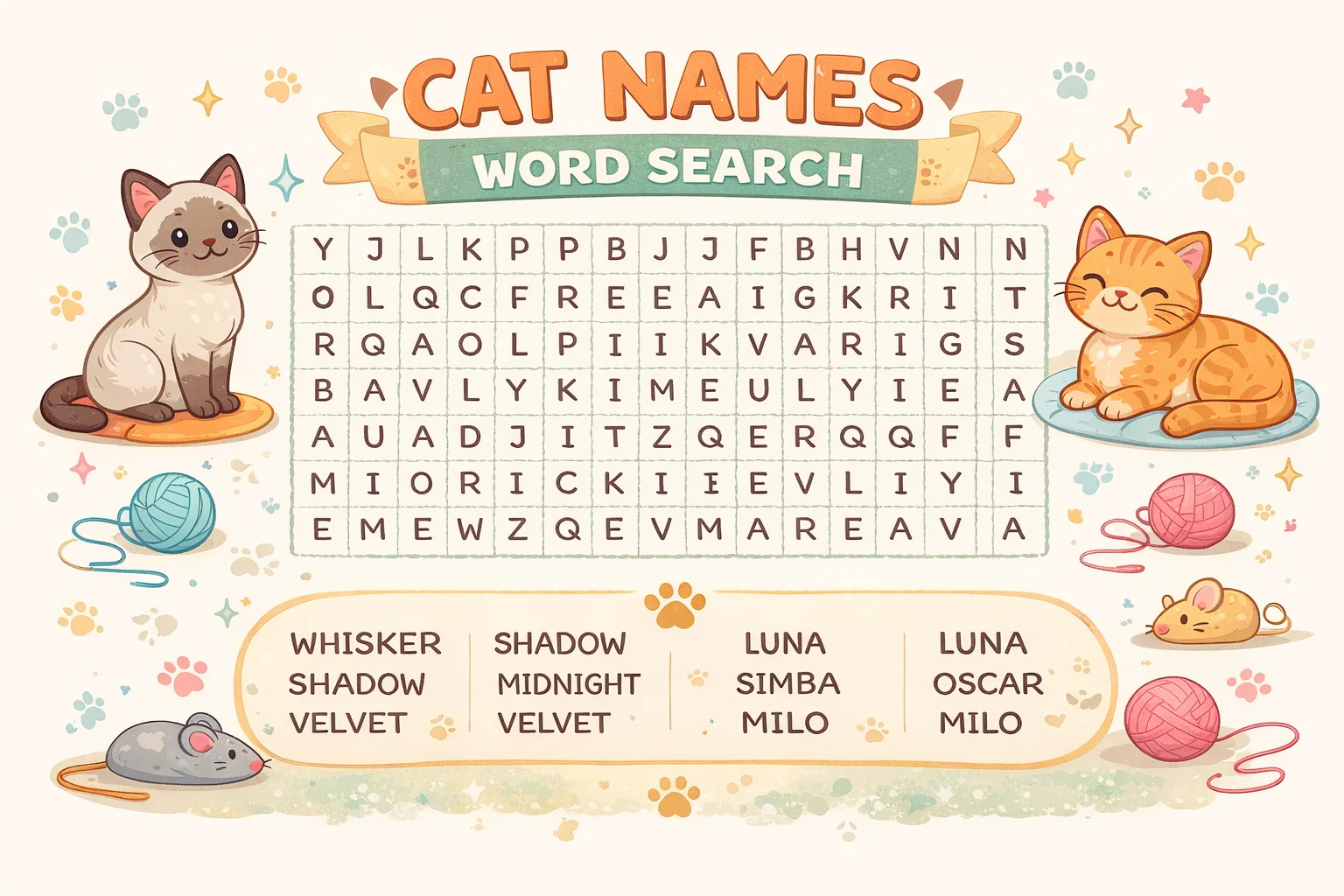
There is something quietly magical about the moment you sit down with a cat names word search puzzle. The grid stretches out before you, packed with hidden words moving in every direction, and each name you discover feels like a small adventure. But beyond the puzzle-solving satisfaction, cat names word search activities serve a surprisingly practical purpose: they are one of the most enjoyable and memorable ways to explore naming ideas for a new pet.
Whether you are a teacher creating an educational classroom activity, a parent entertaining a child who just adopted a kitten, a puzzle enthusiast who loves themed word searches, or someone genuinely hunting for the perfect name for a new feline companion, understanding how cat names work across different categories, cultures, and themes dramatically improves the quality of your puzzle experience and your naming decisions.
This guide goes deep into the educational and informational dimensions of cat names. We explore why names matter to cats, how different cultures approach feline naming traditions, what makes certain categories of names consistently popular, and how word search puzzles actually help people make better naming choices. Plus, a comprehensive FAQ section at the end answers the most searched questions about cat names on the internet today.
Why Cat Naming Is More Scientifically Important Than You Think
Most people choose a cat name based on instinct or appearance, never realising that feline neuroscience has quite a bit to say about which names work best. Cats process sound differently from humans. While we hear words as complex units of meaning, cats respond primarily to the acoustic properties of sound: pitch, rhythm, and the final syllable of a word.
- The Fascinating World of Cat Names and Word Search Puzzles
- Why Cat Naming Is More Scientifically Important Than You Think
- The Science of Phonetics and Cat Response
- Consistency Over Creativity
- Puzzles:
- How Cat Names Word Search Puzzles Actually Help With Naming Decisions
- Themed Puzzles Create Better Naming Focus
- A Learning Guide Understanding Cat Name Categories
- Nature and Botanical Names
- Mythological and Historical Names
- Food and Drink Inspired Names
- Colour-Coordinated Names
- Cultural and International Names
- The Art and Craft of Building a Cat Names Word Search Puzzle
- Grid Architecture and Word Placement Strategy
- Direction Difficulty and Solver Experience
- Adding Educational Value to Cat Names Puzzles
- A Cultural Survey Global Cat Naming Traditions
- Japan: The Nation That Loves Cats Most
- Ancient Egypt: Cats as Sacred Beings
- From Superstition to Beloved Companion Western Europe
- What Your Cat Name Choice Says About You
- Conclusion: Where Learning, Language, and Love Converge
The Science of Phonetics and Cat Response
Research in animal cognition consistently shows that cats are more responsive to names and calls that end in high-frequency vowel sounds. This is why names ending in long E sounds (Lily, Rosie, Pixie, Benny, Lucky) tend to produce faster responses than names ending in hard consonants. It is also why short names of one or two syllables are often recommended for domestic cats: they are quicker to call, easier to repeat consistently, and phonetically cleaner for a cat to distinguish from background noise.
Interestingly, a 2019 study published in Scientific Reports found that cats can distinguish their own names from other words with similar phonetic structures, even when called by unfamiliar people. This means your cat genuinely knows its name and chooses whether to acknowledge it, which will surprise absolutely nobody who has ever owned a cat.
Consistency Over Creativity
One practical lesson from feline phonetics is that consistency matters more than creativity. A cat named Bartholomew who is regularly called Bart, Barthy, B, and Hey You will struggle to form the neural association between a specific sound and itself. If you choose a long or elaborate name from a word search puzzle, commit to one shortened form for daily use and stick to it. The elaborate version can live on paper; the shortened version lives in your cat's working memory.
Puzzles:
How Cat Names Word Search Puzzles Actually Help With Naming Decisions
There is a well-documented psychological phenomenon called the mere exposure effect, which describes how people tend to develop preferences for things simply because they have encountered them before. In the context of naming, this means that passively scanning a word search grid full of cat names creates a subtle familiarity with those names before you have consciously evaluated them.
When a name suddenly appears as you scan the grid, there is a small burst of recognition and reward. Your brain registers the name not just visually but emotionally. By the time you have completed a themed cat names word search puzzle, several names will have imprinted on your memory as pleasant, satisfying discoveries. These are often the names that end up on the shortlist.
Themed Puzzles Create Better Naming Focus
Themed word searches are particularly useful because they group names by category: girly cat names, Japanese cat names, mythological names, food-inspired names, colour-based names. This thematic grouping helps pet owners clarify what they actually value in a name before they make a final decision. Someone who gravitates toward the Japanese names section but keeps circling back to the mythology section might realise they want something that sounds exotic but carries meaningful heritage. That is a naming insight a simple list could never provide.
Educational cat names word searches also serve classroom purposes beautifully. Children learn vocabulary, cultural awareness, and basic geography through themed naming puzzles. A Japanese cat names word search, for example, teaches children words like Yuki, Hana, and Mochi alongside the meanings behind them. A mythology-themed puzzle introduces Greek and Roman gods in a playful, low-pressure format that encourages curiosity.
A Learning Guide Understanding Cat Name Categories
Cat names naturally group themselves into distinct categories, each with its own cultural history, popularity patterns, and emotional resonance. Understanding these categories helps both puzzle builders and pet owners make more intentional, satisfying choices.
Nature and Botanical Names
Nature-inspired names have remained consistently popular across centuries because they carry inherent beauty without requiring cultural knowledge to appreciate. Names drawn from flowers, trees, seasons, weather, and natural phenomena tend to be universally accessible and visually evocative. A name like Willow instantly conjures a graceful, flowing image. Storm carries drama and force. Ember glows warm and bright. These names work in word search puzzles because they are real words with independent meanings that solvers enjoy discovering in unexpected contexts.
Mythological and Historical Names
Mythological names represent one of the most intellectually rich categories in cat naming. Names drawn from Greek, Roman, Norse, Egyptian, Celtic, and Slavic traditions carry centuries of storytelling weight. When you name a cat Freya, you are borrowing from Norse mythology's goddess of love, war, and magic. When you choose Anubis, you are invoking the Egyptian guardian of the underworld. These names reward research and create instant conversation starters.
For word search puzzle builders, mythological names are technically valuable because many of them are long, consonant-heavy words that anchor grids effectively. Names like Persephone, Andromeda, Clytemnestra, or Mnemosyne create challenging diagonal and vertical finds that reward advanced puzzle solvers. Shorter mythological names like Ares, Iris, or Nyx provide contrast and allow for denser grid construction.
Food and Drink Inspired Names
Food-inspired cat names have surged dramatically in popularity over the past decade, driven largely by social media culture where cats with funny or unexpected names perform exceptionally well. Names like Biscuit, Mochi, Waffles, Cheddar, Espresso, Noodle, and Pretzel consistently generate engagement because they are inherently charming and slightly absurd in a way that matches actual cat behaviour perfectly.
The psychology behind food names is worth understanding. Food is associated with comfort, pleasure, and warmth. When you name a cat after something edible and beloved, you transfer those positive associations to the cat itself. People who name their cats Mochi or Biscuit tend to report that the name feels like an expression of affection rather than a label, which creates a stronger emotional bond between owner and pet.
Colour-Coordinated Names
Naming a cat based on its coat colour is one of the oldest feline naming traditions in human history. Ancient Egyptians named their cats after their appearance. Medieval European households named black cats after dark materials and white cats after snow and milk. This tradition persists because it creates an immediate, visual narrative connection between the cat and its name that strangers can appreciate instantly.
Colour-based word search puzzles are particularly satisfying because they create natural thematic clusters. A grey cat names puzzle might include words like Ash, Slate, Pewter, Graphite, Mist, Nimbus, and Sterling, each evoking a different shade and texture of grey. Solvers find themselves thinking about the subtle differences between these greys as they search, which is a genuinely educational visual experience.
Cultural and International Names
As the world has become more connected through travel, media, and the internet, pet naming has become an increasingly multicultural practice. Japanese names in particular have crossed cultural boundaries with remarkable success. The global popularity of Japanese pop culture, cuisine, and aesthetic sensibility has made names like Yuki, Hana, Sakura, Mochi, and Tama recognizable and beloved worldwide.
Irish and Celtic names have experienced a similar rise, driven partly by streaming services producing high-quality Celtic-themed content and partly by a broader cultural interest in heritage. Names like Saoirse, Niamh, Finn, and Brigid are appearing on veterinary clinic records in countries far from Ireland, carried by owners who discovered them in word search puzzles or online naming articles and fell in love with their sounds.
The Art and Craft of Building a Cat Names Word Search Puzzle
Word search construction is a genuine craft that combines linguistic knowledge, spatial reasoning, and thematic curation. A well-built cat names word search is not simply a random collection of names dropped into a grid. It is a carefully balanced experience designed to reward both beginner and expert solvers.
Grid Architecture and Word Placement Strategy
Professional puzzle constructors place their longest words first because these anchor words define the grid's structural possibilities. A name like Persephone (10 letters) or Butterscotch (12 letters) placed diagonally across a grid creates a backbone around which shorter words can be woven. Aim for a grid size that accommodates your longest word with comfortable padding on each side.
Word length variety is crucial to solver satisfaction. A puzzle containing only short three-letter names feels too easy and lacks visual drama. A puzzle containing only long names becomes frustratingly difficult. The ideal mix includes approximately 30 percent short words of three to four letters, 50 percent medium words of five to seven letters, and 20 percent long words of eight or more letters. This distribution creates a satisfying rhythm of quick finds followed by challenging hunts.
Direction Difficulty and Solver Experience
Standard word search puzzles include horizontal and vertical placement only. Intermediate puzzles add diagonal words. Advanced puzzles include backward horizontal, backward vertical, and backward diagonal placement. For educational purposes targeting children, limit directions to horizontal and vertical. For adult enthusiasts, all eight directions create the most rewarding challenge.
Fill letters between hidden words should be genuinely random to avoid creating false trails. One common amateur mistake is filling leftover spaces with the first letters that come to mind, which often creates accidental partial words that frustrate solvers who spend time pursuing paths that lead nowhere. Many professional puzzle builders use a small program or algorithm to generate genuinely randomised fill letters.
Adding Educational Value to Cat Names Puzzles
The best cat names word search puzzles do more than hide words in a grid. They educate. Consider adding a brief meaning or origin note beside each name in the word list. If the puzzle features Japanese names, include a small cultural sidebar explaining the significance of cats in Japanese tradition. If the theme is mythology, a quick note about each deity or figure mentioned transforms a simple puzzle into a genuine learning resource.
Teachers who use cat names word searches in classrooms report that the contextual information dramatically increases student retention. Children who discover that Artemis was the Greek goddess of the moon and hunt are far more likely to remember the name and its mythology than those who encounter the word purely as a hidden puzzle entry.
A Cultural Survey Global Cat Naming Traditions
Cat naming practices vary fascinatingly across cultures, and exploring these traditions adds rich educational depth to any themed word search puzzle.
Japan: The Nation That Loves Cats Most
Japan has arguably the world's most elaborate relationship with cats. Japan has multiple cat islands, most famously Aoshima in Ehime Prefecture, where the feline population vastly outnumbers the human residents. Cat cafes originated in Japan in 1998 and have since spread globally. Even the Tokyo subway once employed a cat named Tama as an official stationmaster at the Kishi Station, a role that demonstrably increased passenger numbers before her death in 2015.
Traditional Japanese cat names often reflect direct observations about the cat: its colour, size, personality, or sound.
Ancient Egypt: Cats as Sacred Beings
Ancient Egypt elevated cats to divine status. The goddess Bastet, depicted with the head of a domestic cat, was one of the most widely worshipped deities in the Egyptian pantheon. Killing a cat, even accidentally, was historically punishable by death in ancient Egyptian law. Egyptian cats were often mummified and buried alongside their owners as beloved companions and spiritual protectors.
This sacred history has influenced how many modern cat owners approach naming. Egyptian-themed cat names remain popular precisely because they carry this ancient weight of reverence. Names drawing from Egyptian mythology, geography, and culture appear frequently in uniquely themed cat names word search puzzles, adding genuine historical depth to the puzzle experience.
From Superstition to Beloved Companion Western Europe
Medieval European attitudes toward cats were complicated. Black cats in particular became associated with witchcraft and misfortune, a superstition that persisted in some regions well into the modern era and still influences cat naming today. The surge in Halloween-themed cat names, witchcraft-inspired names, and magical dark names can be traced directly to this historical association, reclaimed and celebrated by modern cat owners who find the gothic aesthetic genuinely beautiful.
Contemporary Western naming trends have shifted decisively toward humanisation. Cats are increasingly named with human names that would not look out of place on a birth certificate. Names like Theodore, Margaret, Arthur, Penelope, and Adelaide are now regularly given to cats, reflecting a cultural shift toward viewing pets as genuine family members deserving of dignified, meaningful names.
What Your Cat Name Choice Says About You
Pet psychologists and animal behaviour researchers have noted consistent patterns between cat owner personality types and their naming preferences. While these are generalisations rather than definitive rules, they offer fascinating insight into the psychology of the cat naming process.
Owners who choose mythological or historical names tend to score high on openness to experience and have a strong interest in learning, history, and culture. They often research their chosen name thoroughly before committing and enjoy explaining the etymology to visitors. Owners who choose food-inspired names tend to score high on agreeableness and warmth. They are typically less interested in prestige naming and more interested in creating an immediate emotional connection through humour and comfort. Owners who choose colour-based names tend to be highly observant and practical. They value accuracy and authenticity in representation and want the name to be a genuine reflection of the cat rather than an imposed identity.
The most important quality of any cat name is that it feels right to the owner and produces a positive emotional association every time it is called. A name that makes you smile is a name that will be called with warmth and consistency, which is ultimately the most important thing for the cat's wellbeing and responsiveness.
Read More: Dog Names
Conclusion: Where Learning, Language, and Love Converge
Cat names word search puzzles occupy a unique intersection of entertainment and education. They are simultaneously a linguistic exercise, a cultural survey, a psychological tool, and a joyful creative activity. Every category of cat names, from the mythological to the silly, from the Japanese to the gothic, carries its own story, its own history, and its own emotional logic.
Understanding the science behind cat naming makes you a more thoughtful puzzle builder and a more intentional pet owner. Knowing that cats respond best to high-frequency vowel endings helps you evaluate names not just aesthetically but practically. Understanding cultural naming traditions enriches the word search solving experience from a game into a genuine learning journey. Recognising the psychological dimensions of naming helps you understand why certain names feel immediately right and others feel awkward despite being objectively lovely.
Whether you have just solved a cat names word search and discovered a name you love, or you are building one for a classroom, a website, or a gift, the knowledge in this guide gives you everything you need to approach the process with depth and confidence. The right name is out there. And there is a good chance it is hiding diagonally across a grid right now, waiting to be found.