Discover Every Shade, of Puzzles Color Names Word Search
Opening the Color Wheel: More Than Just Red, Yellow, and Blue
Ask a group of adults to name every color they know and most people stop somewhere between twelve and twenty. Ask a professional painter, a textile designer, or a botanist the same question and the answers stretch into the hundreds. The difference is not in what these people can see. It is in what they have been taught to name. Color naming is a learned skill, and the vocabulary of color is one of the most intellectually rewarding areas of the English language to explore.
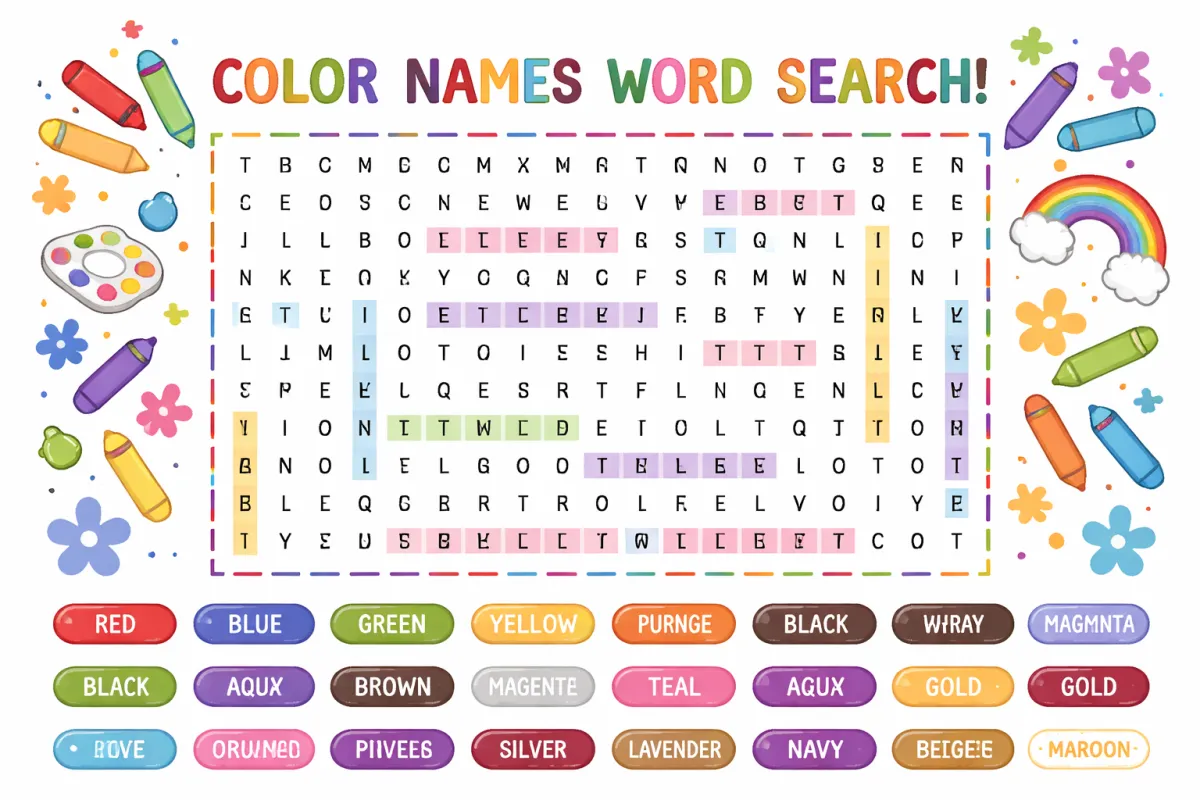
Color names word search puzzles turn this vocabulary expansion into something genuinely pleasurable. When you scan a grid searching for a hidden word, your brain processes that word at a deeper level than it does when you simply read it in a list. You notice the letter patterns, the unusual combinations, the unexpected length of a word like xanthic or chrysocolla. By the time you circle it, you own it. The word has moved from the page into your active memory in a way that passive reading rarely achieves.
This guide takes a fresh approach to color names that goes beyond shade catalogues and hex code lists. It examines the cognitive and creative dimensions of color vocabulary, explores how color names function differently across design fields, investigates the surprising mathematics and physics behind how colors get their names, and provides genuinely useful guidance for anyone who wants to deepen their understanding of the color names that fill our visual world. Every section connects back to why word search puzzles are one of the best educational formats for building color vocabulary that actually sticks.
The Psychology of Color Perception and Why Naming Matters
The human visual system can theoretically distinguish up to ten million different colors. The English language has names for a few thousand of them. This enormous gap between what we can perceive and what we can name creates a fascinating situation in which most of our color experiences are literally unspeakable, felt and seen but not labeled. When a color finally receives a name, something important happens in the brain. The color becomes easier to remember, easier to communicate, and easier to retrieve from memory later.
- Opening the Color Wheel: More Than Just Red, Yellow, and Blue
- The Psychology of Color Perception and Why Naming Matters
- The Stroop Effect and Color Word Puzzles
- Puzzles:
- Different Fields, Different Vocabularies Color Names Across Design Disciplines
- Color Names in Fine Art: Pigment and Permanence
- Color Names in Fashion: Trend, Seasonality, and Marketing
- Rare and Unusual Color Names Worth Knowing
- Building Visual Literacy From the Ground Up Color Names for Kids
- Nature as the Original Color Naming System
- Understanding the Physics Color Names and the Science of Light
- Conclusion: Every Color Has a Story Worth Learning
Researchers call this phenomenon categorical perception, and it has been studied extensively in relation to color. When people are shown two shades that sit on opposite sides of a color category boundary, they identify them as different more quickly than two equally separated shades that fall within the same named category. In practical terms, this means that knowing the name cornflowerblue makes you better at distinguishing cornflower blue from periwinkle than you would be if you did not know either name. Language actively shapes perception, and expanding color vocabulary genuinely changes how you see.
The Stroop Effect and Color Word Puzzles
One of the most famous findings in color psychology is the Stroop effect, discovered in 1935. When people are asked to name the ink color of a word that spells a different color, for example the word RED printed in blue ink, their response is significantly slower and less accurate than when the word and ink color match. This demonstrates that reading color names is automatic and nearly impossible to suppress, even when it conflicts with direct visual perception. Color names are processed faster and more deeply than almost any other category of words.

This psychological depth is exactly why color names word search puzzles create such strong learning outcomes. The act of searching for a color word in a grid activates both the visual system and the language system simultaneously. When a solver is looking for vermillion and finally spots those nine letters running diagonally across the grid, the combination of visual search, pattern recognition, and linguistic identification creates a rich, multi-layered memory trace. Vermillion becomes a word you know in your hands as well as your eyes.
Puzzles:
Different Fields, Different Vocabularies Color Names Across Design Disciplines
One of the most surprising things about color names is how differently they function across different professional fields. A color that a painter calls cadmium orange is called orange 021 C by a Pantone-trained print designer, referred to as hex code FF6600 by a web developer, and described as deep amber by an interior decorator working with the same client. These are not simply different labels for the same thing. Each naming system encodes different information and serves different practical purposes within its discipline.
Color Names in Fine Art: Pigment and Permanence
Fine art color names are among the oldest and most historically layered in the entire color vocabulary. Names like Naples yellow, Prussian blue, viridian green, burnt umber, and rose madder connect contemporary painters directly to centuries of artistic tradition. Each name carries information about the pigment chemistry, the historical source of the color, and its behavior when mixed with other colors or exposed to light. Burnt umber, for example, is named after the Umbria region of Italy where the raw earth pigment was mined, and the word burnt specifies that it has been calcined, or heat-treated, to deepen its reddish tone.
Art students who learn color names through historical and material contexts develop a fundamentally different relationship with their palette than those who learn colors simply as visual categories. Understanding that raw sienna and burnt sienna are the same earth pigment in two different states, or that the green called emerald today is not the same chemical formulation as the historical emerald green that was used in the nineteenth century before its arsenic content was discovered to be dangerously toxic, transforms color naming into a genuine encounter with art history.
Color Names in Fashion: Trend, Seasonality, and Marketing
The fashion industry has its own color naming culture, which operates according to entirely different principles than those of fine art or web design. Fashion color names are explicitly emotional, aspirational, and seasonal. The same color might be called dusty rose in one season and mauve blush in the next. A medium grey becomes dove grey when the intention is softness and quiet luxury, but graphite when the intended mood is urban and architectural. Fashion color names are marketing instruments as much as descriptive labels, and learning to decode them reveals a great deal about how color vocabulary is constructed to sell feelings as much as hues.
Luxury fashion brands invest significantly in color naming because they understand that a customer who buys midnight navy is buying something different from a customer who buys dark blue, even if the two garments are produced from identical dye lots. The name creates a context and an aspiration that the simpler name cannot. This is color naming as storytelling, and it represents one of the most sophisticated applications of color vocabulary in contemporary culture.

Rare and Unusual Color Names Worth Knowing
The English language contains hundreds of legitimate color names that most educated adults have never encountered. These rare color names are not obscure for the sake of obscurity. Each one describes a genuinely distinct visual experience that has been named because someone, at some point, needed a word for exactly that color. Learning rare color names is one of the most direct paths to developing a more refined and articulate visual perception.
Glaucous describes a soft, pale grey-blue-green reminiscent of a bloom on a grape or the underside of a eucalyptus leaf. It comes from a Greek word meaning gleaming and has been used in botanical and zoological descriptions for centuries to describe the soft, powdery surface color of certain plants and animals. Feldgrau is a German military grey-green, literally meaning field grey, a color that became historically significant as the standard uniform color of the German army in both World Wars. Smaragdine means emerald green and derives from the same Latin root as the word emerald itself.
Gamboge is a deep golden yellow historically derived from the resin of Southeast Asian trees and used extensively in traditional Chinese and Southeast Asian painting as well as in European watercolor. Its name comes from the Latinized form of Cambodia, where the resin was commercially harvested. Aureolin is a different golden yellow, a transparent pigment used in watercolor painting whose name comes from the Latin word for golden. Zaffre is a deep blue obtained from impure cobalt oxide, one of the oldest synthetic blue pigments in European art.
These rare color names make extraordinarily rewarding entries in word search puzzles precisely because discovering them feels like genuine discovery. A solver who finds gamboge hidden diagonally across a grid and looks up the meaning has learned something real about art history, trade history, and the geography of color production that they are unlikely to forget. This is the educational potential of color names word search at its highest expression.
Building Visual Literacy From the Ground Up Color Names for Kids
Children learn color names as part of their earliest language development, typically acquiring basic color words between the ages of two and four. However, the acquisition of basic color vocabulary is just the beginning of a much richer process of visual literacy development that continues throughout childhood and adolescence. A child who knows red, blue, and green is visually literate at the most fundamental level. A child who knows crimson, cobalt, and chartreuse is beginning to develop the more refined perceptual vocabulary that supports creativity, precise communication, and aesthetic appreciation.
Color names word search puzzles designed for children serve a different educational purpose at each developmental stage. For preschool and early elementary children, puzzles featuring the twelve to twenty most common color names reinforce the connection between written words and visual color concepts that is essential for early literacy. The puzzle format adds a motivational element that simple flashcards cannot match, because finding a hidden word feels like an achievement rather than an exercise.
For older elementary and middle school children, themed color puzzles introduce the concept that colors exist on spectrums and that humans have developed specialized vocabulary to describe different positions on those spectrums. A child who completes a puzzle dedicated to shades of blue, finding navy, cobalt, cerulean, powder blue, teal, and indigo, has learned something profound about color categorization that will inform every subsequent encounter with color in art class, science class, and everyday visual experience.
Nature as the Original Color Naming System
The single most productive source of color names in the English language is the natural world. Plants, animals, minerals, weather phenomena, astronomical objects, and natural materials have contributed an enormous proportion of the color vocabulary we use today, and tracing these natural origins reveals a surprisingly systematic pattern in how human beings have historically understood and categorized color.
Flower names have been particularly productive. Rose, violet, lavender, lilac, fuchsia, marigold, saffron, iris, orchid, and peony are all color names that originated as plant names. Each flower gave its color name not simply because of its color but because that flower represented a specific, culturally important shade that lacked an existing name. Lavender, for example, became a color name not just because lavender flowers are purple-grey but because that specific dusty, grey-toned purple was sufficiently distinct and culturally significant to warrant its own term.
Mineral and gemstone names have been equally productive, though they tend to cluster at the more vivid and prestigious end of the color spectrum. Ruby, emerald, sapphire, amethyst, topaz, onyx, jade, coral, and turquoise are all color names drawn from precious or semiprecious materials. These names carry inherent associations of value and rarity that simple descriptive color terms cannot match. Calling a color sapphire blue rather than deep blue activates a completely different set of cultural associations, connecting the color to jewelry, royalty, and centuries of human attachment to beautiful materials.
Animals contribute their own share of color names. Flamingo pink, raven black, dove grey, fawn, buff, cream, and bay are all animal-derived color terms. Sky blue and cloud white are atmospheric color names that point upward. Soil brown, sand beige, clay red, and slate grey point downward to the earth. Stone grey, granite, and chalk white reference the mineral world. Together these nature-derived color names create a vocabulary that is simultaneously descriptive and evocative, telling you not just what color something is but where in the natural world that color lives.
Understanding the Physics Color Names and the Science of Light
Behind every color name lies a physical reality measured in nanometers of wavelength. The visible light spectrum runs from approximately 380 nanometers at the violet end to about 700 nanometers at the red end, with all other colors of the rainbow occupying the space between. This physical fact creates a logical framework for understanding why certain color names cluster together and why some names describe positions in the spectrum while others describe mixtures or modifications of spectral colors.

Pink and brown are two of the most instructive examples of non-spectral color names. Neither pink nor brown appears in the rainbow. Pink is a mixture of red light and violet light that the brain interprets as a unified color. Brown is a low-luminance version of orange, a color that only exists because the brain evaluates orange differently when it is surrounded by brighter colors. Both pink and brown are perceptual constructions rather than physical realities, which makes naming them a genuinely cognitive achievement rather than a simple observation.
The color names associated with light itself form their own fascinating cluster. Luminous, incandescent, phosphorescent, iridescent, and nacreous all describe not just colors but optical phenomena involving the behavior of light on or within surfaces. Iridescent colors, which shift with the viewing angle like the wing of a morpho butterfly or the surface of a soap bubble, are particularly challenging to name because they are not single colors at all but dynamic color experiences that change as you move. The vocabulary developed to describe these phenomena represents some of the most sophisticated color naming in the English language.
Read More: Asian Countries
Conclusion: Every Color Has a Story Worth Learning
Color names are among the oldest, most practically useful, and most culturally rich words in any language. They encode history, chemistry, geography, botany, psychology, and human desire simultaneously. Learning them is not an academic exercise but a genuine expansion of perceptual experience. The person who knows the difference between cerulean and cobalt does not just know two more words. They see the sky and the ocean differently, with a more articulate awareness of what exactly makes each shade of blue unique and meaningful.
Color names word search puzzles at itwordsearches.com provide an ideal format for this kind of learning because they make the vocabulary acquisition process active, enjoyable, and genuinely rewarding. The grid becomes a landscape of discovery. Every word found is a color name claimed, a piece of visual vocabulary that now belongs to the solver in a way it did not before they started searching.
The color names are waiting. The grid is ready. And somewhere in that arrangement of letters, a shade you have never named before is hiding, ready to become part of the way you see the world.