Olympic Sports Word Search: The Ultimate Guide to Learning, Playing,
The Ultimate Guide to Learning, Playing, and Winning Olympic Sports Word Search
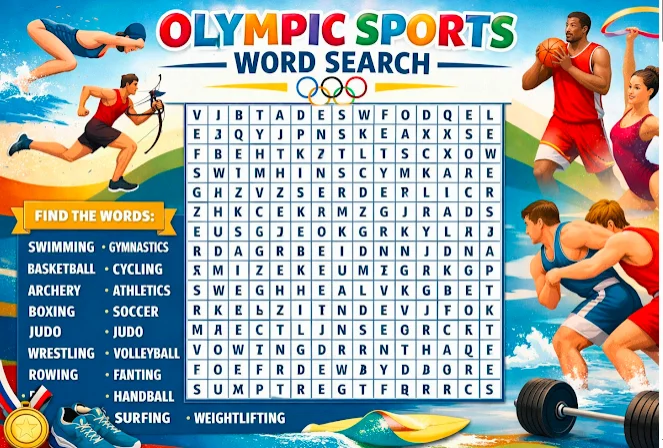
Every four years, billions of people around the world tune in to witness the greatest gathering of human athletic achievement on the planet. The Olympic Games bring together thousands of athletes from over 200 nations, competing across dozens of sports that span centuries of tradition and cutting-edge innovation. But what if you could bring that Olympic energy into your living room, classroom, or community center through the simple yet deeply rewarding activity of an Olympic sports word search? This guide dives deep into what makes Olympic sports word search puzzles so uniquely powerful as both learning tools and recreational activities and how you can get the most out of every grid you pick up.
What Exactly Is an Olympic Sports Word Search?
At its core, a word search puzzle is a rectangular grid of letters packed with hidden words. The solver's job is to locate every word on a given list by scanning the grid horizontally, vertically, diagonally, and sometimes even backwards. When the theme is the Olympic Games, the hidden vocabulary transforms into a curated journey through athletic history. Words like DECATHLON, VELODROME, POMMEL, BIATHLON, EPEE, and LUGE are not just letters arranged cleverly in a grid they are doorways into entire worlds of sport, culture, and human ambition.
- The Ultimate Guide to Learning, Playing, and Winning Olympic Sports Word Search
- What Exactly Is an Olympic Sports Word Search?
- A Brief History of the Sports Featured in Olympic Word Searches
- Puzzles:
- The Science Behind Why Word Searches Work So Well for Learning
- Key Olympic Terms You'll Find in Every Puzzle Decoding the Vocabulary
- Athletic Disciplines and Events
- Venues and Infrastructure
- Olympic Ceremony and Values
- How to Design an Effective Olympic Sports Word Search
- Integrating Olympic Word Searches Into Classroom Curriculum
- Olympic Sports Word Searches for Different Age Groups and Skill Levels
- Tips and Strategies for Solving Olympic Sports Word Searches Faster
- The Cultural and Global Perspective in Olympic Word Searches
- Conclusion: Small Grid, Big World
An Olympic sports word search takes this familiar format and elevates it by connecting every solved word to a real athletic discipline, venue, governing body, or milestone. The moment a young solver circles the word PENTATHLON, a question naturally follows: what is a pentathlon? That curiosity is the magic ingredient that transforms a simple puzzle into a genuine learning experience. Unlike rote memorization or traditional vocabulary drills, word searches embed new terms in a context of active discovery. The brain's reward system fires when a hidden word is found, and the positive emotion helps cement the new knowledge in long-term memory.
A Brief History of the Sports Featured in Olympic Word Searches
To truly appreciate an Olympic sports word search, it helps to understand the remarkable timeline of the sports themselves. The ancient Olympic Games, held at Olympia in Greece from around 776 BCE until 393 CE, featured events tied directly to military and survival skills: foot races, discus throwing, javelin hurling, wrestling, and chariot racing. When Baron Pierre de Coubertin revived the games for the modern era in Athens in 1896, he included athletics, cycling, fencing, gymnastics, shooting, swimming, tennis, weightlifting, and wrestling a thoughtful blend of ancient tradition and contemporary sport.
Over the following 130 years, the Olympic program expanded dramatically. Rowing, sailing, and boxing joined early on. The winter program was separated into its own Games in 1924, eventually adding events like alpine skiing, ski jumping, speed skating, luge, bobsled, curling, and ice hockey. In recent decades, the International Olympic Committee has actively courted younger audiences by adding skateboarding, sport climbing, surfing, BMX freestyle, and breaking a move that reflects a genuine commitment to keeping the Games culturally relevant. When you pick up an Olympic word search puzzle today, the words hidden in the grid tell this entire story of athletic evolution across millennia.
Puzzles:
-
Esports Terms Word Search
-
Minecraft Terms Word Search
-
Web Development Word Search
-
Water Sports Word Search
The Science Behind Why Word Searches Work So Well for Learning
Cognitive scientists and educators have long studied why puzzle-based learning outperforms many traditional instructional approaches. The answer lies in what researchers call the generation effect: information that we actively produce or discover ourselves is retained far better than information we passively receive. When a student scans a grid and identifies the word DRESSAGE among a sea of random letters, that moment of recognition is self-generated. The brain processes it differently from simply reading a list of equestrian sports off a whiteboard.
Additionally, word searches engage multiple cognitive processes simultaneously. Visual scanning activates the occipital lobe, pattern recognition draws on the parietal and frontal lobes, and the conscious effort to match letters to a target word engages working memory. For children still developing reading fluency, the repeated exposure to correctly spelled sports vocabulary within the puzzle strengthens orthographic memory the brain's internal dictionary of how words look. For adults, the sustained focus required to complete a challenging grid provides a form of mindful attention that research links to reduced stress hormones.
There is also a social dimension worth noting. Olympic sports word searches work beautifully as group activities. When families tackle a puzzle together during an Olympic broadcast, the conversation that erupts "Wait, what IS the modern pentathlon?" or "Did you know curling started in Scotland?" creates what educators call elaborative interrogation, a deep processing strategy proven to enhance memory. Shared discovery is inherently more engaging than solo consumption of information.
Key Olympic Terms You'll Find in Every Puzzle Decoding the Vocabulary
Part of what makes Olympic sports word searches so rich is the sheer breadth of vocabulary involved. The Games touch on athletics, equipment, scoring systems, venues, governing structures, and ceremony traditions. Understanding these categories helps you approach any Olympic word search more strategically and get more educational value from the experience.
Athletic Disciplines and Events
The backbone of any Olympic word search is the names of sports themselves. Summer staples include ARCHERY, BADMINTON, BOXING, CANOE, CYCLING, EQUESTRIAN, FENCING, FOOTBALL, GOLF, GYMNASTICS, HANDBALL, HOCKEY, JUDO, KAYAK, MARATHON, ROWING, SAILING, SHOOTING, SOFTBALL, TAEKWONDO, TRIATHLON, VOLLEYBALL, WEIGHTLIFTING, and WRESTLING. Winter editions feature BIATHLON, BOBSLED, CURLING, LUGE, SKELETON, SLALOM, SNOWBOARD, and SPEED SKATING. Beyond the sport names, events within each discipline generate additional vocabulary: EPEE and FOIL in fencing, POMMEL and VAULT in gymnastics, BREASTSTROKE and BUTTERFLY in swimming.
Venues and Infrastructure
Olympic word searches frequently include venue-related vocabulary that connects sport to place. VELODROME (the banked cycling track), VELODROME, AQUATICS CENTER, VELODROME, VÉLODROME, ARENA, STADIUM, VELODROME, and VELODROME appear across many puzzles. Host cities like ATHENS, PARIS, BEIJING, LONDON, TOKYO, and SYDNEY often appear, teaching geography alongside sport. Learning that the word HIPPODROME originally referred to horse racing venues in ancient Greece and that modern Olympic equestrian events still echo that tradition turns a simple word search entry into a mini history lesson.
Olympic Ceremony and Values
Some of the most meaningful words in an Olympic word search relate to the ceremony and philosophy of the Games. OLYMPISM, CITIUS (faster), ALTIUS (higher), FORTIUS (stronger), TORCH, RELAY, CAULDRON, ANTHEM, PODIUM, MEDAL, LAUREL, TRUCE, and SOLIDARITY all carry weight beyond their letters. When a student encounters OLYMPISM in a grid and asks what it means, the answer opens a conversation about the Olympic Charter, fair play, respect, and the idea that sport can build bridges between nations at peace and at war.
How to Design an Effective Olympic Sports Word Search
If you are a teacher, parent, or event organizer who wants to create a custom Olympic sports word search, a few design principles will significantly improve the quality and educational impact of your puzzle. First, define your learning objective before you choose your word list. Are you trying to introduce the Paris 2024 sports program to middle schoolers? Help ESL students build athletic vocabulary? Celebrate a school's Olympic Day event? The answer shapes everything from word selection to grid complexity.
Word length diversity is crucial. A list that consists entirely of short words like SKI, ROW, and BOX will produce a trivially easy puzzle with little educational value. Conversely, a list dominated by very long terms like CROSS-COUNTRY SKIING can make a puzzle frustrating rather than challenging. Aim for a distribution that includes short words (4-5 letters), medium words (6-9 letters), and a handful of longer terms (10+ letters) that serve as signature challenge words. In an Olympic context, WEIGHTLIFTING, SKATEBOARDING, and SYNCHRONIZED make excellent long anchor words.
Grid size should scale with the number of words and the intended audience. A 12x12 grid works well for 10-15 words targeting elementary students. A 20x20 grid can comfortably house 25-35 words for older solvers. Professional puzzle designers recommend a filler density of roughly 60-70% real letters with approximately 30-40% genuine noise enough randomness to make searching genuinely challenging without creating impossible-to-solve configurations. Always include an answer key with any puzzle you distribute, both to support independent learners and to give educators a quick verification tool.
Integrating Olympic Word Searches Into Classroom Curriculum
The most effective use of an Olympic sports word search in an educational setting is not as a standalone activity but as one component of a broader thematic unit. Consider a three-phase approach that moves from activation to acquisition to application. In the activation phase, students complete the word search before any formal instruction about the Olympic Games. This primes their curiosity they encounter words they do not yet know, which creates a mental hook for new information. Research on pre-exposure and learning shows that encountering vocabulary before formal instruction improves subsequent retention.
In the acquisition phase, use the word list as a reading guide. Assign short informational paragraphs on each sport, organized by continent of origin or by summer vs. winter classification. Students annotate their paragraphs, looking for connections between what they found in the puzzle and the information they are now reading. This cross-referencing deepens semantic processing the words are no longer just isolated targets but nodes in a growing network of athletic knowledge.
In the application phase, students demonstrate understanding through creative output. They might write a sports profile of one Olympic discipline that appeared in their word search, create their own mini word search for a classmate to solve, or design an imaginary five-sport Olympic program for a fictional country and explain their choices. These activities move knowledge from passive recognition to active production, the highest level of Bloom's Taxonomy and the stage most predictive of long-term retention and real-world transfer.
Olympic Sports Word Searches for Different Age Groups and Skill Levels
One of the most appealing characteristics of the word search format is its inherent scalability. A well-designed Olympic sports word search can be calibrated for virtually any audience simply by adjusting grid size, word length, directional complexity, and thematic depth.
For children ages 6-9, keep grids small (10x10 or 12x12), use words of four to six letters, and limit directions to horizontal and vertical only. Sport names at this level might include SWIM, JUMP, RACE, GOLF, JUDO, BIKE, SAIL, and SKATE. Pairing each found word with a simple illustration of the sport reinforces comprehension and makes the activity more visually engaging for early readers.
For tweens and teenagers, introduce diagonal and backward words, expand the grid to 15x15 or 18x18, and build vocabulary around full sport names and related terms. DECATHLON, VELODROME, POMMEL, BIATHLON, and EQUESTRIAN are appropriately challenging. At this level, adding a research challenge asking students to look up the country of origin for each sport they find transforms the puzzle into a geography and cultural studies exercise.
For adults, the most engaging Olympic word searches go beyond sport names to include athlete nicknames, technical terminology, host city names, and record-setting years. A puzzle might hide NADIA (as in Romanian gymnastics legend Nadia Comaneci), FOSBURY (the American high jumper who invented the Fosbury Flop technique), and ANQUETIL alongside more conventional entries like MARATHON and HAMMER THROW. These historically rich puzzles reward deep Olympic knowledge and motivate further reading to fill in any gaps.
Tips and Strategies for Solving Olympic Sports Word Searches Faster
Even experienced puzzle solvers can pick up new techniques that reduce solve time and increase satisfaction. The most effective strategy is to tackle long words first. In an Olympic grid, WEIGHTLIFTING, SYNCHRONIZED, or STEEPLECHASE will be easier to locate than a three-letter word like SKI because longer words occupy more of the grid and intersect with more other letters, creating recognizable patterns. Experienced solvers scan for the first letter of a long word and then immediately look in all eight directions for the second letter, quickly narrowing possibilities.
Another powerful technique is to scan for distinctive letter combinations. In Olympic vocabulary, the sequence THL appears in ATHLETICS and TRIATHLON, QU appears in EQUESTRIAN, and XY appears in BOXING. Training your eye to spot these clusters can dramatically speed up search time, especially in large grids. Finally, marking off words as you find them and crossing them off the list simultaneously prevents duplicate searching and gives you a clear sense of progress important for maintaining motivation through a long, complex puzzle.
The Cultural and Global Perspective in Olympic Word Searches
Perhaps the most underappreciated dimension of Olympic sports word searches is their capacity to build genuine cross-cultural understanding. Many Olympic sports carry deep cultural histories that the puzzle format can introduce in a low-pressure, exploratory way. TAEKWONDO originated in Korea and became an Olympic sport in 2000. JUDO was founded in Japan by Jigoro Kano in 1882 and has been on the Olympic program since 1964. WRESTLING traces a continuous competitive lineage back to the ancient Olympic Games. FENCING evolved from European sword fighting traditions. Each of these words, encountered in a grid, is an invitation to explore a different corner of human history.
For educators working with diverse classrooms, this cultural dimension is invaluable. Students from Korean, Japanese, or European backgrounds may light up when they find sports rooted in their heritage. This recognition fosters pride and validates cultural identity within the shared framework of Olympic sports. Meanwhile, students from other backgrounds gain genuine exposure to traditions different from their own not through a lecture but through the pleasurable act of discovery in a puzzle grid.
Conclusion: Small Grid, Big World
An Olympic sports word search may look like a simple grid of letters, but it contains multitudes. Within those rows and columns lies a compressed version of human athletic history spanning thousands of years and every corner of the globe. Every word hidden in the grid is a story waiting to be told of ancient Greek champions, Japanese judo masters, Norwegian cross-country skiers, Jamaican sprinters, and Brazilian volleyball players who all share the same Olympic dream.
Whether you are a teacher building a curriculum unit around the Games, a parent looking for an engaging screen-free activity, a puzzle enthusiast seeking your next challenge, or simply a sports fan who wants to deepen your knowledge of the world's most diverse athletic competition, an Olympic sports word search offers something rare: a place where fun and learning are genuinely the same thing. Find your next puzzle, sharpen your pencil, and start exploring the Olympic Games are hiding in plain sight, one letter at a time.