The Renaissance Word Search
Click and drag to select words
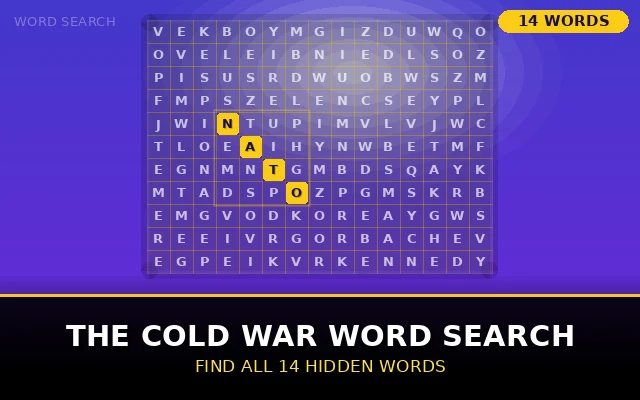
Track down 14 words connected to the decades long standoff between superpowers, ...
Play Now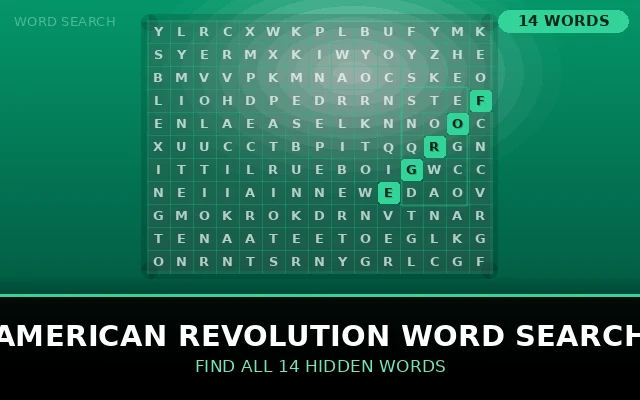
Play the free American Revolution word search puzzle featuring founding fathers,...
Play Now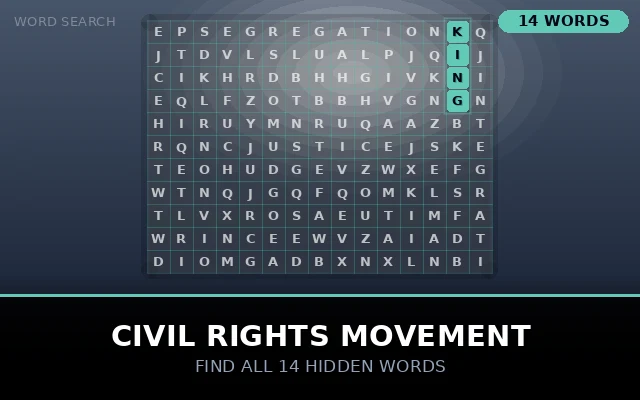
Find 14 key terms tied to the fight for equality in America, including names, ev...
Play NowUncover 14 words tied to the rebirth of art, science, and culture in Europe, featuring names and terms linked to the Renaissance period, ideal for art lovers and history students exploring this golden age.
Track down 14 words connected to the decades long standoff between superpowers, covering terms like NATO, Berlin Wall, and Nuclear, and giving solvers a quick grasp of Cold War era tension and politics.
Play Now
Play the free American Revolution word search puzzle featuring founding fathers, key battles, and revolutionary ideals. Perfect for students, teachers, and history fans.
Play Now
Find 14 key terms tied to the fight for equality in America, including names, events, and ideals from the Civil Rights Movement, offering a meaningful way to learn about a defining chapter in US history.
Play NowThe Renaissance Word Search Guides & Articles
The Renaissance Word Search: Rediscover the Age of Art, Science, and Genius
Introduction: Entering the Age of Rebirth
The Renaissance word search puzzle invites players to step into one of the most transformative periods in Western history an era of extraordinary artistic achievement, scientific discovery, and intellectual awakening. Featuring eight words connected to this remarkable age, this renaissance puzzle in It wordsearch offers an engaging way to explore the ideas and personalities that reshaped European civilization between the 14th and 17th centuries.
This article explores the historical context of the Renaissance, examines the significance of the vocabulary featured in the puzzle, and explains why this renaissance history word search continues to be a favorite among students and history enthusiasts.
Understanding the Renaissance: A Cultural Rebirth
The term "Renaissance," derived from the French word for "rebirth," describes the period of renewed interest in classical Greek and Roman learning, art, and philosophy that emerged in Italy during the 14th century before spreading across Europe. This cultural movement marked a dramatic shift away from the religious focus of the medieval period toward a new emphasis on humanism, individual achievement, and the exploration of the natural world.
The Birthplace: Renaissance Italy
The Renaissance began in the wealthy city-states of Italy, particularly Florence, which became the epicenter of this cultural explosion thanks to the patronage of powerful families like the Medici. Florence's wealth, generated through banking and trade, allowed prominent families to sponsor artists, architects, and scholars on an unprecedented scale, creating the conditions for a flourishing of creative and intellectual achievement. Other Italian cities, including Rome, Venice, and Milan, also became important centers of Renaissance culture, each developing distinct artistic and intellectual traditions.
Humanism and the New Worldview
At the philosophical core of the Renaissance was humanism, an intellectual movement that emphasized the value and potential of human beings, drawing inspiration from classical texts rediscovered from ancient Greece and Rome. Humanist scholars studied subjects like rhetoric, poetry, history, and moral philosophy, believing that education and reason could improve both individuals and society. This shift in worldview encouraged a spirit of inquiry and creativity that permeated every aspect of Renaissance culture, from art to science to politics.
Leonardo da Vinci: The Ultimate Renaissance Man
No figure better embodies the spirit of the Renaissance than Leonardo da Vinci, whose insatiable curiosity spanned painting, engineering, anatomy, botany, and countless other fields. Da Vinci's masterpieces, including the Mona Lisa and The Last Supper, remain among the most celebrated artworks in human history, admired for their technical brilliance and psychological depth. Beyond painting, da Vinci filled notebooks with detailed sketches of flying machines, anatomical studies, and engineering concepts centuries ahead of their time, earning him the enduring title of the quintessential "Renaissance man." His name is so closely associated with this era that leonardo da vinci word search puzzles have become a popular way to introduce students to his remarkable legacy.
Michelangelo and the Sistine Chapel
Michelangelo Buonarroti stands alongside da Vinci as one of the greatest artists of the Renaissance, celebrated for masterpieces like the statue of David and the ceiling of the Sistine Chapel. His work exemplified the Renaissance ideal of combining technical mastery with profound emotional and spiritual depth, and his influence on Western art continues to resonate centuries later. Michelangelo's dedication to anatomical accuracy, informed by his own studies of the human body, reflected the broader Renaissance emphasis on empirical observation and scientific inquiry.
The Printing Press and the Spread of Knowledge
One of the most consequential inventions of the Renaissance era was Johannes Gutenberg's printing press, developed around 1440. This revolutionary technology dramatically reduced the cost of producing books, allowing ideas to spread faster and further than ever before. The printing press played a crucial role in disseminating humanist ideas, scientific discoveries, and eventually the religious ideas that would fuel the Protestant Reformation, fundamentally transforming how knowledge was shared and preserved.
Scientific Discovery and the Renaissance
The Renaissance also witnessed remarkable advances in scientific understanding, as thinkers began to question long-held assumptions about the natural world. Nicolaus Copernicus proposed a heliocentric model of the solar system, challenging the long-accepted belief that the Earth stood at the center of the universe. Later, Galileo Galilei used telescopic observation to provide evidence supporting Copernicus's theories, though his findings brought him into direct conflict with the Catholic Church. These scientific breakthroughs laid the groundwork for the Scientific Revolution that would follow in subsequent centuries.
Renaissance Art and Techniques
Renaissance artists developed revolutionary techniques that transformed the visual arts, including linear perspective, which created convincing illusions of three-dimensional space on flat surfaces, and chiaroscuro, the dramatic use of light and shadow to create depth and volume. These technical innovations, combined with a renewed focus on realistic human anatomy and classical subject matter, produced some of the most enduring masterpieces in art history.
Architecture and the Classical Revival
Renaissance architecture drew heavily on classical Greek and Roman principles, favoring symmetry, proportion, and geometric harmony over the ornate Gothic styles that dominated the medieval period. Architects like Filippo Brunelleschi, who designed the magnificent dome of Florence Cathedral, demonstrated how classical principles could be combined with innovative engineering to create structures of unprecedented scale and beauty.
Why Renaissance Vocabulary Matters for Students
Understanding renaissance vocabulary provides students with essential context for interpreting art, literature, and scientific developments that continue to shape Western culture today.
Connecting Art and History: Learning terms associated with Renaissance art helps students appreciate the technical and cultural significance of masterpieces they encounter in museums, textbooks, and popular culture.
Understanding the Roots of Modern Science: Many foundational scientific concepts trace their origins to Renaissance thinkers who challenged medieval assumptions about the natural world.
Appreciating Cultural Achievement: Studying the Renaissance helps students understand how periods of economic prosperity and intellectual freedom can produce extraordinary bursts of creative and scientific achievement.
Building Cross-Disciplinary Knowledge: Renaissance history naturally connects to art, science, philosophy, and religion, making this renaissance art word search a valuable tool for interdisciplinary learning.
Tips for Solving the Renaissance Word Search
To maximize your enjoyment of this renaissance puzzle, try these strategies:
- Review the word list first — Familiarizing yourself with all eight words before starting helps your brain recognize patterns more efficiently.
- Focus on distinctive names — Names like "Medici" or "humanism" often have unique letter patterns that make them easier to locate.
- Scan systematically — Move through the grid in a consistent direction to avoid missing hidden words.
- Take your time with longer words — Longer terms may span more of the grid, so give yourself extra time to trace their full length.
The Enduring Appeal of Renaissance-Themed Puzzles
The Renaissance continues to captivate modern audiences through museum exhibitions, documentaries, and popular culture, making educational word search puzzles on this topic especially appealing. This broad interest ensures that a renaissance history word search resonates with:
- Students studying European history, art history, or world civilizations
- Teachers planning lessons on the Renaissance period or Renaissance art
- Art enthusiasts who want to deepen their knowledge of famous masterpieces and artists
- Homeschool families covering European cultural history
- Adults and seniors who enjoy history-themed brain games and trivia
Extending Your Renaissance Learning Journey
After completing the puzzle, consider exploring related topics such as the works of Raphael, the political philosophy of Machiavelli's The Prince, or the broader impact of the Protestant Reformation, which emerged partly as a response to the intellectual currents unleashed by Renaissance humanism. These topics provide natural extensions of the vocabulary and concepts introduced in the word search.
Conclusion
The Renaissance word search puzzle offers a captivating gateway into one of history's most extraordinary periods of artistic and intellectual achievement. From the genius of Leonardo da Vinci to the scientific breakthroughs of Copernicus and Galileo, this renaissance word search helps players engage meaningfully with the ideas and personalities that defined an age of rebirth and discovery. Whether you're a student, art lover, or history enthusiast, this puzzle offers an enjoyable and educational journey through one of the most influential eras in human history.
Target Keywords: renaissance word search, renaissance puzzle, renaissance history word search, renaissance art word search, free word search puzzles, history word search for kids, leonardo da vinci word search, educational word search puzzles, renaissance vocabulary, european history puzzle, word search game online, renaissance artists