World War I Word Search
Click and drag to select words
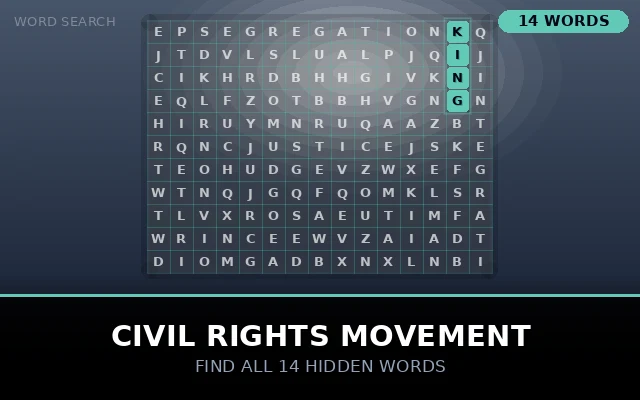
Find 14 key terms tied to the fight for equality in America, including names, ev...
Play Now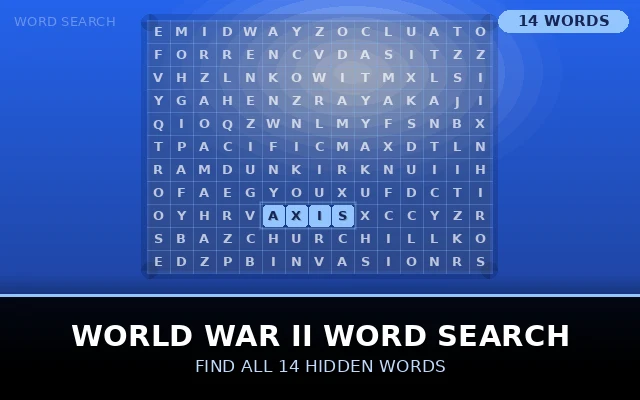
Play the free World War II word search puzzle featuring key battles, leaders, an...
Play Now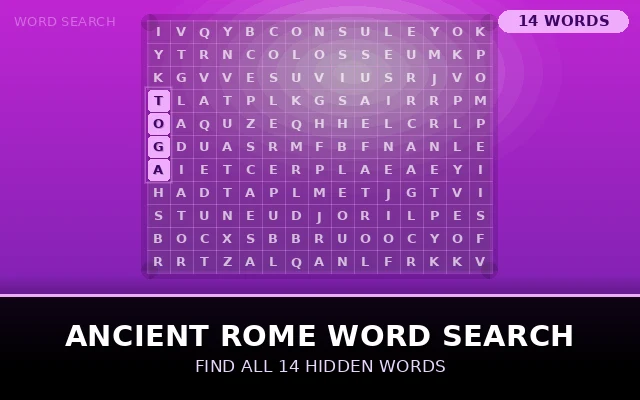
Play the free Ancient Rome word search puzzle featuring emperors, gladiators, an...
Play NowPlay the free World War I word search puzzle featuring key terms, battles, and figures from the Great War. A perfect educational resource for students and history fans.
Find 14 key terms tied to the fight for equality in America, including names, events, and ideals from the Civil Rights Movement, offering a meaningful way to learn about a defining chapter in US history.
Play Now
Play the free World War II word search puzzle featuring key battles, leaders, and events from history's largest conflict. Ideal for students, teachers, and history enthusiasts.
Play Now
Play the free Ancient Rome word search puzzle featuring emperors, gladiators, and the Roman Empire. A fun, educational puzzle for students, teachers, and history lovers.
Play NowWorld War I Word Search Guides & Articles
World War I Word Search: Explore the Great War Through an Educational Puzzle
Introduction: Remembering the Great War
The World War 1 word search puzzle offers an engaging way to explore one of the most transformative conflicts in modern history. Featuring 14 words connected to the events, technology, and consequences of the First World War, this wwi word search puzzle helps students, teachers, and history enthusiasts deepen their understanding of a conflict that reshaped the political map of the world and set the stage for many of the 20th century's greatest challenges.
This article examines the historical background of World War I, explores the vocabulary featured in the puzzle, and explains why this great war word search remains such a valuable educational tool.
Understanding World War I: The War to End All Wars
World War I, often called the Great War before the outbreak of World War II, It wordsearch lasted from 1914 to 1918 and involved the majority of the world's great powers, organized into two opposing alliances: the Allied Powers, including France, Britain, Russia, and later the United States, and the Central Powers, led by Germany and Austria-Hungary. The conflict resulted in unprecedented casualties, reshaped international borders, and fundamentally altered the course of 20th-century history.
The Spark: Assassination in Sarajevo
The immediate trigger for World War I was the assassination of Archduke Franz Ferdinand of Austria-Hungary by Gavrilo Princip, a Serbian nationalist, in Sarajevo on June 28, 1914. This single event set off a rapid chain reaction of diplomatic ultimatums and military mobilizations, as a complex web of alliances pulled one European power after another into the conflict. Within weeks, a regional crisis in the Balkans had escalated into a continent-wide war, demonstrating how fragile the balance of European diplomacy had become by the early 20th century.
The Alliance System and Total War
World War I was shaped by an intricate system of alliances that had developed across Europe in the decades before the war. When Austria-Hungary declared war on Serbia following the assassination, Russia mobilized to defend its Serbian ally, prompting Germany to declare war on Russia and France. This chain reaction quickly drew in Britain, which entered the war after Germany invaded neutral Belgium. The scale of mobilization and the involvement of entire national populations in the war effort marked World War I as one of history's first examples of "total war," in which the resources and manpower of entire societies were directed toward the war effort.
Trench Warfare and the Western Front
Perhaps no aspect of World War I is more iconic than trench warfare, which came to define the brutal stalemate of the Western Front. Soldiers on both sides dug extensive networks of trenches stretching from the North Sea to the Swiss border, creating a landscape of mud, barbed wire, and constant danger. The area between opposing trenches, known as "no man's land," became a killing field where advances often came at horrific human cost for minimal territorial gain. This grueling form of warfare came to symbolize the futility and suffering that characterized much of the conflict, and terms like "trenches" remain central to any study of the war.
New Technologies of Destruction
World War I introduced devastating new military technologies that dramatically increased the scale of casualties. Machine guns allowed defenders to mow down advancing troops with terrifying efficiency, while poison gas attacks introduced a horrifying new dimension of chemical warfare that left lasting psychological and physical scars on survivors. Tanks made their combat debut during this war, offering a potential solution to the stalemate of trench warfare, while airplanes, initially used for reconnaissance, gradually evolved into weapons of aerial combat. These technological innovations transformed the nature of warfare and contributed to the war's staggering casualty figures.
The Eastern Front and Global Scope
While the Western Front often dominates popular memory of World War I, the conflict also raged across the Eastern Front, where Russian forces battled the Central Powers across a vast and shifting battle line. The war's global scope extended beyond Europe as well, with fighting occurring in the Middle East, Africa, and various colonial territories, as European powers drew on resources and manpower from their overseas empires. This global dimension of the conflict underscores why World War I is sometimes considered the first truly global war in modern history.
The United States Enters the War
The United States initially maintained a policy of neutrality, but a combination of factors, including unrestricted German submarine warfare and the interception of the Zimmermann Telegram, in which Germany proposed a military alliance with Mexico against the United States, ultimately led President Woodrow Wilson to request a declaration of war in April 1917. American entry into the conflict provided crucial fresh troops and resources to the exhausted Allied forces, playing a significant role in tipping the balance toward eventual Allied victory.
The Armistice and the Treaty of Versailles
World War I officially ended with the signing of an armistice on November 11, 1918, though the formal peace settlement came with the Treaty of Versailles in 1919. This treaty imposed harsh terms on defeated Germany, including significant territorial losses, military restrictions, and substantial reparations payments. Many historians argue that the punitive terms of the Versailles settlement, combined with widespread economic hardship, created conditions that contributed to the rise of extremist political movements in Germany, ultimately setting the stage for the outbreak of World War II two decades later.
Why WWI Vocabulary Matters in Education
Understanding wwi vocabulary provides students with essential context for interpreting 20th-century history, literature, and international relations.
Understanding Modern Geopolitics: Many contemporary national borders and international tensions trace their origins to decisions made during and immediately after World War I.
Appreciating Literary and Cultural Impact: World War I profoundly influenced literature and art, inspiring works like Erich Maria Remarque's All Quiet on the Western Front and the poetry of Wilfred Owen, making this vocabulary essential for literary studies as well.
Building Historical Empathy: Learning about the immense human cost of the war helps students develop a deeper appreciation for the sacrifices made by soldiers and civilians during this devastating conflict.
Connecting Cause and Effect: Studying World War I helps students understand how complex alliance systems and unresolved grievances can escalate into large-scale conflict, a lesson with enduring relevance to international relations.
Strategies for Solving This WWI Word Search Puzzle
To make the most of this world war one history puzzle, try these techniques:
- Study the word list beforehand — Familiarizing yourself with all 14 words before beginning helps you recognize patterns more efficiently while scanning.
- Look for military and geographic terms — Words related to specific battles, technologies, or locations often have distinctive letter combinations.
- Scan the grid systematically — Work through the puzzle in a consistent pattern, whether row by row or in sections, to ensure thorough coverage.
- Research unfamiliar terms afterward — Use any unfamiliar words as a starting point for further historical research.
The Broader Educational Value of History Puzzles
History word search for kids and adults alike serve an important function beyond entertainment. By engaging with educational word search puzzles covering significant historical events, players reinforce their knowledge while developing valuable cognitive skills like pattern recognition and sustained concentration. This makes puzzles like the World War I word search particularly valuable for:
- Middle and high school students studying 20th-century world history
- Teachers planning lessons around Remembrance Day, Armistice Day, or World War I history units
- History enthusiasts interested in military history and geopolitics
- Homeschool families covering major 20th-century conflicts
- Adults and seniors who enjoy trivia and history-themed brain games
Extending Your Knowledge of World War I
After completing this puzzle, consider exploring related topics such as the role of women on the home front, the experiences of colonial troops who fought for European powers, or the influenza pandemic that struck in the war's final year, compounding the devastation of the conflict itself. These subjects offer rich opportunities for continued learning beyond the puzzle.
Conclusion
The World War I word search puzzle offers a meaningful way to engage with one of history's most consequential conflicts. From the horrors of trench warfare to the complex web of alliances that triggered the war, this world war 1 word search helps players build a deeper understanding of the events that reshaped the 20th-century world. Whether used in the classroom or enjoyed as a personal educational challenge, this puzzle honors the historical significance of the Great War while providing an engaging and accessible learning experience.
Target Keywords: world war 1 word search, wwi word search puzzle, great war word search, world war one history puzzle, free word search puzzles, history word search for kids, trench warfare word search, educational word search puzzles, wwi vocabulary, 20th century history puzzle, word search game online, world war one facts