Famous Explorers Word Search
Click and drag to select words
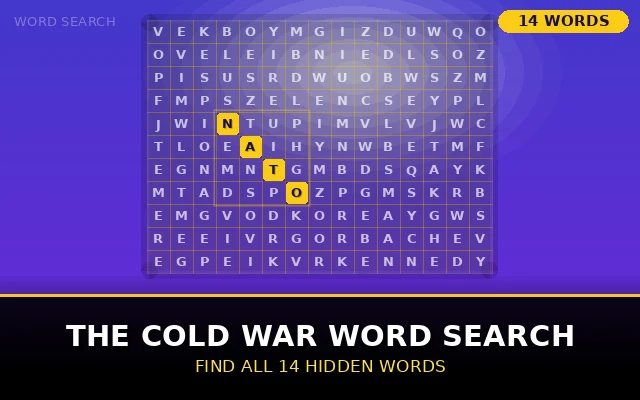
Track down 14 words connected to the decades long standoff between superpowers, ...
Play Now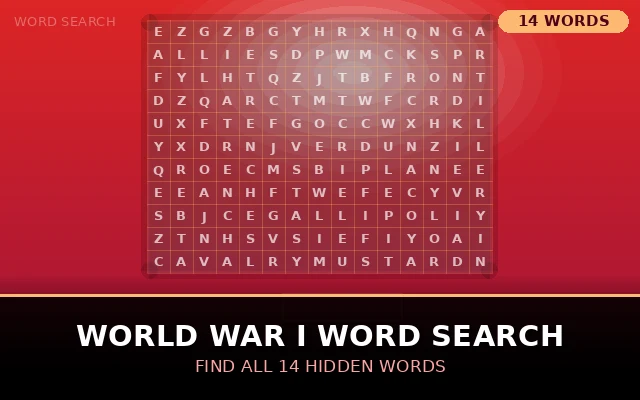
Play the free World War I word search puzzle featuring key terms, battles, and f...
Play Now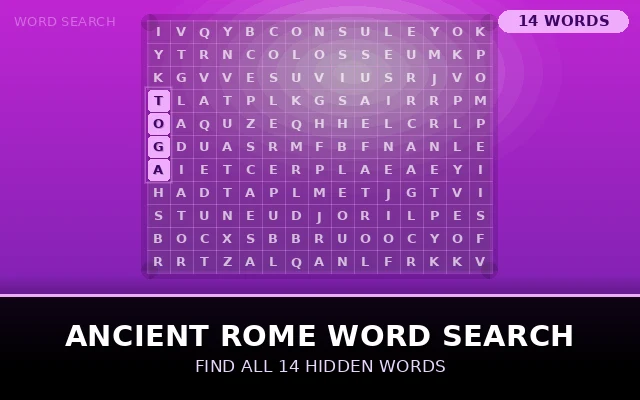
Play the free Ancient Rome word search puzzle featuring emperors, gladiators, an...
Play NowPlay the free Famous Explorers word search puzzle featuring legendary voyagers who charted the unknown world. Perfect for students, teachers, and history enthusiasts.
Track down 14 words connected to the decades long standoff between superpowers, covering terms like NATO, Berlin Wall, and Nuclear, and giving solvers a quick grasp of Cold War era tension and politics.
Play Now
Play the free World War I word search puzzle featuring key terms, battles, and figures from the Great War. A perfect educational resource for students and history fans.
Play Now
Play the free Ancient Rome word search puzzle featuring emperors, gladiators, and the Roman Empire. A fun, educational puzzle for students, teachers, and history lovers.
Play NowFamous Explorers Word Search Guides & Articles
Famous Explorers Word Search: Chart a Course Through the Age of Discovery
Introduction: Setting Sail Into History
The Famous Explorers word search puzzle invites players to embark on a journey through one of history's most transformative periods: the Age of Discovery. Featuring nine words connected to legendary voyagers who charted unknown seas, discovered new lands, and reshaped humanity's understanding of the world, this explorers word search puzzle offers students, teachers, and history enthusiasts an engaging way to learn about the individuals who expanded the boundaries of human knowledge and connected distant civilizations for the first time.
This article explores the fascinating history of global exploration, examines the vocabulary featured in the puzzle, and explains why this age of discovery word search continues to be a favorite among educators and puzzle lovers alike.
The Age of Discovery: A Transformative Era
The Age of Discovery, also known as the Age of Exploration, refers to the period from the early 15th century through the 17th century It wordsearch when European explorers undertook ambitious sea voyages that connected previously isolated regions of the world. Driven by desires for new trade routes, wealth, religious conversion, and national glory, these expeditions fundamentally reshaped global politics, economics, and cultural exchange, though they also brought devastating consequences for indigenous populations across the Americas, Africa, and Asia.
Christopher Columbus and the Voyage to the Americas
Christopher Columbus remains one of history's most famous and controversial explorers, having led four voyages across the Atlantic Ocean between 1492 and 1504 while searching for a westward route to Asia. Sailing under the sponsorship of the Spanish monarchy, Columbus's arrival in the Caribbean in 1492 marked the beginning of sustained European contact with the Americas, initiating a period of exploration, colonization, and exchange that would permanently transform both hemispheres. While Columbus never realized he had reached an entirely new continent rather than Asia, his voyages opened the door to centuries of European exploration and eventual colonization of the Americas. His significant historical impact explains why christopher columbus word search puzzles remain popular educational tools, even as modern historical scholarship increasingly emphasizes the complex and often tragic consequences of his voyages for indigenous populations.
Vasco da Gama and the Sea Route to India
Portuguese explorer Vasco da Gama achieved a monumental feat in 1498 by becoming the first European to reach India by sea, sailing around the Cape of Good Hope at the southern tip of Africa. This achievement established a direct maritime trade route between Europe and Asia, bypassing the overland routes controlled by Middle Eastern and Central Asian intermediaries. Da Gama's successful voyage helped establish Portugal as a dominant early power in global maritime trade, opening new economic opportunities that would reshape international commerce for centuries.
Ferdinand Magellan and the First Circumnavigation
Ferdinand Magellan's expedition, launched in 1519, achieved one of history's most remarkable feats: the first circumnavigation of the globe. Though Magellan himself was killed in the Philippines before the voyage's completion, his remaining crew successfully returned to Spain in 1522, providing definitive proof that the Earth could be circled by sea and offering crucial evidence supporting the planet's spherical shape. This extraordinary journey, fraught with hardship, mutiny, and tragedy, demonstrated both the immense risks and the transformative potential of oceanic exploration during this era.
Marco Polo and Overland Exploration
Before the Age of Discovery's maritime voyages, Venetian merchant and explorer Marco Polo undertook an extraordinary overland journey to China in the 13th century, spending nearly two decades traveling and living within the Mongol Empire under Kublai Khan. Polo's detailed accounts of his travels, later compiled into a book that captivated European readers, provided some of the first substantial European knowledge of Asian civilizations, geography, and trade practices. His writings inspired generations of subsequent explorers, including Christopher Columbus, who reportedly carried an annotated copy of Polo's travel accounts during his own voyages.
Explorers of the New World's Interior
Beyond the initial coastal voyages, numerous explorers ventured deep into the interior of newly encountered continents. Hernando de Soto led extensive expeditions through the southeastern regions of North America, while Francisco Vázquez de Coronado explored significant portions of the American Southwest in search of legendary golden cities. These interior expeditions, while often driven by mistaken beliefs about vast hidden wealth, contributed significantly to European geographic knowledge of the Americas and established early patterns of contact, conflict, and exchange with indigenous peoples.
Navigation Technology and Exploration
The Age of Discovery was made possible by significant advances in navigation technology and shipbuilding. Improvements to the astrolabe and compass allowed sailors to determine their position and direction with greater accuracy, while new ship designs, particularly the Portuguese caravel, offered improved speed, maneuverability, and capacity for long ocean voyages. These technological innovations, combined with growing geographic knowledge accumulated through successive expeditions, enabled increasingly ambitious voyages into previously unknown waters.
The Columbian Exchange
One of the most significant and far-reaching consequences of the Age of Discovery was the Columbian Exchange, the massive transfer of plants, animals, diseases, and cultures between the Eastern and Western Hemispheres following Columbus's voyages. This exchange introduced crops like potatoes, corn, and tomatoes to Europe, Africa, and Asia, while bringing horses, cattle, and wheat to the Americas. However, the Columbian Exchange also had devastating consequences, as European diseases like smallpox decimated indigenous American populations who had no prior immunity, representing one of history's most tragic demographic catastrophes.
The Legacy of Exploration
The Age of Discovery fundamentally reshaped the modern world, establishing global trade networks, initiating centuries of European colonialism, and creating patterns of cultural exchange and conflict that continue to influence international relations today. While the achievements of these explorers demonstrated remarkable human ingenuity, courage, and determination, modern historical scholarship increasingly emphasizes the complex and often devastating consequences these voyages had for indigenous populations, providing a more nuanced and complete understanding of this pivotal historical era.
Why Exploration History Matters for Students
Understanding world explorers vocabulary provides students with essential context for interpreting the origins of global trade, cultural exchange, and colonialism that continue to shape international relations today.
Understanding Global Interconnection: Studying the Age of Discovery helps students appreciate how exploration fundamentally connected previously isolated regions of the world, creating the foundations of our modern globalized society.
Developing Critical Historical Thinking: Examining the complex legacy of famous explorers encourages students to think critically about how historical narratives can be told from multiple perspectives, including the experiences of indigenous populations.
Connecting Geography and History: Exploration history naturally reinforces geographic knowledge, as students learn about the routes, distances, and challenges involved in these historic voyages.
Building Interdisciplinary Knowledge: The Age of Discovery connects to subjects like science, through navigation technology; economics, through global trade; and biology, through the Columbian Exchange, making this geography history puzzle valuable for cross-curricular learning.
Tips for Solving the Famous Explorers Word Search
To maximize your success with this famous voyages word search, consider these strategies:
- Familiarize yourself with explorer names — Reviewing key figures from the Age of Discovery before starting can help you recognize surnames more quickly.
- Look for distinctive name patterns — Explorer surnames, often of Spanish, Portuguese, or Italian origin, may contain unique letter combinations.
- Search systematically — Work through the grid in a consistent pattern to ensure thorough coverage.
- Connect names to voyages — After finding each name, try to recall a specific achievement associated with that explorer to reinforce your learning.
The Educational Value of Exploration-Themed Puzzles
Educational word search puzzles covering the Age of Discovery serve an important role in helping students understand the origins of our interconnected modern world. A history word search for kids focused on famous explorers makes this pivotal historical era accessible and engaging for younger learners while still offering substantive educational content for older students. This puzzle appeals to:
- Elementary and middle school students studying world history and geography
- Teachers planning units on the Age of Discovery or global exploration
- Homeschool families covering world history curricula
- Geography enthusiasts interested in historical trade routes and navigation
- History buffs fascinated by tales of adventure and discovery
Extending Your Knowledge of Global Exploration
After completing this puzzle, consider exploring related topics such as the voyages of Captain James Cook in the Pacific, the search for the Northwest Passage, or the complex and often tragic history of indigenous encounters with European explorers throughout the Americas. These subjects offer rich opportunities for continued historical exploration and critical thinking.
Conclusion
The Famous Explorers word search puzzle offers an exciting journey through one of history's most transformative eras. From Columbus's voyages across the Atlantic to Magellan's historic circumnavigation of the globe, this famous explorers word search helps players engage meaningfully with the courage, ambition, and consequences that defined the Age of Discovery. Whether you're a student, teacher, or lifelong history enthusiast, this puzzle offers an enjoyable and educational way to explore the voyages that connected our world and shaped the course of global history.
Target Keywords: famous explorers word search, explorers word search puzzle, age of discovery word search, exploration history puzzle, free word search puzzles, history word search for kids, christopher columbus word search, educational word search puzzles, world explorers vocabulary, geography history puzzle, word search game online, famous voyages word search