The Cold War Word Search
Click and drag to select words
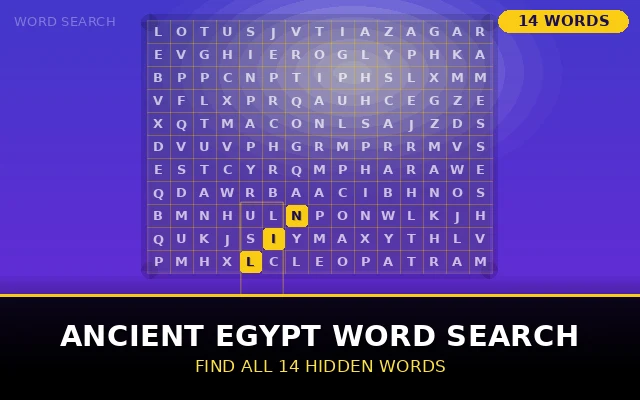
Play the free Ancient Egypt word search puzzle featuring pyramids, pharaohs, and...
Play Now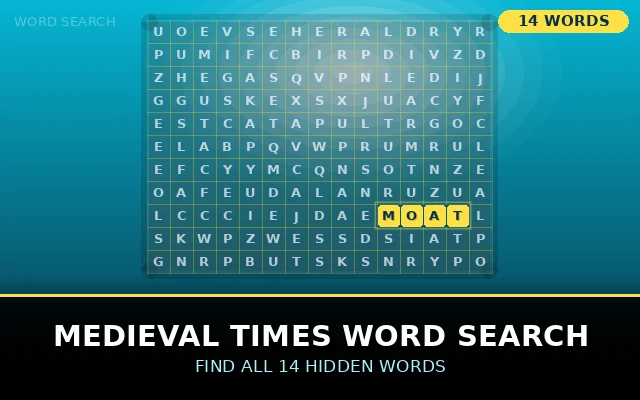
Explore the age of knights, castles, and kingdoms with this 14 word puzzle featu...
Play Now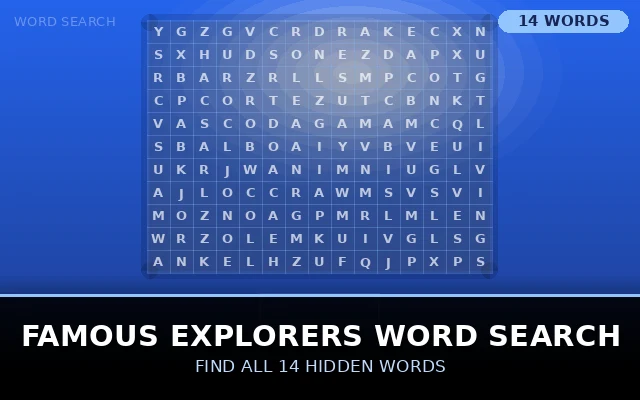
Play the free Famous Explorers word search puzzle featuring legendary voyagers w...
Play NowTrack down 14 words connected to the decades long standoff between superpowers, covering terms like NATO, Berlin Wall, and Nuclear, and giving solvers a quick grasp of Cold War era tension and politics.
Play the free Ancient Egypt word search puzzle featuring pyramids, pharaohs, and mummies. A fun, educational history puzzle for students, teachers, and puzzle lovers.
Play Now
Explore the age of knights, castles, and kingdoms with this 14 word puzzle featuring terms like Knight, Castle, Crusade, and Feudalism, perfect for anyone curious about medieval Europe and its traditions.
Play Now
Play the free Famous Explorers word search puzzle featuring legendary voyagers who charted the unknown world. Perfect for students, teachers, and history enthusiasts.
Play NowThe Cold War Word Search Guides & Articles
The Cold War Word Search: Explore Decades of Global Tension and Rivalry
Introduction: Reliving the Tension of the Cold War Era
The Cold War word search puzzle offers a compelling way to explore one of the most consequential geopolitical rivalries in modern history. Featuring ten words connected to the decades-long standoff between the United States and the Soviet Union, this cold war puzzle helps students, history enthusiasts, and puzzle lovers engage with the ideological, military, and cultural tensions that defined global politics from the end of World War II until the early 1990s.
In this article, we'll unpack the history behind the Cold War, explore the meaning of key vocabulary featured in the puzzle, and explain why this cold war history word search It wordsearch serves as such a valuable educational resource.
What Was the Cold War?
The Cold War refers to the prolonged period of political and military tension between the United States and its allies, representing capitalism and democracy, and the Soviet Union and its allies, representing communism. Despite the name, the Cold War never erupted into direct large-scale military conflict between the two superpowers. Instead, it was characterized by proxy wars, espionage, propaganda campaigns, and an unprecedented arms race that brought the world dangerously close to nuclear catastrophe on multiple occasions.
The Origins of the Conflict
The roots of the Cold War trace back to the closing months of World War II, as the wartime alliance between the United States, Britain, and the Soviet Union began to unravel over disagreements about the postwar order in Europe. As Soviet forces occupied much of Eastern Europe, installing communist governments in countries like Poland, Hungary, and East Germany, Western leaders grew increasingly alarmed about Soviet expansionism. Winston Churchill's famous 1946 "Iron Curtain" speech captured the growing divide, describing the ideological and physical barrier separating communist Eastern Europe from the democratic West.
The Iron Curtain and Divided Germany
Perhaps no symbol better represents the Cold War than the Berlin Wall, constructed in 1961 to physically divide East and West Berlin. This concrete barrier, patrolled by armed guards, became the most visible manifestation of the broader "Iron Curtain" dividing communist and democratic Europe. Families were separated, and the wall stood as a stark reminder of the ideological chasm between the two superpowers until its dramatic fall in 1989, an event widely seen as symbolizing the beginning of the end of the Cold War.
The Nuclear Arms Race
One of the defining features of the Cold War was the unprecedented arms race between the United States and the Soviet Union. Both superpowers raced to develop increasingly powerful nuclear weapons, resulting in arsenals capable of destroying human civilization many times over. This concept, known as "mutually assured destruction," paradoxically helped prevent direct conflict between the two nations, as any nuclear attack would guarantee catastrophic retaliation. The nuclear arms race also spurred technological innovation, contributing to advances in rocketry, computing, and materials science that had far-reaching effects beyond military applications.
The Cuban Missile Crisis
In October 1962, the Cold War reached its most dangerous point during the Cuban Missile Crisis, when American reconnaissance discovered Soviet nuclear missiles being installed in Cuba, just 90 miles from the United States coastline. For thirteen tense days, the world stood on the brink of nuclear war as President John F. Kennedy and Soviet Premier Nikita Khrushchev negotiated a resolution. The crisis was ultimately resolved through diplomatic backchannels, with the Soviets agreeing to remove the missiles in exchange for a secret U.S. commitment to remove missiles from Turkey. This event remains one of the most studied episodes in Cold War history, illustrating both the dangers and the possibilities of superpower diplomacy.
The Space Race
Cold War competition extended beyond military and political spheres into space exploration. The launch of the Soviet satellite Sputnik in 1957 shocked the American public and government, sparking fears that the Soviets had gained a decisive technological advantage. This anxiety fueled massive American investment in science and technology education, ultimately leading to the establishment of NASA and the eventual Apollo 11 moon landing in 1969, when American astronauts became the first humans to walk on the lunar surface. The Space Race demonstrated how Cold War rivalry extended into virtually every domain of scientific and technological achievement.
Proxy Wars and Global Conflicts
Rather than fighting each other directly, the United States and Soviet Union frequently supported opposing sides in regional conflicts around the world, turning local disputes into extensions of the broader superpower rivalry. The Korean War, the Vietnam War, and various conflicts in Africa, Latin America, and the Middle East were all shaped by Cold War dynamics, as each superpower sought to expand its sphere of influence while limiting the other's reach. These proxy wars resulted in significant loss of life and long-lasting geopolitical consequences that continue to shape international relations today.
Espionage and Intelligence Operations
The Cold War also gave rise to an era of unprecedented espionage activity, as intelligence agencies like the American CIA and Soviet KGB conducted covert operations, gathered intelligence, and occasionally engaged in high-stakes spy exchanges. This period inspired countless works of fiction, from James Bond films to John le Carré novels, reflecting public fascination with the secretive world of Cold War intelligence gathering.
The End of the Cold War
The Cold War gradually wound down in the late 1980s as Soviet leader Mikhail Gorbachev introduced reforms known as glasnost (openness) and perestroika (restructuring), which inadvertently accelerated the collapse of Soviet influence in Eastern Europe. The fall of the Berlin Wall in 1989 and the eventual dissolution of the Soviet Union in 1991 marked the definitive end of the Cold War, reshaping the global political landscape and ushering in a new era of international relations.
The Educational Importance of Cold War Vocabulary
Understanding cold war vocabulary is essential for students studying 20th-century world history, as many of the political and diplomatic concepts that emerged during this era continue to shape international relations today.
Building Historical Context: Terms like "communism," "capitalism," and "propaganda" help students understand the ideological foundations of 20th-century global conflicts.
Developing Critical Thinking: Studying Cold War strategy and diplomacy encourages students to think critically about the complex motivations behind international relations and foreign policy decisions.
Connecting to Modern Geopolitics: Many contemporary international tensions have roots in Cold War-era alliances and rivalries, making this historical knowledge directly relevant to understanding current events.
Enhancing Cross-Curricular Learning: Cold War history intersects with subjects like science (the Space Race), economics (competing economic systems), and literature (spy fiction), making it a rich subject for interdisciplinary study.
Strategies for Solving This 20th Century History Puzzle
To make the most of this cold war history word search, consider these solving tips:
- Familiarize yourself with the era first — Reading a brief overview of Cold War history before starting can help you recognize relevant terms more quickly.
- Look for compound and multi-syllable words — Cold War vocabulary often includes longer terms that stand out visually in the grid.
- Search methodically — Work through the grid in a consistent pattern rather than jumping randomly between sections.
- Use the word list as a study guide — After completing the puzzle, research any unfamiliar terms to deepen your historical understanding.
Why This Puzzle Appeals to a Broad Audience
The Cold War remains a subject of enduring fascination, appearing frequently in films, documentaries, and popular culture. This broad interest makes the cold war puzzle appealing not just to students but also to:
- History enthusiasts interested in 20th-century global politics
- Teachers covering World War II's aftermath and the 20th-century geopolitical landscape
- Documentary and spy-fiction fans who want to deepen their understanding of the era
- Trivia and puzzle lovers looking for a substantive mental challenge
- Adults who lived through part of the Cold War era and enjoy reminiscing through educational entertainment
Connecting the Puzzle to Broader Historical Study
After completing this word search, consider exploring related topics such as the Marshall Plan, NATO and the Warsaw Pact, the Vietnam War, or the fall of the Soviet Union. These subjects naturally extend the vocabulary and concepts introduced in the puzzle, offering opportunities for continued learning and discussion.
Conclusion
The Cold War word search puzzle offers an engaging entry point into one of the most complex and consequential periods of modern history. By exploring vocabulary connected to nuclear diplomacy, ideological rivalry, and global proxy conflicts, this cold war word search helps players build a deeper understanding of the forces that shaped the second half of the 20th century. Whether you're a student, educator, or history enthusiast, this puzzle offers a rewarding blend of entertainment and education that brings this pivotal era vividly to life.
Target Keywords: cold war word search, cold war puzzle, cold war history word search, us ussr word search, free word search puzzles, history word search for kids, nuclear arms race word search, educational word search puzzles, cold war vocabulary, 20th century history puzzle, word search game online, cold war terms