Ancient Egypt Word Search
Click and drag to select words
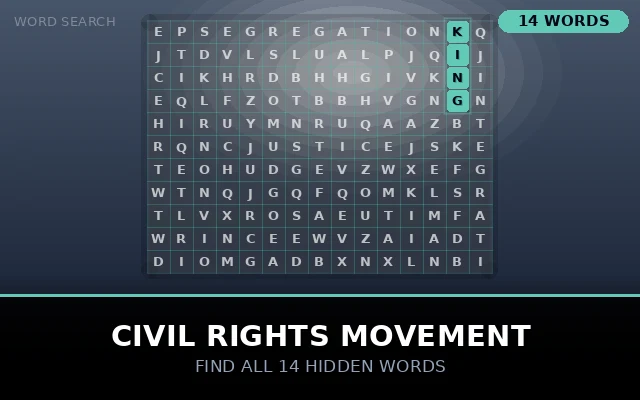
Find 14 key terms tied to the fight for equality in America, including names, ev...
Play Now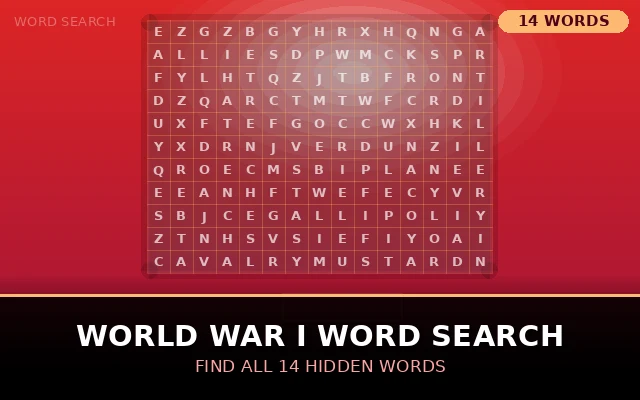
Play the free World War I word search puzzle featuring key terms, battles, and f...
Play Now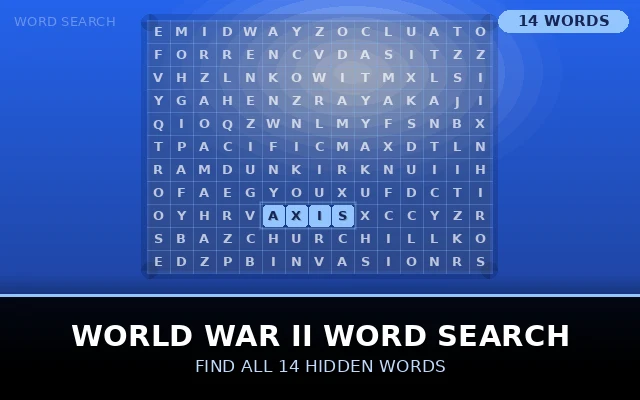
Play the free World War II word search puzzle featuring key battles, leaders, an...
Play NowPlay the free Ancient Egypt word search puzzle featuring pyramids, pharaohs, and mummies. A fun, educational history puzzle for students, teachers, and puzzle lovers.
Find 14 key terms tied to the fight for equality in America, including names, events, and ideals from the Civil Rights Movement, offering a meaningful way to learn about a defining chapter in US history.
Play Now
Play the free World War I word search puzzle featuring key terms, battles, and figures from the Great War. A perfect educational resource for students and history fans.
Play Now
Play the free World War II word search puzzle featuring key battles, leaders, and events from history's largest conflict. Ideal for students, teachers, and history enthusiasts.
Play NowAncient Egypt Word Search Guides & Articles
Ancient Egypt Word Search: Uncover the Secrets of the Pharaohs
Introduction: Journey Along the Nile
The Ancient Egypt word search puzzle invites players to explore one of the most enduring and fascinating civilizations in human history. Featuring nine words connected to pharaohs, pyramids, and the mysteries of the ancient Nile Valley, this egypt puzzle offers students, teachers, and history enthusiasts an engaging way to learn about a culture that has captivated human imagination for thousands of years.
This article dives into the remarkable history of Ancient Egypt, explores the vocabulary featured in the puzzle, and explains why this beloved theme continues to be such a popular subject for history word search for kids and adults alike.
The Gift of the Nile: Understanding Ancient Egyptian Civilization
Ancient Egyptian civilization flourished along the Nile River for over 3,000 years, from roughly 3100 BCE to 30 BCE, making it one of the longest-lasting civilizations in human history. The predictable annual flooding of the Nile deposited rich, fertile soil across the surrounding land, allowing ancient Egyptians to develop sophisticated agricultural practices that supported a large, stable population and enabled the development of complex political, religious, and cultural institutions.
The Pharaohs: Divine Rulers of Egypt
At the center of ancient Egyptian society stood the pharaoh, an It wordsearch ruler believed to be a living god and the intermediary between the divine realm and the mortal world. Pharaohs held absolute political and religious authority, overseeing everything from military campaigns to massive construction projects. Some of history's most famous pharaohs include Ramesses II, who ruled for an astonishing 66 years and commissioned numerous monumental building projects; Tutankhamun, whose intact tomb, discovered in 1922, provided an unprecedented window into royal Egyptian life; and Hatshepsut, one of the few female pharaohs, who oversaw a period of prosperous trade and ambitious architectural achievement.
The Great Pyramids: Engineering Marvels
Few structures capture the imagination quite like the pyramids of Egypt, massive stone monuments constructed as tombs for pharaohs and their treasures. The Great Pyramid of Giza, built for the Pharaoh Khufu around 2560 BCE, remained the tallest man-made structure in the world for nearly 3,800 years, a testament to the extraordinary engineering and organizational capabilities of ancient Egyptian society. The precision and scale of pyramid construction continue to astonish modern engineers and archaeologists, who still debate the exact methods used to move and position the massive stone blocks without the benefit of modern machinery.
Mummification and Beliefs About the Afterlife
Ancient Egyptians held elaborate beliefs about the afterlife, believing that proper preservation of the body was essential for a successful journey into the next world. This belief system gave rise to the practice of mummification, an intricate process involving the removal of internal organs, treatment with natural preservatives like natron salt, and careful wrapping in linen bandages. Wealthy Egyptians and pharaohs were buried with elaborate grave goods, including jewelry, furniture, and food offerings, intended to support them in the afterlife. The sophistication of Egyptian mummification techniques has allowed many mummies to survive remarkably well-preserved for thousands of years, providing invaluable insights for modern archaeologists and historians.
Egyptian Mythology and Religion
Religion permeated nearly every aspect of ancient Egyptian life, with a complex pantheon of gods and goddesses believed to govern various aspects of existence. Osiris, god of the afterlife and resurrection, played a central role in Egyptian beliefs about death and rebirth. Isis, his wife, was revered as a powerful goddess of magic and motherhood, while Ra, the sun god, was considered one of the most important deities, believed to travel across the sky each day in a solar barque. Anubis, depicted with the head of a jackal, guided souls through the process of judgment in the afterlife, weighing their hearts against the feather of truth to determine their fate. This rich mythology, often explored through egyptian mythology word search puzzles, continues to fascinate students and scholars alike.
Hieroglyphics: The Written Language of Egypt
Ancient Egyptians developed one of history's earliest writing systems, hieroglyphics, which combined pictorial symbols representing sounds, words, and ideas. This sophisticated writing system was used for religious texts, historical records, and administrative documents, and its decipherment remained a mystery to modern scholars until the discovery of the Rosetta Stone in 1799. This artifact, featuring the same text written in hieroglyphics, Demotic script, and ancient Greek, provided the crucial key that allowed French scholar Jean-François Champollion to finally decode hieroglyphic writing in 1822, unlocking a wealth of historical knowledge previously hidden within untranslated ancient texts.
The Nile River: Lifeblood of Egyptian Civilization
The Nile River served as the foundation of ancient Egyptian civilization, providing water for agriculture, transportation for trade and communication, and a source of fish and other resources. Ancient Egyptians developed sophisticated irrigation systems to maximize the benefits of the Nile's annual flooding, allowing them to grow abundant crops of wheat and barley that supported a thriving population. The reliability of the Nile's cycles also influenced Egyptian religious beliefs and calendar systems, reflecting the deep interconnection between the natural environment and ancient Egyptian culture.
Egyptian Society and Daily Life
Ancient Egyptian society was structured hierarchically, with the pharaoh and royal family at the top, followed by priests, nobles, scribes, artisans, and farmers, with slaves occupying the lowest social position. Scribes held a particularly respected position in society, as literacy was relatively rare and essential for administrative, religious, and commercial record-keeping. Daily life for most ancient Egyptians centered around agricultural work, though skilled artisans also produced remarkable pottery, jewelry, and other crafts that demonstrate the sophistication of Egyptian material culture.
Why Ancient Egypt Fascinates Students Worldwide
Understanding ancient egypt vocabulary offers students a compelling introduction to ancient world history while developing broader historical thinking skills.
Sparking Curiosity About Archaeology: Ancient Egypt's well-preserved artifacts and monuments make it an ideal entry point for introducing students to archaeological methods and historical inquiry.
Building Cross-Curricular Connections: Ancient Egyptian history connects to subjects like geography, through study of the Nile River; mathematics, through pyramid construction; and religious studies, through Egyptian mythology.
Developing Chronological Thinking: The extraordinary length of Egyptian civilization helps students understand deep historical time and how civilizations can evolve and persist across thousands of years.
Encouraging Global Perspective: Studying Ancient Egypt alongside other ancient civilizations helps students appreciate the diversity of human cultural and technological achievement throughout history.
Tips for Solving the Ancient Egypt Word Search
To maximize your success with this pyramids word search puzzle, consider these strategies:
- Review the word list first — Familiarizing yourself with all nine words before starting helps your brain recognize relevant patterns more quickly.
- Look for distinctive letter combinations — Words related to Egyptian mythology and terminology often contain unique letter patterns that stand out in the grid.
- Search methodically — Scan the grid in a consistent pattern to ensure thorough coverage without missing hidden words.
- Use context clues — If you're familiar with Egyptian history, use your existing knowledge to anticipate likely vocabulary and search more efficiently.
The Enduring Appeal of Egypt-Themed Puzzles
Ancient Egypt remains one of the most popular historical themes in education and popular culture, from museum exhibitions to blockbuster films. This enduring fascination makes educational word search puzzles about Ancient Egypt particularly effective at engaging students who might otherwise find history less exciting. This puzzle appeals to:
- Elementary and middle school students studying ancient civilizations
- Teachers planning units on ancient world history or Egyptian mythology
- Homeschool families covering ancient history curricula
- Museum enthusiasts who enjoy exploring Egyptian artifacts and exhibitions
- History and archaeology buffs of all ages fascinated by ancient mysteries
Extending Your Ancient Egypt Learning Journey
After completing this puzzle, consider exploring related topics such as the construction techniques behind the pyramids, the fascinating discovery of Tutankhamun's tomb by Howard Carter, or the broader history of ancient Egyptian trade relationships with neighboring civilizations. These subjects naturally extend the vocabulary and concepts introduced in the puzzle.
Conclusion
The Ancient Egypt word search puzzle offers a captivating journey into one of history's most remarkable civilizations. From the towering pyramids to the intricate mythology of gods like Osiris and Anubis, this ancient egypt word search helps players engage meaningfully with the culture, beliefs, and achievements of ancient Egyptian society. Whether you're a student, teacher, or lifelong history enthusiast, this puzzle offers an enjoyable and educational way to explore the timeless mysteries of the pharaohs and their extraordinary civilization along the Nile.
Target Keywords: ancient egypt word search, egypt puzzle, pharaoh word search, pyramids word search puzzle, free word search puzzles, history word search for kids, ancient civilizations word search, educational word search puzzles, egyptian mythology word search, ancient egypt vocabulary, word search game online, mummies word search