Ancient Rome Word Search
Click and drag to select words
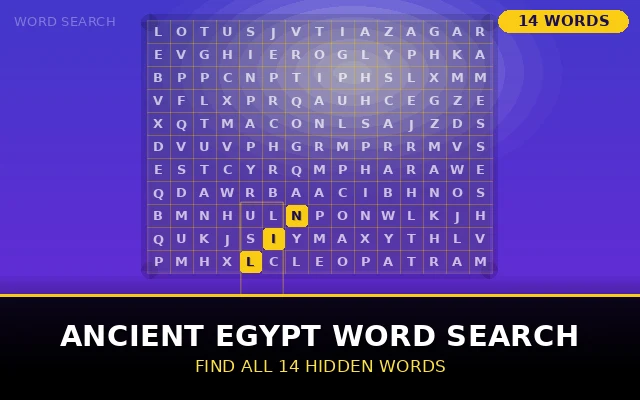
Play the free Ancient Egypt word search puzzle featuring pyramids, pharaohs, and...
Play Now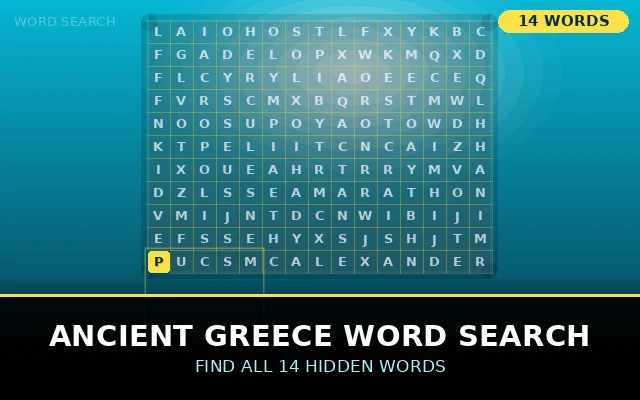
Search for iconic Ancient Greece terms like Sparta, Athens, Olympus, and Democra...
Play Now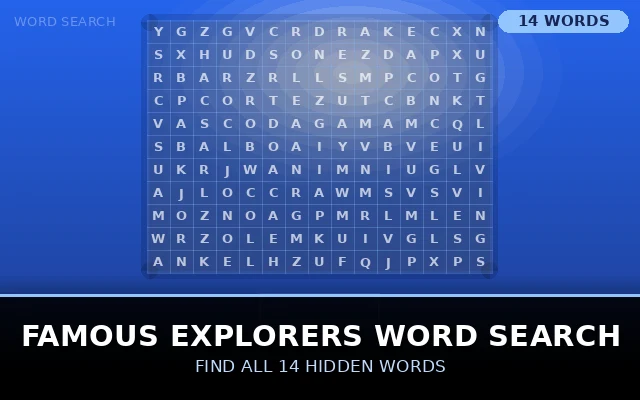
Play the free Famous Explorers word search puzzle featuring legendary voyagers w...
Play NowPlay the free Ancient Rome word search puzzle featuring emperors, gladiators, and the Roman Empire. A fun, educational puzzle for students, teachers, and history lovers.
Play the free Ancient Egypt word search puzzle featuring pyramids, pharaohs, and mummies. A fun, educational history puzzle for students, teachers, and puzzle lovers.
Play Now
Search for iconic Ancient Greece terms like Sparta, Athens, Olympus, and Democracy in this 14 word puzzle covering the myths, philosophy, and city states that shaped Western civilization forever.
Play Now
Play the free Famous Explorers word search puzzle featuring legendary voyagers who charted the unknown world. Perfect for students, teachers, and history enthusiasts.
Play NowAncient Rome Word Search Guides & Articles
Ancient Rome Word Search: Explore the Rise and Fall of a Mighty Empire
Introduction: Enter the Eternal City
The Ancient Rome word search puzzle transports players to one of history's most influential civilizations, a society whose political systems, architecture, and language continue to shape the modern world nearly two thousand years after its decline. Featuring 11 words connected to the rise, glory, and legacy of Rome, this roman empire word search offers students, teachers, and history enthusiasts an engaging way to explore one of the most consequential civilizations in human history.
This article examines the remarkable history of Ancient Rome, explores the vocabulary featured in the puzzle, and explains why this roman history puzzle continues to captivate learners of all ages.
From City-State to Empire: The Rise of Rome
According to legend, Rome was founded in 753 BCE by the twin brothers Romulus and Remus, though the historical reality of Rome's origins is more gradual and complex. What began as a small settlement along the Tiber River eventually grew into one of the largest and most powerful empires in human history, controlling territory stretching from Britain in the north to North Africa in the south, and from Spain in the west to the Middle East in the east at the height of its power.
The Roman Republic
Before becoming an empire, Rome operated as a republic for nearly 500 years, beginning around 509 BCE after the overthrow of Rome's monarchy. The It wordsearch Roman Republic developed a complex system of government featuring elected officials, a powerful Senate composed of aristocratic families, and various checks and balances designed to prevent any single individual from seizing absolute power. This republican system, with its emphasis on citizenship, law, and representative governance, profoundly influenced the development of later democratic systems, including the United States Constitution, whose framers drew direct inspiration from Roman republican principles.
Julius Caesar: The Man Who Changed Rome Forever
Few figures loom larger in Roman history than Julius Caesar, a brilliant military commander and political leader whose actions ultimately transformed Rome from a republic into an empire. Caesar's military conquests in Gaul dramatically expanded Roman territory and cemented his popularity among the Roman people, but his growing power alarmed traditionalist senators who feared he intended to establish himself as a king. Caesar's assassination in 44 BCE by a group of senators, including his friend Brutus, plunged Rome into civil war, ultimately paving the way for his adopted heir, Octavian, to become Rome's first emperor. Because of his outsized influence on Roman history, julius caesar word search puzzles remain among the most popular ways to introduce students to this pivotal historical figure.
The Roman Empire: Augustus and Beyond
Octavian, later known as Augustus, became Rome's first emperor in 27 BCE, ushering in a period of relative peace and stability known as the Pax Romana, or "Roman Peace," which lasted for approximately 200 years. During this era, Rome experienced remarkable prosperity, engineering achievement, and cultural flourishing, as the empire's vast network of roads, aqueducts, and trade routes connected diverse territories across three continents. Subsequent emperors, including Trajan, who oversaw the empire's greatest territorial extent, and Hadrian, known for his famous defensive wall in Britain, continued to shape the empire's development through military campaigns, infrastructure projects, and administrative reforms.
Gladiators and Roman Entertainment
Roman entertainment culture centered around massive public spectacles, most famously the gladiatorial combats held in arenas like the Colosseum in Rome, completed around 80 CE. Gladiators, often enslaved people, prisoners of war, or free men seeking fame and fortune, fought in front of massive crowds, sometimes to the death, in displays that served both as entertainment and as demonstrations of Roman power and social hierarchy. While often associated with brutal violence, gladiatorial combat also required significant skill and training, and successful gladiators could achieve considerable fame and even earn their freedom. This fascinating aspect of Roman culture makes gladiator word search puzzle content especially popular among students studying ancient history.
Roman Engineering and Architecture
Ancient Rome's engineering achievements remain impressive even by modern standards. Roman engineers developed sophisticated concrete that allowed for the construction of massive domes, arches, and aqueducts that transported water across vast distances to supply Roman cities. The extensive network of Roman roads, many of which formed the basis for modern European road systems, facilitated trade, communication, and military movement across the empire's vast territory. Structures like the Pantheon, with its still-intact concrete dome, and the aqueducts that supplied Roman cities with fresh water demonstrate the remarkable sophistication of Roman engineering knowledge.
Roman Mythology and Religion
Roman religion drew heavily on Greek mythology, adapting Greek gods into a distinctly Roman pantheon with new names and characteristics. Jupiter, the king of the Roman gods, corresponded to the Greek Zeus, while Mars, the god of war, held particular importance in a society that placed tremendous value on military achievement and conquest. Venus, goddess of love and beauty, was considered the mythical ancestor of the Roman people through her son Aeneas, whose legendary journey from Troy to Italy was immortalized in Virgil's epic poem, the Aeneid. This rich mythological tradition, often explored through roman mythology word search puzzles, continues to influence Western art, literature, and language today.
The Legal Legacy of Rome
Roman law represents one of the civilization's most enduring contributions to the modern world. Roman legal principles, including concepts like the presumption of innocence, the right to a fair trial, and the codification of laws into organized legal systems, profoundly influenced the development of legal systems throughout Europe and beyond. Many modern legal terms and concepts trace their origins directly to Roman law, demonstrating the civilization's lasting impact on contemporary governance and justice systems.
The Decline and Fall of the Roman Empire
The fall of the Western Roman Empire in 476 CE, when the Germanic leader Odoacer deposed the last Roman emperor, marked the end of centuries of Roman dominance in Western Europe. Historians debate the complex combination of factors that contributed to Rome's decline, including economic troubles, military overextension, political instability, and pressure from migrating Germanic tribes. However, the Eastern Roman Empire, later known as the Byzantine Empire, continued to thrive for nearly another thousand years, preserving and transmitting much of Roman culture and knowledge until its eventual fall in 1453.
Why Roman History Remains Essential Education
Understanding ancient rome vocabulary provides students with crucial context for interpreting Western political systems, legal traditions, and cultural institutions that continue to shape modern society.
Understanding the Roots of Democracy: Studying the Roman Republic helps students understand the historical development of representative government and civic participation.
Appreciating Engineering Achievement: Roman infrastructure projects demonstrate impressive technical innovation that continues to inspire modern engineering and architecture.
Building Language Skills: Latin, the language of Ancient Rome, forms the foundation for many modern languages and provides the root words for countless English terms, making Roman history valuable for language education as well.
Connecting Legal and Political Systems: Roman legal principles continue to influence modern justice systems, making this history directly relevant to understanding contemporary governance.
Strategies for Solving the Ancient Rome Word Search
To make the most of this roman history puzzle, try these solving techniques:
- Review the word list beforehand — Familiarizing yourself with all 11 words before starting helps your brain recognize patterns more efficiently.
- Look for Latin-derived terms — Words related to Roman government, mythology, or culture often have distinctive letter patterns rooted in Latin vocabulary.
- Scan the grid systematically — Work through the puzzle in a consistent direction to ensure thorough coverage.
- Research unfamiliar terms afterward — Use any unfamiliar words as a starting point for deeper historical exploration.
The Broad Appeal of Rome-Themed Educational Puzzles
Ancient Rome remains a perennially popular subject in education and popular culture, from blockbuster films to bestselling historical fiction. This widespread fascination makes educational word search puzzles about Ancient Rome particularly effective for engaging diverse audiences, including:
- Middle and high school students studying ancient world history or Latin
- Teachers planning units on the Roman Republic, Roman Empire, or classical civilization
- Homeschool families covering ancient history curricula
- History and mythology enthusiasts interested in Roman culture and legend
- Adults and seniors who enjoy trivia and history-themed brain games
Extending Your Ancient Rome Learning Journey
After completing this puzzle, consider exploring related topics such as the construction of the Colosseum, the life and philosophy of Marcus Aurelius, or the fascinating history of Pompeii, the Roman city famously preserved by the eruption of Mount Vesuvius in 79 CE. These subjects offer rich opportunities for continued historical exploration.
Conclusion
The Ancient Rome word search puzzle offers a captivating gateway into one of history's most influential civilizations. From the political innovations of the Roman Republic to the dramatic conquests of Julius Caesar and the engineering marvels of Roman architecture, this ancient rome word search helps players engage meaningfully with a civilization whose legacy continues to shape the modern world. Whether you're a student, teacher, or lifelong history enthusiast, this puzzle offers an enjoyable and educational journey through the rise and legacy of the Roman Empire.
Target Keywords: ancient rome word search, roman empire word search, gladiator word search puzzle, roman history puzzle, free word search puzzles, history word search for kids, ancient civilizations word search, educational word search puzzles, roman mythology word search, ancient rome vocabulary, word search game online, julius caesar word search