Art Movements Word Search: From Renaissance to Modern Art (2026)
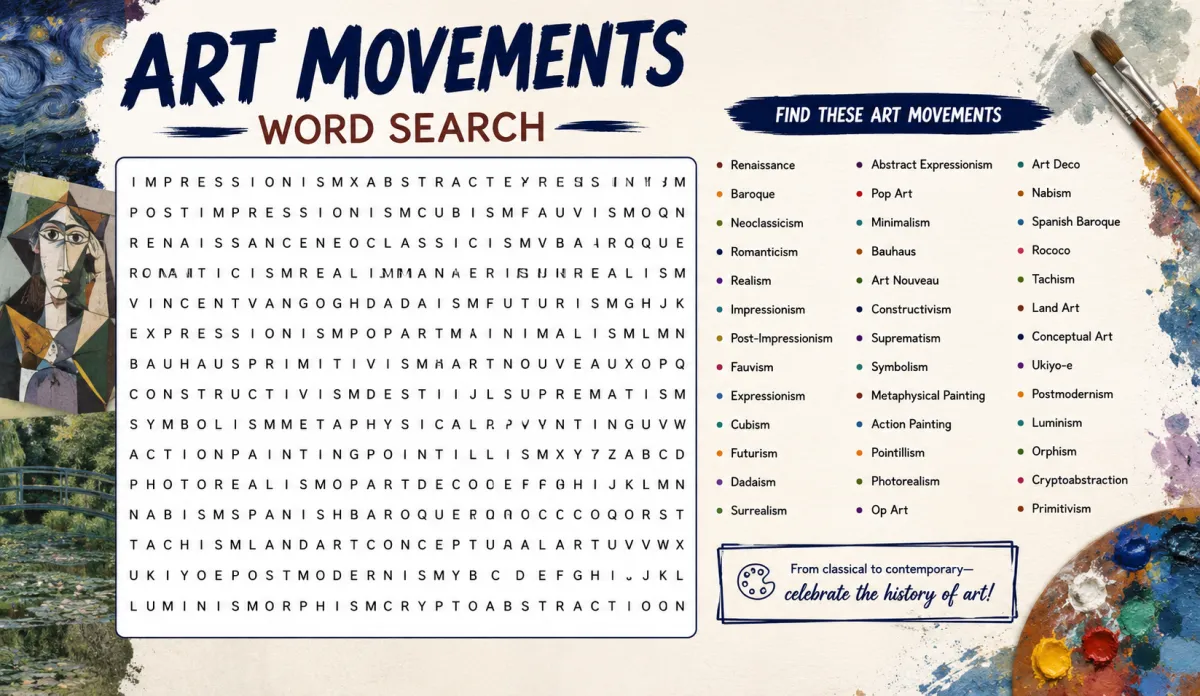
Art history spans thousands of years and dozens of distinct movements, each with its own philosophy, style, and cast of legendary artists. An art movements word search brings this rich creative history to life in puzzle form, turning the names of famous styles, periods, and artists into an engaging vocabulary challenge that is as educational as it is enjoyable.
Whether you are an art student memorizing key movements for an exam, a museum visitor looking to deepen your understanding, or simply someone who appreciates beautiful things, an art movements word search offers a unique and rewarding way to engage with the history of human creativity. itwordsearches.com features a dedicated Art category with free puzzles covering movements, artists, and techniques from across the centuries.
Why Art Movements Word Search Are So Valuable
Art history is a subject that rewards familiarity. The more you know about movements like Impressionism or Surrealism, the richer your experience becomes when visiting a gallery, watching a documentary, or even noticing design influences in everyday life. Word search puzzles build this familiarity naturally, reinforcing the names of movements, artists, and terms through repeated visual engagement rather than passive reading.
For students in particular, this format is genuinely useful for exam preparation. Art history coursework often requires recall of specific movement names, associated artists, and defining characteristics all of which a well-designed word search can reinforce in a low-pressure, engaging way.
Puzzles:
Major Art Movements Covered in Word Search Puzzles
Renaissance and Classical Art
The Renaissance represents one of the most significant periods in Western art history, marking a shift toward naturalism, perspective, and humanism in the fifteenth and sixteenth centuries. Key names like Leonardo, Michelangelo, and Raphael define this era. Word searches built around the Renaissance help students and art lovers connect these famous names to the broader artistic revolution they represent.
- Why Art Movements Word Search Are So Valuable
- Puzzles:
- Major Art Movements Covered in Word Search Puzzles
- Benefits of Art Movements Word Search Puzzles
- How Art History Word Search Support Classroom Learning
- Art Movements and Their Lasting Cultural Influence
- Printable vs Online Art Word Searches
- Popular Art Word Search Topics to Try
- Why it wordsearch Is a Great Place to Start
- Art Movements and Cultural Context
- Conclusion: Explore Centuries of Creativity One Puzzle at a Time
Impressionism and Post-Impressionism
Monet, Renoir, Cezanne, and Van Gogh define these late nineteenth-century movements that broke away from academic tradition in favor of light, color, and personal expression. Impressionism-themed puzzles are among the most popular art word searches, thanks to the widespread recognition of these artists and their iconic works.
Modernism and Abstract Art
Cubism, Expressionism, Dadaism, and Surrealism represent the radical experimentation that defined early twentieth-century art. Artists like Picasso, Kandinsky, and Dali pushed the boundaries of what art could be, and word searches built around these movements introduce players to the vocabulary of modern artistic thought.
Contemporary and Street Art
Pop Art, Minimalism, and Street Art reflect the democratic, rebellious, and concept-driven approaches that have shaped art from the mid-twentieth century to the present day. These puzzles appeal especially to younger players drawn to contemporary visual culture.
Art Techniques and Materials
Watercolor, sculpture, etching, and fresco introduce the technical vocabulary artists use to create their work. These puzzles are valuable for students studying studio art as well as history, helping connect the theoretical with the practical.
Benefits of Art Movements Word Search Puzzles
- Reinforces art history vocabulary for students and museum visitors
- Builds familiarity with movement names, artists, and periods
- Supports exam preparation for art history coursework
- Sparks curiosity about specific movements and their key artists
- Introduces art technique terminology in an accessible format
- Provides a relaxing, creative activity for art enthusiasts of every level
Art teachers frequently use movement-themed word searches as warm-up activities before gallery visits or new unit introductions, helping students mentally engage with the vocabulary they will soon encounter in deeper study.
How Art History Word Search Support Classroom Learning
The challenge with teaching art history is that it involves a large number of unfamiliar names movement titles, artist surnames, technique terms that can feel overwhelming when encountered for the first time in a lecture or textbook. A word search solves this problem by providing repeated, low-stakes exposure to these names before formal study begins.
When a student has already scanned a grid searching for Impressionism, Cubism, and Surrealism, those words carry a sense of familiarity when they appear later in a classroom discussion. This pre-exposure effect is well-documented in educational research and is one of the key reasons teachers across subjects use vocabulary puzzles as pre-reading and pre-lesson tools.
Art Movements and Their Lasting Cultural Influence
The movements covered in art word searches did not simply exist in galleries they shaped design, film, fashion, and even advertising in ways that are still visible today. Bauhaus design principles underpin modern graphic design and architecture. Surrealist imagery appears constantly in contemporary advertising and music videos. Pop Art's bold, ironic sensibility has influenced generations of graphic artists and street muralists.
Understanding these connections transforms an art history word search from a simple vocabulary exercise into a window onto the visual forces that continue to shape the world around us. Each movement name found in the grid carries an entire history of ideas, rebellion, and creative vision behind it.
Printable vs Online Art Word Searches
Printable Art Word Search
Printable puzzles work beautifully as classroom handouts before gallery trips, as quiet activity supplements during art class, or as take-home worksheets for students reviewing movement names ahead of an exam.
Online Art Word Search
Online puzzles load instantly on any device, making them ideal for a quick revision break during self-study or a relaxing activity during a lunch break at a museum. itwordsearches.com offers both formats for every puzzle in the Art category, with no registration required.
Popular Art Word Search Topics to Try
- Renaissance Masters — Leonardo, Michelangelo, and Raphael
- Impressionism — Monet, Renoir, and the plein air tradition
- Modern Movements — Cubism, Surrealism, and Expressionism
- Contemporary Art — Pop Art, Minimalism, and Street Art
- Art Techniques — watercolor, sculpture, and fresco
- Famous Artworks — the Mona Lisa, Starry Night, and The Persistence of Memory
Why it wordsearch Is a Great Place to Start
It wordsearch was designed to make themed word search puzzles accessible to learners and enthusiasts of every background, and the Art category reflects that mission with coverage spanning centuries of creative history. Puzzles load instantly with no registration required and work smoothly across desktop, tablet, and mobile devices, making them easy to access whether you are at home, in a classroom, or browsing between gallery rooms.
New art-themed puzzles are added regularly, ensuring a steady stream of fresh challenges for students, teachers, and art lovers who want to keep exploring the endlessly rich history of human creativity.
Art Movements and Cultural Context
Art movements word search also help players understand why certain movements emerged as reactions to what came before. Impressionism arose partly as a rejection of the rigid academic traditions that dominated European art institutions in the nineteenth century. Abstract Expressionism emerged from the trauma and disillusionment of the mid-twentieth century. Even understanding these basic contextual relationships transforms a list of movement names into a coherent, meaningful narrative of human creative history.
For this reason, educators find that art word search work best when paired with brief visual introductions to each movement a short slideshow of representative works, for example, gives the vocabulary names immediate visual anchors that dramatically improve retention and deepen the connection between the puzzle activity and the broader study of art history.
Conclusion: Explore Centuries of Creativity One Puzzle at a Time
Art movements word search offer a uniquely engaging way to explore the history of human creativity, from the masters of the Renaissance to the radical experimenters of the twentieth century and beyond. Every puzzle is an invitation to encounter names and ideas that have shaped not only art but culture, design, and the way we see the world.
Best of all, you do not need a gallery membership or a textbook to begin. itwordsearches.com offers a complete Art category with free, printable, and online puzzles ready whenever curiosity about the history of art strikes.