Musical Instruments Word Search: Tuning Into Fun While Learning Music Vocabulary
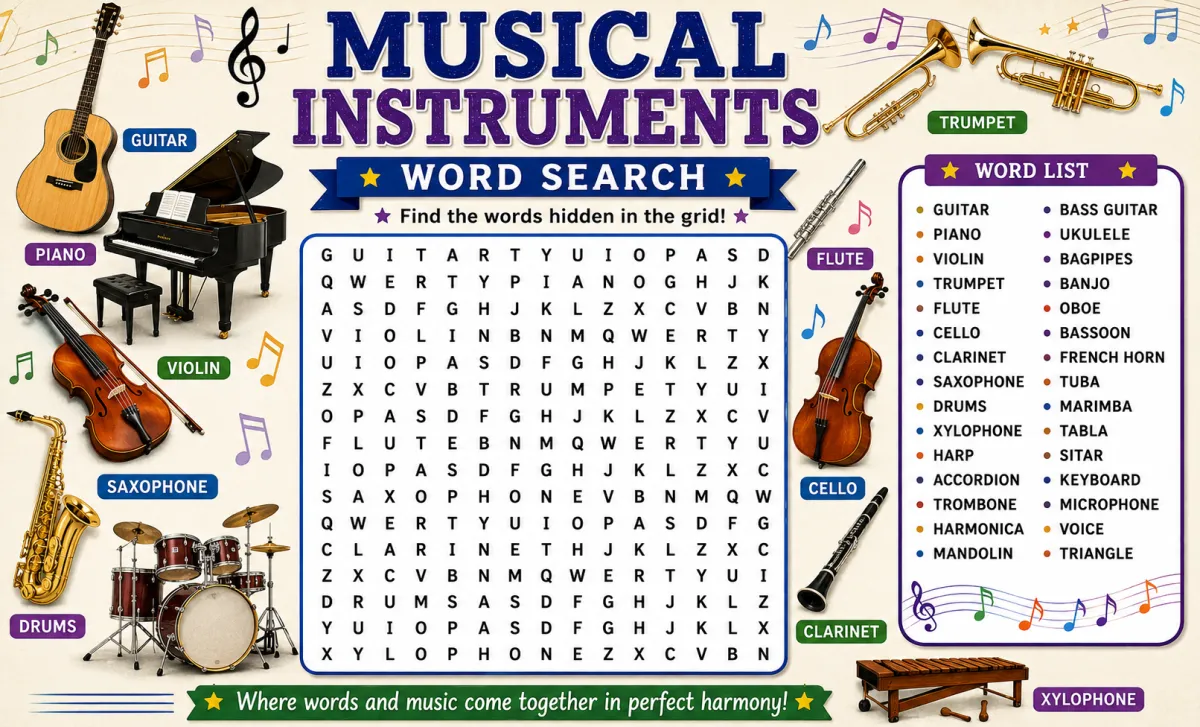
Music surrounds us in nearly every part of daily life, from the songs played on the radio to the instruments featured in school bands and orchestras. A musical instruments word search takes this universally loved subject and transforms it into an engaging puzzle activity that introduces players to the names, families, and terminology associated with the world of music. Whether used in a classroom, a music therapy session, or simply as a relaxing solo activity, this puzzle theme offers something for nearly everyone, regardless of musical background or age.
Organizing the Puzzle Around Instrument Families
One of the most effective ways to structure a musical instruments word search is by grouping words according to the traditional instrument families found in music education. This approach not only makes the puzzle more organized but also reinforces an important foundational concept in music theory.
String Instruments
This family includes instruments that produce sound through vibrating strings, such as violin, viola, cello, double bass, guitar, harp, and banjo. These words are often among the first introduced to beginner music students, since string instruments are commonly featured in school orchestras starting at a young age.

- Organizing the Puzzle Around Instrument Families
- String Instruments
- Wind Instruments
- Percussion Instruments
- Keyboard Instruments
- Puzzles:
- Why This Theme Works So Well for Learning
- Building Difficulty Into the Grid
- Where This Puzzle Theme Is Commonly Used
- Cross-Curricular Connections Worth Exploring
- Tips for Solving This Puzzle Type Quickly
- A Few Fun Facts About Musical Instruments
- Creative Ways to Extend the Activity
- Conclusion
Wind Instruments
Wind instruments produce sound through vibrating air, and this category splits further into woodwinds and brass. Woodwind examples include flute, clarinet, oboe, bassoon, and saxophone, while brass instruments include trumpet, trombone, French horn, and tuba. Including both subcategories in a single puzzle offers a broader introduction to how wind instruments function differently despite sharing a similar sound-production method.
Percussion Instruments
Percussion instruments create sound through striking, shaking, or scraping, and this family includes drums, xylophone, tambourine, cymbals, maracas, and timpani. Because percussion instruments are often the most physically intuitive to understand, this category works particularly well for younger puzzle solvers just beginning to explore musical concepts.
Keyboard Instruments
Though sometimes overlapping with strings or percussion depending on classification, keyboard instruments are frequently grouped separately and include piano, organ, harpsichord, and synthesizer. These words are especially useful in puzzles designed for students studying the historical evolution of keyboard-based music.
Puzzles:
Why This Theme Works So Well for Learning
Musical instruments offer a naturally visual and auditory subject, which makes the word search format particularly effective as a learning tool. Unlike more abstract vocabulary themes, most instrument names can be paired with an actual sound or image that students already associate with real-world experience, whether from school music classes, concerts, or media exposure. This existing familiarity lowers the barrier to entry, allowing even young children to engage confidently with the puzzle from the very first attempt.
Additionally, because instrument names vary widely in length and complexity, from short words like "drum" or "harp" to longer ones like "saxophone" or "harpsichord," this theme naturally supports a wide range of difficulty levels within a single puzzle, making it adaptable for mixed-age groups or differentiated classroom instruction.
Building Difficulty Into the Grid
Puzzle creators can adjust difficulty in several ways beyond simply choosing harder words. Grid size plays a significant role, with smaller ten by ten grids working well for early elementary students, while larger twenty by twenty grids suit older students or adult puzzle enthusiasts looking for a more demanding challenge. Word direction also affects difficulty considerably, since beginner puzzles typically restrict placements to horizontal and vertical directions only, whereas advanced versions incorporate diagonal and backward placements to increase the mental effort required to locate each term. Some puzzle designers also choose to omit a visible word list entirely for advanced solvers, instead providing picture clues of each instrument, requiring players to first identify the instrument before searching for its name within the grid.
Where This Puzzle Theme Is Commonly Used
Music teachers frequently rely on instrument-themed word searches during the early weeks of a school year, using them as an icebreaker activity that helps students become familiar with the instruments available in the school's band or orchestra program before formal lessons begin. Elementary general music classes often use simplified versions paired with listening activities, allowing students to hear a recording of each instrument while simultaneously searching for its name in the puzzle grid.
Beyond traditional classrooms, music therapists sometimes incorporate these puzzles into sessions with patients recovering from cognitive impairments, since the combination of familiar vocabulary and gentle mental engagement can support memory recall in a low-pressure format. Retirement communities and senior activity centers have also adopted musical instrument puzzles as part of broader brain health programming, often pairing the activity with live music performances or sing-alongs that reinforce the vocabulary being searched.
Homeschooling parents introducing a music appreciation unit often find this puzzle theme useful as a supplementary activity alongside listening assignments, while summer camps with a performing arts focus sometimes use printed versions as a quiet activity option between more physically active sessions.
Cross-Curricular Connections Worth Exploring
A musical instruments word search can extend beyond pure vocabulary recognition by connecting to other subjects entirely. Science teachers covering the physics of sound sometimes pair a simplified version of this puzzle with lessons on vibration, frequency, and pitch, using instrument names as a practical entry point into more abstract acoustic concepts. History and cultural studies classes occasionally expand the word list to include instruments from specific regions or traditions, such as sitar, djembe, bagpipes, or accordion, offering a broader global perspective on musical diversity beyond the standard Western orchestra. Even math classes have occasionally used rhythm and instrument-based puzzles as a creative way to introduce concepts like fractions, since musical timing naturally involves dividing beats into equal parts.
Tips for Solving This Puzzle Type Quickly
A few practical strategies can help you move through a musical instruments word search more efficiently. Start by identifying the longest words on the list first, since terms like "saxophone" or "harpsichord" are far easier to spot in a crowded grid than shorter three or four letter words. Pay attention to instrument names that share common letter patterns, since many end in similar sounds, such as words ending in "-one" like trombone and saxophone, which can help train your eye to recognize familiar endings more quickly. Working through the grid in sections rather than scanning it all at once also tends to produce faster results, particularly on larger grids where random searching can waste significant time. Finally, if a puzzle includes both a family category and an answer key, cross-referencing which family you are currently focused on can help narrow your search to a smaller, more manageable subset of the full word list.
- Airport and Flying Terms Word Search
- Mountains and Rivers Word Search
- Cars and Vehicles Word Search
- Norse Mythology Word Search
A Few Fun Facts About Musical Instruments
Adding a bit of trivia alongside the puzzle can make the activity even more memorable for solvers of any age. The piano is technically classified as a percussion instrument because sound is produced when its internal hammers strike the strings, despite its keyboard appearance suggesting otherwise. The theremin holds the distinction of being one of the only instruments played without any physical contact, using electromagnetic fields controlled by hand movements near two antennas. Orchestras typically tune to the note A before a performance because it produces a particularly clear, resonant pitch that is easy for musicians across different instrument families to match. The world's largest playable instrument is often cited as a massive pipe organ, with some installations containing tens of thousands of individual pipes working together to produce sound.
Creative Ways to Extend the Activity
Once the puzzle itself is complete, several follow-up activities can deepen engagement with the material. Teachers might ask students to draw or research one instrument from each family found in the puzzle, adding a creative or research-based component to the otherwise vocabulary-focused activity. Music classrooms sometimes follow up a completed puzzle with a listening quiz, playing short audio clips of each instrument and asking students to match the sound to the correct word from the grid. Family game nights centered around a music theme might use the puzzle as a warm-up activity before moving into more interactive games like naming songs from short clips or guessing instruments from muffled recordings.
Conclusion
A musical instruments word search offers a simple yet genuinely effective way to introduce or reinforce vocabulary tied to one of humanity's most universal art forms. By organizing words around recognizable instrument families and adjusting difficulty to suit different age groups, this puzzle theme remains flexible enough for classrooms, therapy sessions, senior activities, and casual solo enjoyment alike. Whether used as a quick vocabulary warm-up or paired with deeper cross-curricular lessons in science, history, or math, this puzzle proves that learning about music does not always require an instrument in hand. Sometimes, all it takes is a pencil, a grid full of letters, and an ear already tuned to the sounds hidden within.