Australian Animals Word Search
Click and drag to select words

Discover fascinating elephant vocabulary in our Elephants word search! A fun, ed...
Play Now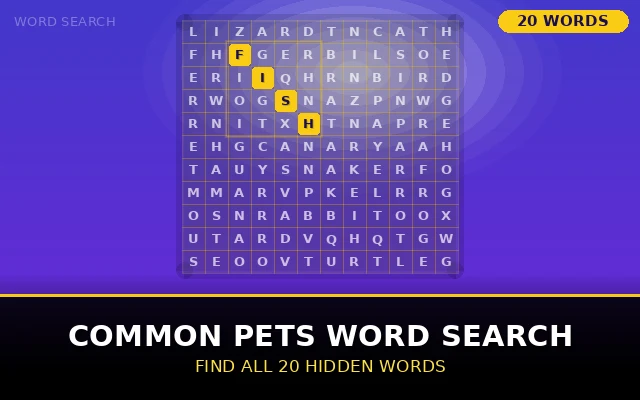
Discover the Most Common Pets word search dogs, cats, rabbits and more in a fun,...
Play Now
Discover eagles, hawks, falcons and more in this Birds of Prey word search. A th...
Play NowKangaroos, koalas, wombats and more. Play our Australian Animals word search and explore the unique wildlife of Australia. Free puzzle, no sign-up needed.
Discover fascinating elephant vocabulary in our Elephants word search! A fun, educational puzzle for wildlife lovers of all ages. Play free no sign-up!
Play Now
Discover the Most Common Pets word search dogs, cats, rabbits and more in a fun, free puzzle for all ages. Play online now this Puzzle.
Play Now
Discover eagles, hawks, falcons and more in this Birds of Prey word search. A thrilling puzzle for bird lovers and nature fans of all ages. Play free online.
Play NowAustralian Animals Word Search Guides & Articles
Exploring the Outback Through an Australian Animals Word Search
Isolated for millions of years from the rest of the world's landmasses, Australia evolved into a living laboratory of strange and wonderful wildlife found nowhere else on Earth. Hopping marsupials, egg laying mammals, and venomous reptiles all call this continent home, creating one of the most distinctive animal populations anywhere on the planet. An Australian animals word search bottles up this remarkable biodiversity into a single grid of letters, inviting solvers to hunt for names like Kangaroo, Koala, and Wombat as though they were tracking creatures across the outback itself.
This particular puzzle theme stands apart from more generic wildlife categories because nearly every animal on the list carries some element of novelty. Few other continents can claim an entire ecosystem built around pouched mammals, and that sense of the unusual gives an Australian animals word search a built in hook that keeps solvers curious from the very first word they find.
A Continent of Evolutionary Oddities
Australia's long geographic isolation allowed its wildlife to develop along a completely separate evolutionary path from the rest of the world. Marsupials, mammals that carry and nurse their young in a pouch rather than a womb, dominate much of the continent's mammal population, including instantly recognizable animals like Kangaroo, Koala, and Wombat. Even more unusual are the monotremes, an ancient group of egg laying mammals represented by only two living examples anywhere on Earth, the Platypus and the Echidna, both of which frequently appear in Australian themed word lists precisely because of how bizarre and singular they are.
Beyond mammals, Australia is also famous, and occasionally infamous, for its reptile population. The continent is home to a disproportionate share of the world's most venomous snakes, alongside massive reptiles like the Saltwater Crocodile, which patrols coastal waterways in the northern regions of the country. This blend of cuddly, iconic mammals alongside genuinely dangerous wildlife gives puzzle creators an unusually wide emotional range to work with when building a word list.
Vocabulary That Populates the Grid
A typical Australian animals word search in It wordsearch draws heavily from the continent's most iconic and recognizable species. Expect to see Kangaroo, Koala, Wombat, Dingo, Platypus, Echidna, and Emu anchoring most beginner friendly grids, since these names represent the animals most people already associate strongly with Australia even without any specialized wildlife knowledge. Slightly more advanced puzzles often introduce Wallaby, Bandicoot, Quokka, and Cassowary, names that reward solvers who already have some familiarity with Australian fauna beyond the most famous headline species.
Puzzles aimed at older children or adults sometimes push further into the continent's reptile population, incorporating words like Crocodile, Taipan, Goanna, and Cockatoo, broadening the vocabulary beyond mammals into birds and reptiles as well. Some designers also enjoy including regional habitat terms like Outback, Bushland, and Billabong, which root the animal names firmly within the distinctly Australian landscape they inhabit.
The Global Fascination With Australian Wildlife
Australian wildlife holds a particular fascination for people around the world precisely because so much of it feels genuinely alien compared to animals found on other continents. A Kangaroo's method of locomotion, bounding across open ground on powerful hind legs, looks nothing like the movement pattern of any mammal found in Europe, Asia, or the Americas. A Platypus, with its duck like bill, webbed feet, and venomous spur, seems almost too strange to be real the first time most people encounter a picture of one.
This sense of wonder translates directly into engagement with an Australian animals word search. Solvers are not simply matching random letters to a list, they are actively thinking about some of the most genuinely unusual creatures the natural world has to offer, which adds a layer of curiosity and delight that more familiar animal categories sometimes lack.
Classroom Applications and Cross Curricular Connections
Teachers covering world geography, biomes, or evolutionary biology often find that Australian wildlife provides an unusually rich case study. The continent's isolation and resulting biodiversity offer a clear, concrete example of how geographic separation shapes evolution over millions of years, a concept that can otherwise feel abstract to younger students. Pairing a lesson on continental drift or evolutionary biology with an Australian animals word search gives students a lighthearted way to reinforce vocabulary immediately after encountering the more academic content.
Because several Australian species, including the Koala and various wallaby species, face genuine conservation challenges related to habitat loss and climate related bushfires, some educators extend the puzzle activity into a broader conversation about environmental science and wildlife protection, using the puzzle as an entry point into more serious discussion for older students.
Approaching the Puzzle Strategically
Solving an Australian animals word search efficiently benefits from recognizing that many of the featured animal names carry distinctive letter patterns not commonly found in everyday English vocabulary. Words like Echidna, Quokka, and Wallaby contain unusual letter combinations that tend to stand out clearly against a background of randomized filler letters, making them excellent starting points when scanning a crowded grid.
Working through longer, more distinctive names before circling back for shorter, more common words like Emu or Dingo tends to produce faster results, since longer words are constrained to fewer possible positions within the grid. As always, checking all eight possible directions around any promising starting letter remains essential, since many Australian themed puzzles place their more unusual species names diagonally to add an extra layer of challenge for experienced solvers.
Designing an Australian Themed Puzzle
Anyone interested in building a custom version of this puzzle should think carefully about which animals to prioritize based on the intended audience. A puzzle designed for young children benefits from sticking closely to universally recognized species like Kangaroo and Koala, paired with a generously sized grid and minimal use of backwards or diagonal placement. A puzzle intended for teenagers or adults with a genuine interest in wildlife can branch out considerably further, incorporating lesser known species and regional habitat vocabulary that adds depth without sacrificing accessibility.
Grid size should scale with the complexity of the chosen word list, with a standard twelve by twelve or fifteen by fifteen layout comfortably accommodating a well rounded selection of both iconic and lesser known Australian species.
A Puzzle Celebrating Nature's Most Unique Continent
Few word search themes offer quite the same sense of discovery as one built around Australian wildlife. Every hidden word represents an animal shaped by millions of years of isolated evolution, resulting in creatures that continue to surprise and delight people who encounter them for the very first time. Whether solved by a curious child fascinated by hopping marsupials or an adult wildlife enthusiast reminiscing about a trip down under, an Australian animals word search offers a genuinely engaging window into one of the most remarkable ecosystems our planet has ever produced.
Regional Variation Within a Single Continent
Australia is often discussed as though it hosts one uniform ecosystem, but the reality is far more varied. Tropical rainforests in the northeast shelter species like the Cassowary and various tree dwelling possums, while the arid red center of the continent supports hardy desert specialists capable of surviving extreme heat and long stretches without water. Coastal regions bring an entirely different set of animals into the picture, from nesting sea turtles to the massive saltwater crocodiles that patrol estuaries and mangrove swamps. A truly comprehensive Australian animals word search can reflect this regional diversity by grouping words according to habitat, giving solvers a subtle geography lesson alongside the main puzzle activity.
This regional approach also opens the door to themed puzzle series, where one grid focuses exclusively on rainforest species, another on desert dwellers, and a third on coastal and marine life. Puzzle creators who want to avoid repetitive content across multiple Australian wildlife puzzles often find this habitat based structure useful, since it naturally generates fresh word lists without straying from the overall continental theme, while also teaching solvers that a single country can contain climates and ecosystems as different from one another as a tropical jungle and a scorching desert.
Cultural Significance Beyond the Classroom
Many Australian animals carry cultural weight that extends well beyond biology textbooks. The Kangaroo and Emu appear together on the country's official coat of arms, chosen partly because neither animal can walk backwards, a detail that adds an unexpected layer of symbolism to what might otherwise seem like a simple animal name in a puzzle grid. Aboriginal storytelling traditions, some of the oldest continuous cultural narratives in the world, also feature many of these same animals prominently, giving thoughtful puzzle creators an opportunity to add brief cultural notes alongside the word list for solvers who want a deeper connection to the material.
This blend of biology, geography, and culture is ultimately what separates a great Australian animals word search from a merely adequate one, transforming a simple grid of letters into a small doorway leading toward a much larger and richer understanding of the continent and the extraordinary creatures that call it home, one carefully uncovered name at a time.
Related Puzzles:
- Pets Word Search
-
Aquarium Fish Word Search
-
Arctic Animals Word Search
-
Jungle Animals Word Search
-
Amphibians Word Search
-
Bears Word Search
-
Big Cats Word Search
-
Reptiles Word Search
-
Sea Life Word Search
-
Elephants Word Search
-
Types of Snakes Word Search
-
Wild Cats Word Search
-
Dinosaurs Word Search
-
Insects Word Search
-
Dangerous Animals Word Search
-
Common Pets Word Search
-
Farm Animals Word Search
-
Type of Dogs Word Search
-
Birds Word Search
-
Animals Word Search
-
Ocean Creatures
CONCLUSION
The Australian Animals word search is waiting for you can you find all 14 hidden wildlife names? Jump in, have fun, and challenge your friends, classmates, or students to beat your score. Print it out and bring it to class or share it online. Australian animals word search printable, Press play and let the wild adventure begin!