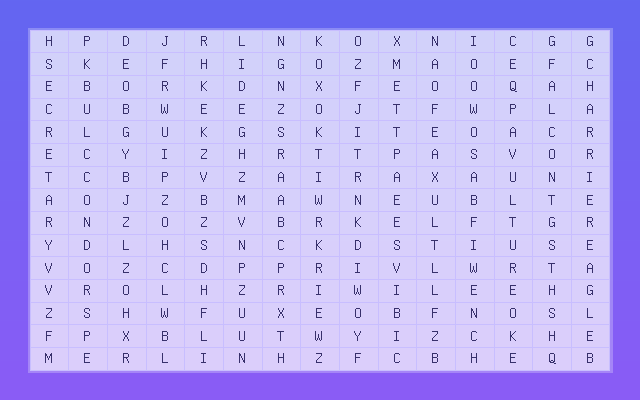
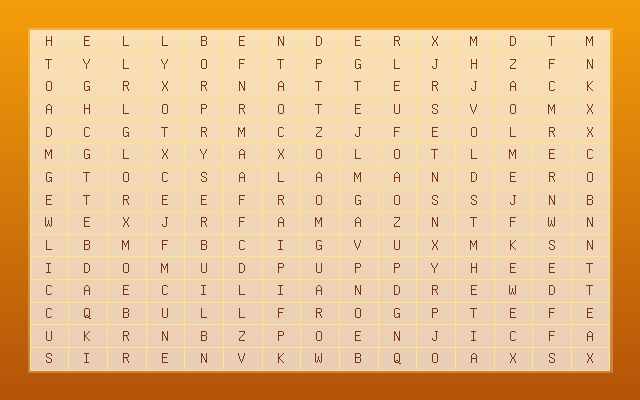
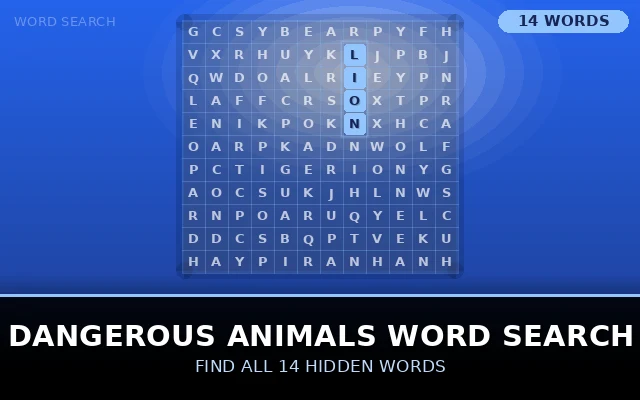
Farm Animals Word Search

Puzzle Grid

Click and drag to select words

Words to Find 0/19

Share Puzzle
More in Animals
Animals Word Search Grid
Animals Word Search

Word puzzles have long been a favorite pastime for children and adults alike,...

Play Now
Type of Dogs Word Search Grid
Type of Dogs Word Search

Every morning, millions of people around the world wake up, pick up their phones...

Play Now
Common Pets Word Search Grid
Common Pets Word Search

Discover the Most Common Pets Word Search a fun, educational puzzle for all ages...

Play Now
Farm Animals Word Search

Explore our fun Farm Animals Word Search activity! Learn names of cows, goats, horses

Animals 4 views
More Puzzles in Animals
Animals Word Search Grid
Animals Word Search

Word puzzles have long been a favorite pastime for children and adults alike,

Play Now
Type of Dogs Word Search Grid
Type of Dogs Word Search

Every morning, millions of people around the world wake up, pick up their phones, and search for the same thing.

Play Now
Common Pets Word Search Grid
Common Pets Word Search

Discover the Most Common Pets Word Search a fun, educational puzzle for all ages

Play Now

Farm Animals Word Search Guides & Articles

Farm Animals Word Search

The Ultimate Educational Activity for Kids & Learners Farm Animals Word Search  

If you have ever watched a child's eyes light up the moment they spot a hidden word inside a jumbled grid, you already know the magic of a word search puzzle. Now imagine that same thrill paired with the colorful, fascinating world of farm animals  and you have one of the most effective learning tools available today. A Farm Animals Word Search is not just a game. It is a bridge between play and learning, between curiosity and knowledge, and between a child's imagination and the real world of agriculture.

Whether you are a teacher preparing classroom materials, a parent looking for a screen-free activity on a rainy afternoon, or a homeschooling parent wanting to make vocabulary lessons stick the Farm Animals Word Search delivers exactly what you need. With keywords like farm animals coloring pages, farm animals list, farm animals pictures, and farm animals activities for preschoolers all connecting to this one powerful theme, this guide gives you everything you need to create, use, and maximize the value of this beloved educational puzzle.

What Is a Farm Animals Word Search?

A Farm Animals Word Search is a puzzle grid  usually made up of letters arranged in rows and columns where the names of various farm animals are cleverly hidden. Players must find words hidden horizontally, vertically, diagonally, or even backwards within the grid. The words can include animals like COW, GOAT, HORSE, PIG, SHEEP, HEN, DUCK, ROOSTER, DONKEY, RABBIT, and many more.

What makes this particular word search so powerful as a learning tool is the rich vocabulary it builds. When a child searches for the word ROOSTER in a grid, they are not just finding letters  they are cementing that word into their long-term memory. Research in educational psychology confirms that active recall during puzzle-solving dramatically improves vocabulary retention compared to passive reading or listening.

Did You Know? Farm animals word search activities are among the top-searched educational printable resources, with searches for 'farm animals word search' generating consistent monthly traffic from teachers, parents, and curriculum designers worldwide.

Farm Animals Word Search
Why Farm Animals Word Search Is the Perfect Learning Tool

In an era dominated by digital distractions and short attention spans, the humble word search puzzle stands out as a refreshingly effective educational tool. Here is why a Farm Animals Word Search deserves a place in every classroom, every homeschool curriculum, and every family's activity drawer:

Builds Vocabulary Naturally

Children who regularly solve farm animal puzzles develop stronger animal vocabulary. Words like CATTLE, LIVESTOCK, POULTRY, and DAIRY become familiar through repeated searching, not through rote memorization. This connects beautifully with related searches like farm animals list, farm animals name, and farm animals vocabulary all high-intent keywords that parents and teachers use when looking for exactly this kind of content.

Enhances Letter Recognition and Spelling

For younger learners, especially those in kindergarten through Grade 2, locating letters in a grid reinforces letter-sound associations and spelling patterns. A child who searches for the word SHEEP practices identifying S, H, E, P in sequence  a powerful spelling exercise disguised as play.

Develops Focus and Patience

Solving a word search requires sustained attention. Children must scan rows methodically, hold the target word in working memory, and check each letter carefully. These are exactly the kinds of executive function skills that educators and child psychologists emphasize in early childhood development.

Works Across All Learning Levels

A Farm Animals Word Search can be designed for any age group. Simple grids with large letters and short animal names like COW, HEN, and PIG work perfectly for preschoolers and early kindergarten learners. More complex grids featuring words like LIVESTOCK, AGRICULTURAL, and DOMESTICATED challenge older students and adult learners. This flexibility makes it one of the most versatile tools in the educational toolkit.

Bridges Classroom and Home Learning

Parents searching for farm animals activities for preschoolers, farm animals printable resources, or farm animals worksheet materials all ultimately want the same thing  a meaningful, educational activity that their child will actually enjoy. A Farm Animals Word Search fits all three criteria perfectly and can be used equally well in classroom settings, as homework, or as a weekend family activity.

Complete List of Farm Animals for Your Word Search

One of the most important aspects of creating a great Farm Animals Word Search is choosing the right words. Here is a comprehensive farm animals list that covers everything from common barnyard favorites to lesser-known agricultural companions:

Common Farm Animals (High Recognition)

Cow:  The most iconic of all farm animals, known for milk and dairy production 

Horse:  A powerful working animal and beloved companion on farms worldwide 

Pig:  Intelligent, sociable, and one of the most widely farmed animals globally 

Sheep:  Farmed for wool, meat, and milk in pastoral communities 

Goat:  Hardy and versatile, goats are raised for milk, meat, and fiber 

Chicken / Hen:  The world's most numerous domestic bird, farmed for eggs and meat 

Rooster: The male chicken, known for its iconic morning crow 

Duck:  A waterfowl commonly kept on farms for eggs and meat 

Turkey:  A large domestic bird farmed primarily for meat 

Rabbit:  A small, gentle animal farmed for meat and fur, also kept as a pet

Additional Farm Animals (Intermediate Level)

Donkey: A sturdy working animal used for transport and farm labor 

Mule: A hybrid between a horse and a donkey, known for strength and endurance 

Llama: Used for wool production and as a pack animal in mountainous regions 

Alpaca: Related to the llama, prized for its extremely soft wool 

Ox: A trained bovine used for plowing and heavy farm work 

Buffalo / Bison: Farmed in certain regions for meat and hide 

Emu: A large flightless bird farmed for meat, oil, and eggs 

Quail: Small birds farmed for their delicate eggs and meat 

Pigeon: Historically used for messaging and still farmed for meat in some cultures 

Cat:  Kept on farms to control rodent populations 

Dog: Farm dogs herd livestock and guard property

Advanced Farm Animals (For Older Learners)

Cattle: The collective term for domesticated bovines kept on a farm 

Poultry:  The category encompassing all domesticated birds raised on farms 

SwineThe formal term for pigs in agricultural and veterinary contexts 

Livestock: A broad term covering all animals kept or raised on a farm 

Dairy Cow: A specific breed of cattle selected for high milk production 

Lamb: A young sheep, typically under one year old 

Foa: A young horse or pony in its first year of life 

Piglet: A baby pig, known for its small size and playful nature 

Chick: A newly hatched chicken, often bright yellow and fluffy 

Farm Animals Word Search

How to Create the Perfect Farm Animals Word Search

Creating a Farm Animals Word Search that is both educationally effective and visually appealing requires attention to a few key design principles. Whether you are making one by hand, using an online generator, or designing a printable worksheet, these guidelines will help:

Choose Your Word List 

Select words based on the age and skill level of your target learners. For preschoolers, stick to three-to-five letter words: COW, PIG, HEN, EWE, RAM, KID. For elementary school students, include medium-length words: HORSE, SHEEP, GOAT, DUCK, MULE. For older learners, add challenging vocabulary: POULTRY, LIVESTOCK, ROOSTER, ALPACA, DONKEY.

Determine Grid Size 

A 10×10 grid works well for younger children with 8 to 10 words. A 15×15 grid is ideal for intermediate learners with 12 to 15 words. A 20×20 grid challenges advanced learners with 18 to 25 words. Always ensure the grid is large enough so that words do not overlap awkwardly or become impossible to find.

Decide on Directions 

For beginners, limit words to horizontal (left to right) and vertical (top to bottom) only. For intermediate puzzles, add diagonal directions. For advanced puzzles, include backwards and diagonal-backwards directions for maximum challenge.

Fill Remaining Spaces 

After placing your animal words, fill the remaining empty spaces with random letters. Avoid creating accidental words that might confuse solvers. Vary the letters used so the grid does not look too obviously patterned.

Add a Word Bank 

Always include a word bank below or beside the puzzle a list of all the animals to find. This is especially important for younger learners. For an extra challenge with older students, you can present the puzzle without a word bank and let them discover the hidden animals independently.

Add Illustrations 

A Farm Animals Word Search becomes significantly more attractive and engaging when accompanied by farm-themed illustrations. Simple black-and-white drawings of a barn, a tractor, or individual animals make the worksheet feel inviting and visually stimulating. This is why related searches like farm animals coloring pages and farm animals clipart are so popular  they are the natural companions to word search activities.

Farm Animals Word Search in the Classroom

Teachers searching for farm animals activities for preschoolers or farm animals for kindergarten materials will find that the word search puzzle is one of the most versatile classroom tools available. Here is how educators across different grade levels can integrate it effectively:

Preschool and Kindergarten 

At this level, the focus is on letter recognition and building a basic farm animal vocabulary. Use a simple 8×8 grid with animal names presented as pictures alongside the word bank. Children circle the letters rather than drawing a line, making it easier for small hands. Pair the activity with animal sounds when a child finds the word COW, play the mooing sound, or ask the class what sound a cow makes. This multisensory approach dramatically improves memory retention.

Grade 1 and Grade 2 

Students at this level can handle larger grids and begin to enjoy the challenge of searching in multiple directions. Introduce simple comprehension questions alongside the word search: 'Which animal gives us milk?' or 'Which animal says baa?' This connects the vocabulary to real-world knowledge and extends the learning beyond the puzzle itself.

Grade 3 and Above 

Older students benefit from farm animals word searches that incorporate agricultural vocabulary, scientific classification terms, and cross-curricular connections. A Grade 3 puzzle might include words like MAMMAL, POULTRY, HERBIVORE, and DOMESTICATED alongside the more familiar animal names. Connect the activity to science lessons about animal habitats, food chains, or the agricultural industry.

Special Education and ESL Classrooms 

For students with learning differences or those learning English as a second language a demographic captured by searches like farm animals in Spanish and farm animals vocabulary word searches offer a low-pressure way to build language skills. The visual nature of the puzzle reduces anxiety, and success in finding a word builds confidence. ESL teachers often use bilingual word banks, listing the English word alongside the Spanish or native language equivalent.

Farm Animals Word Search at Home Family Fun That Actually Teaches

Parents who search for farm animals pictures, farm animals sounds, or farm animals videos for preschoolers are clearly looking for ways to teach their children about the natural world in an engaging way. The Farm Animals Word Search fits seamlessly into family learning because it requires no screens, no batteries, and no internet connection.

Here are some creative ways families can use a Farm Animals Word Search at home:

  • Morning Activity: Start the day with a 10-minute word search while the kids eat breakfast
  • Road Trip Game: Print a few copies and bring them along on car journeys
  • Rainy Day Fun: Pull out the puzzle when outdoor plans get cancelled
  • Birthday Party Activity: A farm-themed party can feature farm animal word searches as a table activity
  • Homework Alternative: Some parents use word searches as an alternative to traditional worksheets to maintain their child's interest in learning
  • Bonding Activity: Solve the puzzle together as a family even adults enjoy the satisfying 'aha!' moment of spotting a hidden word

Farm Animals Word Search Digital vs. Printable

One of the most important decisions when using a Farm Animals Word Search is whether to go digital or printable. Both formats have genuine advantages, and the best choice depends on your specific learning environment.

Printable Farm Animals Word Search Searches for farm animals printable and farm animals worksheet consistently generate significant monthly search volume, and for good reason. Printed word searches offer a tactile learning experience that digital versions simply cannot replicate. Children use pencils or crayons to circle or highlight found words, developing fine motor skills in the process. Printables are also ideal for classroom environments where screen time is limited, and they can be sent home as take-away activities.

Advantages of Printable Word Searches: No screen time, develops handwriting and fine motor skills, easy to distribute in classrooms, can be decorated and colored, tangible sense of achievement when completed.

Digital Farm Animals Word Search Online word searches connected to searches like farm animals game online and farm animals game  offer interactivity that printed versions cannot match. Digital puzzles can provide instant feedback, highlight correctly found words automatically, track completion time, and even read the animal names aloud for emerging readers. They are perfect for home use on tablets and for distance learning scenarios.

Advantages of Digital Word Searches: Instant feedback, audio support for emerging readers, easily shareable, can be played on tablets and computers, no printing required.

The Educational Value of Learning Farm Animals

Beyond the puzzle itself, a Farm Animals Word Search opens the door to a much broader conversation about agriculture, food systems, and the natural world. Here is what children learn when they engage with farm animal content:

Where Our Food Comes From Many children growing up in urban environments have limited exposure to agriculture. Learning the names of farm animals  and by extension, what those animals produce builds foundational food literacy. Cows produce milk, cheese, and butter. Hens lay eggs. Sheep provide wool and lamb meat. Pigs give us pork, bacon, and ham. This knowledge connects children to the agricultural system that feeds them every day.

Animal Care and Responsibility Farm animals require daily care, feeding, and shelter. Learning about these needs  even through a simple word search activity  plants the seeds of empathy and responsibility. Children who understand that animals have needs of their own develop stronger compassion for living creatures in general.

Scientific Classification Farm animals span multiple biological categories: mammals (cows, horses, pigs, goats), birds (chickens, ducks, turkeys), and even reptiles in some tropical farming contexts. Understanding these classifications through engaging activities like word searches builds a foundation for later science education.

Cultural and Historical Significance Farm animals have been central to human civilization for thousands of years. Horses built empires. Oxen plowed the fields that fed ancient cities. Sheep provided wool that clothed medieval Europe. Learning the names of farm animals is, in a very real sense, learning the names of humanity's oldest partners in building civilization.

Read More: Farm Animals

Conclusion  Why Farm Animals Word Search Belongs in Every Learner's Journey

The Farm Animals Word Search is far more than a simple puzzle. It is a gateway to agricultural literacy, a vocabulary builder, a fine motor skills developer, a focus trainer, and above all a genuinely enjoyable activity that children want to do again and again. In a world where educational content competes fiercely for children's attention, that last quality is perhaps its greatest strength.

Whether you use it in a bustling classroom with thirty students, at a kitchen table with one curious child, in a special education setting, or in an ESL program building bridges between languages  the Farm Animals Word Search delivers consistent, proven educational value. It connects naturally to a universe of related learning activities: farm animals coloring pages, farm animals drawing easy tutorials, farm animals sounds exercises, farm animals pictures studies, and farm animals worksheet practice.

So the next time you are planning a lesson, organizing a school event, or simply looking for something genuinely educational to do with a child on a quiet afternoon  print out a Farm Animals Word Search, sharpen a pencil, and watch learning happen one hidden word at a time. The cow, the horse, the goat, the sheep, and all their barnyard friends are waiting patiently inside that grid, ready to be discovered.

Frequently Asked Questions

A Farm Animals Word Search can be adapted for virtually any age group. For children aged 3 to 5 years, simple grids with short animal names like COW, PIG, and HEN work beautifully. Children aged 6 to 9 years can handle medium-difficulty puzzles with 10 to 15 words in multiple directions. Students aged 10 and above can enjoy complex grids featuring advanced agricultural vocabulary. Even adults enjoy well-designed word searches as a relaxing, mentally stimulating activity.

The ideal number of words depends on the age of the learner and the size of the grid. A preschool-level puzzle should include 6 to 8 words in a simple grid. An elementary-level puzzle works best with 10 to 15 words. Advanced or adult-level puzzles can include 20 or more words. As a general rule, no more than 30% of the grid should be covered by hidden words to keep the puzzle visually clean and solvable without frustration.

Absolutely. Farm Animals Word Searches are one of the most effective tools for ESL and language learning classrooms. They build vocabulary in a low-pressure, engaging format that reduces learner anxiety. For ESL students, you can create bilingual word banks that show the English word alongside the learner's native language. This technique is especially effective for vocabulary sets like farm animals in Spanish, where learners can reinforce both languages simultaneously.

Free printable Farm Animals Word Search worksheets are widely available from educational websites, teacher resource platforms, and homeschooling communities. Search specifically for 'farm animals word search printable PDF' or 'farm animals worksheet free download' to find high-quality resources. Many educational publishers also offer tiered difficulty levels, so you can find puzzles appropriate for preschoolers through advanced learners.

A Farm Animals Word Search pairs beautifully with a wide range of complementary activities. Farm animals coloring pages let children reinforce animal names through creative art. Farm animals drawing easy tutorials help children practice illustrating the animals they just found in the puzzle. Farm animals sounds activities add an auditory dimension to the learning experience. Farm animals books and farm animals cartoon videos can extend the theme into reading and media literacy. Together, these activities create a rich, multisensory farm animal learning unit.

Farm Animals Word Searches support early literacy in several powerful ways. They reinforce letter recognition by requiring children to identify individual letters within a grid. They strengthen spelling by encouraging children to match letter sequences to target words. They build left-to-right tracking skills a foundational reading skill as children scan the puzzle rows. They expand vocabulary by introducing animal names that may be new to the child. And they develop phonemic awareness when activities are paired with animal sound exercises, connecting written words to spoken language.

While a Farm Animals Word Search is primarily a learning and reinforcement activity rather than a formal assessment, it can serve a valuable evaluation function. Teachers can observe which students locate words quickly and confidently, which students struggle and may need additional vocabulary support, and how students approach problem-solving within the puzzle. A post-puzzle discussion asking children to name the animals they found and describe what each animal does can serve as an informal comprehension check.

For a beginner-level Farm Animals Word Search, the most important words to include are COW, PIG, HEN, SHEEP, HORSE, GOAT, DUCK, and DOG. These are the animals that most children encounter first through stories, toys, and media, and they form the core of basic farm animal vocabulary. Once children are comfortable with these foundational words, you can expand to include TURKEY, DONKEY, ROOSTER, RABBIT, and LLAMA as they progress to more advanced puzzles.

Yes, farm animals word searches are available in Spanish and in many other languages. Spanish-language farm animal word searches typically include words like VACA (cow), CERDO (pig), CABALLO (horse), OVEJA (sheep), CABRA (goat), GALLINA (hen), and PATO (duck). Bilingual word searches showing both English and Spanish terms are particularly popular for ESL classrooms and bilingual education programs. Searching for 'farm animals in Spanish word search' will lead you to many excellent free resources.

There are several excellent ways to increase the difficulty of a Farm Animals Word Search for advanced learners. First, remove the word bank entirely and ask students to find animals without knowing exactly what to look for. Second, include words in multiple directions including backwards and diagonal-backwards. Third, expand the vocabulary to include collective nouns like HERD (for cattle), FLOCK (for sheep or chickens), and LITTER (for pigs). Fourth, add agricultural terminology like LIVESTOCK, POULTRY, GRAZING, PASTURE, and STABLE. Fifth, design a themed puzzle where all hidden words relate to a specific category, such as dairy animals, poultry birds, or working animals.