Insects Word Search
Click and drag to select words
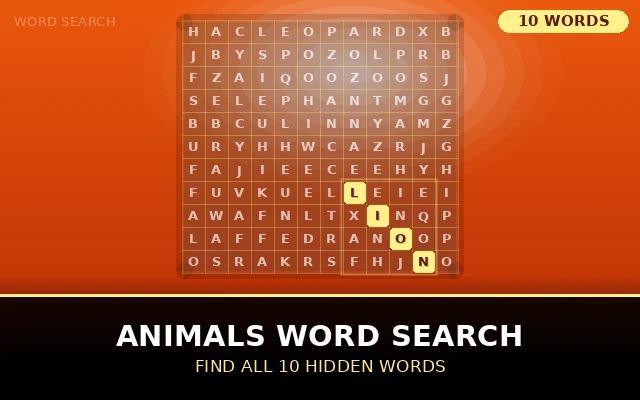
Find wild, domestic and exotic animal names hidden in our Animals word search. A...
Play Now
Find different bear species hidden in the grid! From polar to grizzly, our Bears...
Play Now
Lions, tigers, leopards and cheetahs hidden in the grid! Play our Big Cats word ...
Play NowButterflies, beetles, ants and more hidden in the grid! Play our Insects word search to explore the fascinating world of bugs. Free puzzle play online now!
Find wild, domestic and exotic animal names hidden in our Animals word search. A fun, educational puzzle for all ages. Play free online no registration needed.
Play Now
Find different bear species hidden in the grid! From polar to grizzly, our Bears word search is a fun wildlife challenge. Free to play Online Puzzle.
Play Now
Lions, tigers, leopards and cheetahs hidden in the grid! Play our Big Cats word search for a roaring good time. Free online puzzle no registration needed!
Play NowInsects Word Search Guides & Articles
Insects Word Search: Exploring the Tiny World of Bugs Through Puzzle Play
Insects may be small, but they make up the largest and most diverse group of animals on the planet, with millions of species buzzing, crawling, and fluttering across nearly every environment on Earth. An insects word search takes this tiny yet endlessly fascinating world and turns it into an engaging puzzle experience. It is a theme that works equally well for young children just beginning to learn about bugs and for adults who appreciate the surprising complexity of insect life. This article looks at why insects make such a compelling word search topic, the most commonly featured bugs, and the educational value hidden within this playful puzzle format.
Why Insects Make a Great Word Search Theme
Insects are everywhere, in gardens, forests, homes, and even in the smallest cracks of a city sidewalk, which makes them instantly familiar to solvers of all ages. Unlike more exotic animal themes, an insects word search draws on creatures that most people encounter in daily life, from the ants marching across a picnic blanket to the butterflies fluttering through a summer garden. This familiarity makes the puzzle approachable, while the sheer variety of insect species, colors, and behaviors keeps the word list fresh and interesting.
Getting to Know the World of Insects
Understanding a few key insects adds extra enjoyment to solving an It wordsearch puzzle built around this theme.
Ant – Highly social insects, ants live in organized colonies and are known for their remarkable strength, able to carry many times their own body weight.
Bee – Essential pollinators, bees play a critical role in food production by transferring pollen between flowering plants as they collect nectar.
Butterfly – Known for their colorful wings, butterflies undergo a complete transformation from caterpillar to chrysalis to winged adult, a process called metamorphosis.
Beetle – Making up the largest group of insects on Earth, beetles are recognized by their hardened front wings, which protect a second pair of flight wings underneath.
Dragonfly – One of the fastest flying insects, the dragonfly is also an ancient species, with fossil relatives dating back hundreds of millions of years.
Grasshopper – Equipped with powerful hind legs, grasshoppers can leap great distances relative to their body size to escape predators.
Ladybug – Popular for its bright red and black spotted shell, the ladybug is actually a helpful predator that feeds on garden pests like aphids.
Mosquito – Though often considered a nuisance, only female mosquitoes bite, using the blood meal to develop their eggs.
Cricket – Famous for their chirping sound, crickets produce noise by rubbing their wings together, a behavior known as stridulation.
Moth – Closely related to butterflies, moths are typically active at night and are often attracted to artificial light sources.
Wasp – Known for their painful sting, wasps also serve an important ecological role by preying on other insects that might otherwise damage crops.
Cockroach – Remarkably resilient, cockroaches can survive in a wide range of environments and are considered one of the most adaptable insects on Earth.
Common Words Found in an Insects Word Search
Alongside individual insect names, a well-rounded insects word search often includes vocabulary related to insect biology and behavior. Common terms include Antenna, Exoskeleton, Metamorphosis, Pollinate, Larva, Colony, Habitat, Camouflage, Nectar, Hive, Cocoon, and Swarm. These words help solvers connect individual bugs to the broader scientific concepts that explain how insects grow, communicate, and interact with their environment.
Educational Benefits of an Insects Word Search
Beyond casual entertainment, this puzzle theme carries genuine educational weight, particularly for young learners studying life science.
Introduction to Biology – Searching for terms like "Larva" or "Metamorphosis" gives children an early, low-pressure introduction to biological concepts they will study more formally later in school.
Appreciation for Small Creatures – Many people overlook or fear insects, but learning their names and roles through a puzzle can build appreciation for their importance in nature.
Ecological Awareness – Insects such as bees and ladybugs play vital roles in pollination and pest control, and a themed word search naturally opens the door to conversations about ecosystems and food chains.
Spelling and Vocabulary Growth – Many insect names and related terms are unfamiliar to young readers, offering valuable practice in spelling and word recognition.
Science Classroom Integration – Insects are a staple of elementary science curriculums, making this word search a natural companion activity for lessons on life cycles, habitats, and animal classification.
Tips for Solving an Insects Word Search
Insect names tend to be shorter and more varied in structure compared to some other animal themes, which calls for a slightly different solving approach. Start by locating the shortest words first, such as "Ant" or "Bee," since these are quick wins that build momentum. Next, scan for insect names that share common letter patterns, like the double "T" in "Beetle" or the repeated "S" in "Grasshopper," as these distinctive patterns are easier to spot at a glance. Finally, working through the grid in a consistent direction, left to right and top to bottom, helps ensure that no hidden word is missed, especially in larger, more complex puzzles.
Why Insects Deserve Our Attention
Insects are often misunderstood or dismissed as pests, but they are fundamentally important to nearly every ecosystem on the planet. Bees and butterflies pollinate the crops that make up a significant portion of the global food supply, while other insects break down organic matter, control pest populations, or serve as a food source for birds and small mammals. An insects word search offers a gentle, engaging way to introduce this importance to younger audiences, helping shift perception from simple annoyance to genuine ecological respect.
Related Puzzles:
- Pets Word Search
-
Aquarium Fish Word Search
-
Australian Animals Word Search
-
Arctic Animals Word Search
-
Jungle Animals Word Search
-
Amphibians Word Search
-
Bears Word Search
-
Big Cats Word Search
-
Reptiles Word Search
-
Sea Life Word Search
-
Elephants Word Search
-
Types of Snakes Word Search
-
Wild Cats Word Search
-
Dinosaurs Word Search
-
Dangerous Animals Word Search
-
Common Pets Word Search
-
Farm Animals Word Search
-
Type of Dogs Word Search
-
Birds Word Search
-
Animals Word Search
-
Ocean Creatures
Who Enjoys an Insects Word Search
This theme is particularly popular in elementary classrooms, where insects are a common subject in early science education. Parents also use insect-themed puzzles as a fun summer activity, especially when paired with outdoor bug-watching or gardening. Adults who enjoy nature, gardening, or entomology as a hobby often find this puzzle theme surprisingly satisfying, offering a lighthearted way to engage with a subject they already find fascinating. Because insects are found virtually everywhere in the world, this puzzle theme resonates with an incredibly broad and diverse audience.
Conclusion
An insects word search proves that even the smallest creatures can inspire big learning opportunities. From the tireless work of ants and bees to the quiet transformation of a caterpillar into a butterfly, each hidden word on the grid connects solvers to a world that is easy to overlook but essential to life on Earth. Beyond the simple enjoyment of finding hidden letters, this puzzle theme builds vocabulary, introduces foundational science concepts, and fosters a deeper appreciation for the insect world. Whether used as a classroom activity, a rainy-day pastime, or a relaxing solo puzzle session, an insects word search turns everyday backyard creatures into the stars of an engaging and educational challenge.