Constellations Word Search: Bringing the Night Sky Down to Paper
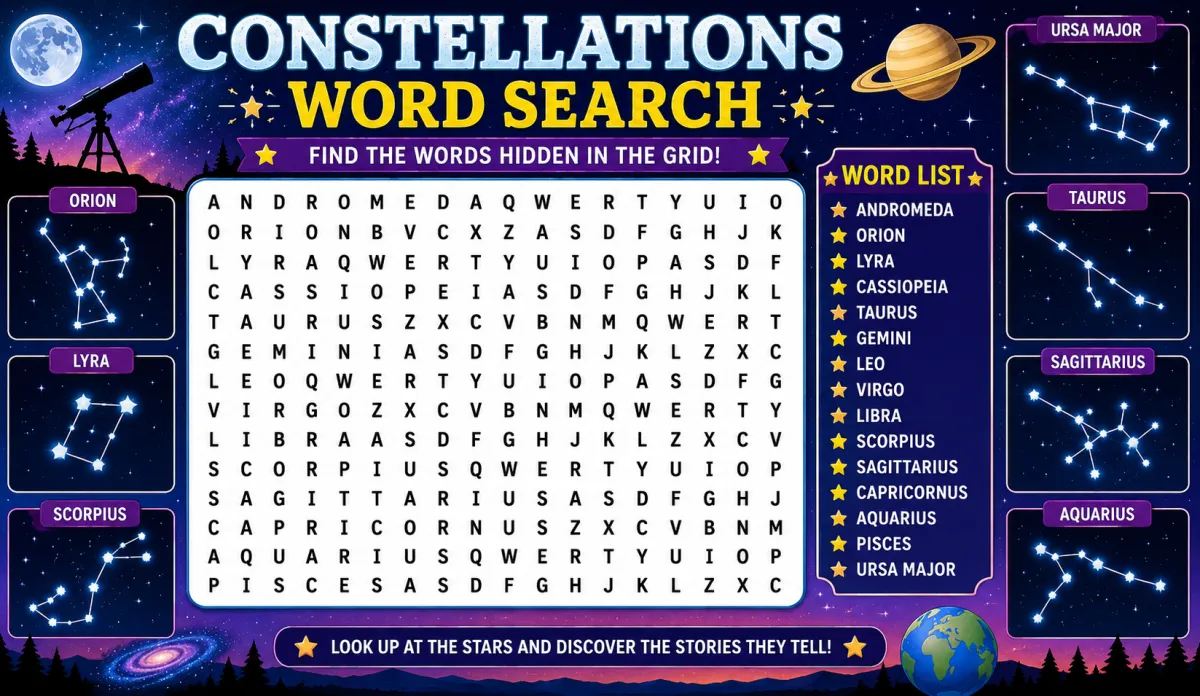
Thousands of years before anyone pointed a telescope at the sky, shepherds, sailors, and storytellers were already tracing shapes between the stars and giving them names that have survived into the modern age. That same sense of wonder is what makes a constellations word search such an enduring and satisfying puzzle format. It takes the ancient, sprawling map of the night sky and compresses it into a simple grid of letters, inviting solvers to rediscover star patterns one hidden word at a time.
This article walks through the history behind constellation naming, how a word search puzzle turns that history into an engaging activity, the kinds of vocabulary these puzzles usually draw from, and practical ways to enjoy or design one for different age groups and settings.
A Brief History: From Sky Stories to Modern Puzzles
Long before formal astronomy existed, ancient cultures in Mesopotamia, Greece, and beyond looked to the sky as a kind of shared canvas. Groups of stars were connected into shapes representing gods, animals, and heroes, giving rise to the constellations we still recognize today, such as Orion the hunter or Ursa Major the great bear. These names weren't just decorative; they helped early civilizations track seasons, navigate the seas, and pass down cultural myths from one generation to the next.
Fast forward to the present, and the International Astronomical Union now recognizes eighty-eight official constellations, each with a defined boundary in the sky. This long history of naming and mapping the stars provides a surprisingly rich foundation for word puzzles, since constellation names carry built-in stories, cultural context, and linguistic variety drawn largely from Greek and Latin origins.
A constellations word search essentially repackages this centuries-old tradition into a format that feels playful rather than academic, letting solvers brush up against astronomical history simply by hunting for hidden letters.
- Heavens Crossword Puzzle
- Solar System Word Search
-
Stars and Galaxies Word Search
-
Space Exploration Word Search
Breaking Down the Puzzle: How It Works
At its core, a constellations word search follows the same mechanics as any classic word-find puzzle. Solvers are presented with a grid of letters and a list of target words, which they must locate by scanning in any direction, including horizontally, vertically, diagonally, or even backward. What distinguishes this version from a generic puzzle is simply the subject matter: every hidden word relates in some way to constellations, stars, or the broader field of astronomy.
- A Brief History: From Sky Stories to Modern Puzzles
- Breaking Down the Puzzle: How It Works
- The Vocabulary Universe: What These Puzzles Include
- Why This Format Works So Well for Learning
- Designing Puzzles for Different Age Groups
- Making Your Own Constellations Word Search
- Beyond the Classroom: Everyday Uses for These Puzzles
- Final Thoughts
The appeal lies in the contrast between the puzzle's simplicity and the depth of the subject behind it. A solver circling the word "Cassiopeia" in a grid may not realize they're also brushing against a myth involving a vain queen from Greek legend, or that the constellation itself sits near the North Star in the night sky. The puzzle format quietly carries this context along with it, even for solvers who aren't actively thinking about astronomy while they play.
The Vocabulary Universe: What These Puzzles Include
Rather than relying on a narrow list of star names, most constellation word searches pull from several overlapping pools of vocabulary, giving the puzzle more depth and replay value.
Recognizable constellations form the backbone of most puzzles, featuring widely known patterns such as Orion, Ursa Major, Ursa Minor, Cassiopeia, Leo, and Scorpius. These tend to appear in almost every version of the puzzle since they're the easiest for solvers to identify in the actual night sky.
Zodiac constellations often make an appearance as well, since they carry cultural relevance beyond astronomy. Aries, Taurus, Gemini, Cancer, Virgo, Libra, Sagittarius, Capricorn, Aquarius, and Pisces are commonly included, appealing to solvers with an interest in astrology as much as astronomy.
Mythological figures tied to constellation names, such as Perseus, Hercules, Pegasus, and Andromeda, add a storytelling layer to the puzzle, reminding solvers that these star patterns were named with narrative purpose rather than arbitrary labeling.
Broader astronomy terms like galaxy, nebula, light-year, telescope, and magnitude round out many puzzles, giving them relevance beyond constellation names alone and introducing solvers to foundational scientific vocabulary.
Star classifications, including terms like supergiant, binary star, dwarf star, and variable star, occasionally appear in puzzles designed for older or more advanced audiences, adding a scientific layer beneath the mythology.
Skywatching vocabulary such as circumpolar, equinox, solstice, and celestial equator sometimes rounds out puzzles focused specifically on observational astronomy and how constellations were historically used for navigation and timekeeping.
Why This Format Works So Well for Learning
Unlike flashcards or memorization drills, a word search asks solvers to engage with vocabulary repeatedly and visually, without the pressure of being tested. Each time a solver scans the grid looking for "Sagittarius" or "nebula," they're reinforcing recognition of that word's spelling and shape, even if they never consciously try to memorize it.
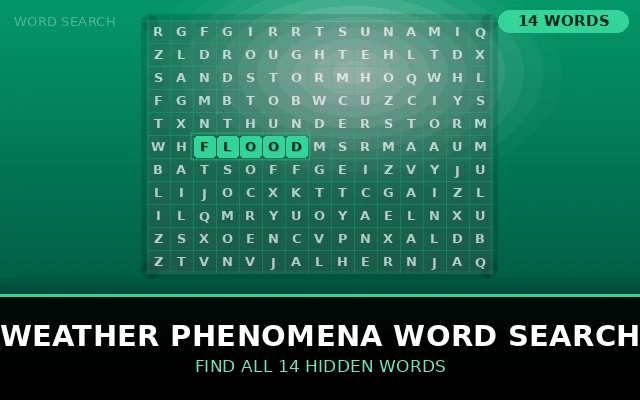
This passive repetition makes constellation word searches especially useful for younger learners, who often benefit more from playful reinforcement than from direct instruction. It also works well for adult hobbyists brushing up on astronomy vocabulary before a stargazing trip or planetarium visit, since the puzzle format feels more like a relaxing pastime than a study session.
Teachers in particular have found value in this approach, using constellation word searches as a supplement rather than a replacement for structured lessons. A puzzle can reinforce vocabulary introduced during a lesson on the zodiac or seasonal constellations, giving students independent practice time that still feels enjoyable rather than repetitive.
Designing Puzzles for Different Age Groups
One of the strengths of the word search format is how easily it scales across age groups and skill levels. For younger children or complete beginners, a smaller grid, often around 10x10, paired with a short list of widely recognized constellations like Orion or Leo, keeps the activity approachable and quick to complete.
For older students or hobbyists looking for more of a challenge, larger grids in the range of 15x15 to 20x20 allow for longer, more obscure words such as "circumpolar" or "celestial equator," along with a greater total number of hidden terms. Increasing the number of directions words can be hidden in, including backward and diagonal placements, also raises the difficulty considerably.
Some puzzle designers further tailor difficulty by grouping words thematically, such as separating a beginner puzzle focused purely on well-known constellations from an advanced version that blends mythology, star classifications, and observational terms together for a more comprehensive challenge.
Making Your Own Constellations Word Search
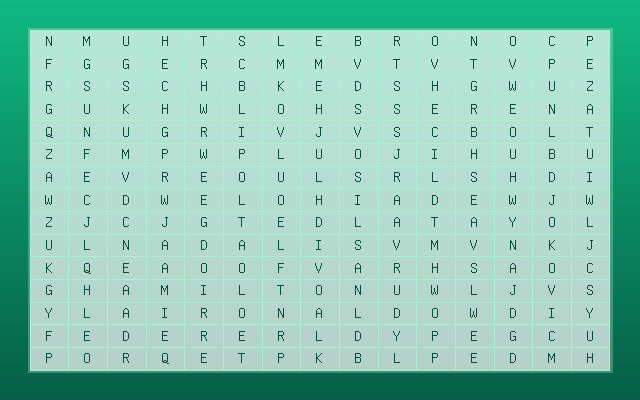
Building a custom puzzle is a manageable task, even without any specialized design background. The process typically starts with selecting a word list, ideally pulling from a mix of the categories described earlier to keep the puzzle varied and engaging rather than repetitive.
Once the word list is finalized, choosing an appropriate grid size depends largely on the intended audience, with smaller grids suited to children and larger ones offering more of a challenge for older solvers. The selected words are then arranged within the grid in multiple directions, and the remaining empty cells are filled with random letters to help conceal the hidden terms.
Free word search generator tools available online can handle much of this layout work automatically, allowing teachers, parents, and astronomy enthusiasts to simply input their chosen word list and receive a ready-to-print puzzle in return, without needing any specialized software or design skills.
Beyond the Classroom: Everyday Uses for These Puzzles
While constellation word searches are a natural fit for classrooms, their appeal extends well beyond formal education. Family road trips, camping activity books, and rainy-day boredom busters often include these puzzles as a screen-free way to introduce children to the night sky in a low-pressure format.
Science museums and planetariums frequently distribute constellation word searches as takeaway activities following a show, giving visitors a way to reinforce what they just learned in a hands-on format. Astronomy clubs also use these puzzles in newsletters and community events, offering a lighthearted activity that keeps members engaged between stargazing sessions.
Even outside of any structured setting, many people simply enjoy constellation word searches as a relaxing solo activity, similar to a crossword or sudoku, but with the added bonus of brushing up on astronomy along the way.
Gift shops attached to observatories and science centers have also picked up on this appeal, often including printed constellation word searches alongside star charts and postcards as an inexpensive, family-friendly souvenir. Because the puzzles require no batteries, screens, or setup, they travel easily and hold up well as a quiet activity during long car rides or flights, especially for families heading toward a stargazing destination or astronomy-themed vacation.
Final Thoughts
A constellations word search takes one of humanity's oldest traditions, naming and storytelling through the stars, and reshapes it into a format that feels immediately approachable and fun. By blending recognizable star patterns, mythological references, and scientific vocabulary into a single grid, these puzzles offer something for complete beginners and seasoned astronomy enthusiasts alike. Whether encountered in a classroom, a planetarium gift shop, or a quiet evening at home, a constellations word search proves that the night sky's oldest stories can still spark curiosity today, one hidden word at a time.