Famous Scientists Word Search: Discovering the Minds That Changed the World
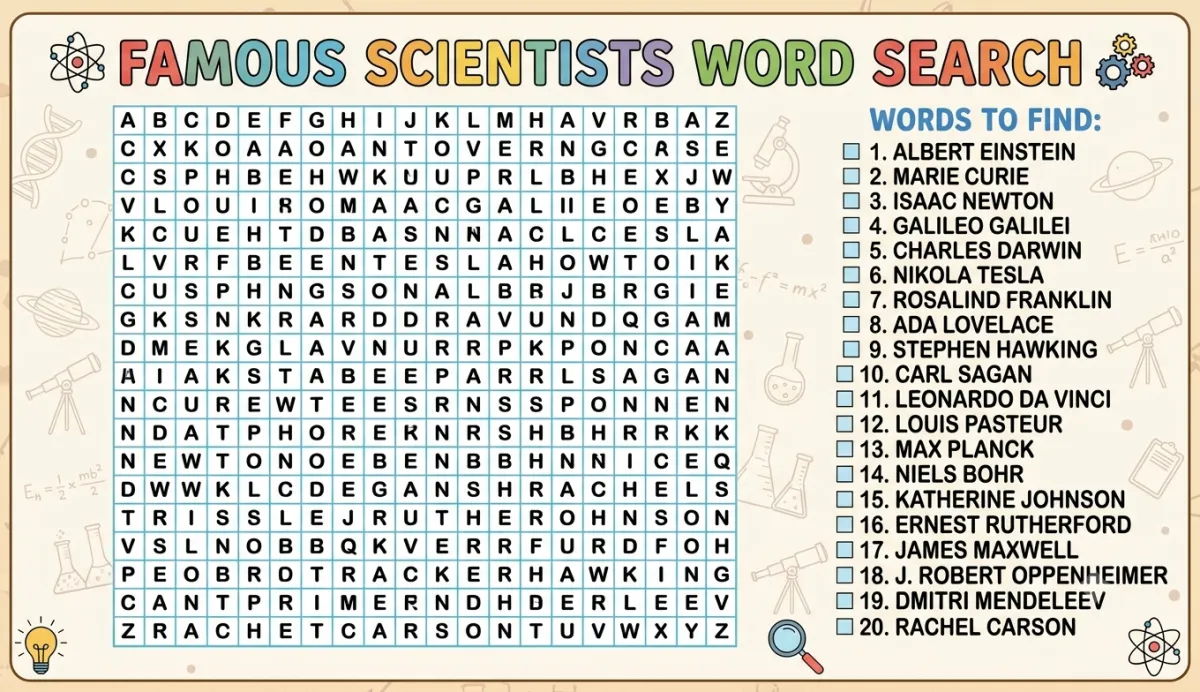
Throughout history, a handful of remarkable individuals have transformed the way we understand the universe, from the laws that govern falling objects to the invisible forces that carry electricity through a wire. A famous scientists word search takes the names of these groundbreaking thinkers and turns them into an engaging vocabulary puzzle, hiding each name inside a letter grid and inviting solvers to uncover a piece of scientific history one word at a time.
What Is a Famous Scientists Word Search?
A famous scientists word search is a grid-based It wordsearch puzzle in which the names of well-known scientists are hidden horizontally, vertically, diagonally, or backwards among rows of letters. Solvers use a provided word list to scan the grid carefully, circling each hidden name as it is found. Rather than presenting science history as a plain list of names to memorize, this puzzle format wraps the learning experience inside an interactive challenge that keeps solvers engaged and curious from the first name they recognize to the last.
What makes this theme especially valuable is how naturally it connects to classroom learning already taking place across nearly every subject in science education. Whether students are studying physics, biology, chemistry, or astronomy, the names hidden in a famous scientists word search often correspond directly to concepts they are already encountering in their coursework, reinforcing vocabulary in a way that feels connected rather than disconnected from what they are learning.
Why This Themed Puzzle Works So Well
Word search puzzles have long been recognized as effective tools for reinforcing vocabulary and spelling, and pairing that structure with the names of influential scientists adds genuine educational depth. Many scientist surnames, such as Einstein, Curie, or Darwin, are already familiar to students in a general sense, but actively searching for and correctly spelling these names in a puzzle format helps cement that recognition far more effectively than passive reading alone, giving the vocabulary a lasting place in memory rather than a fleeting one.
This activity also strengthens several cognitive skills simultaneously. Locating a hidden name requires the solver to hold a target word in working memory while systematically scanning rows and columns, a task that builds sustained attention and visual pattern recognition. For students who might find dense science textbooks intimidating, a famous scientists word search offers a low-pressure, engaging entry point into a subject that can otherwise feel overwhelming or abstract.
There is also a genuine inspirational dimension to this theme. Encountering the names of pioneering scientists in a fun, approachable format often sparks curiosity about their discoveries and life stories, giving teachers and parents a natural opening to discuss perseverance, curiosity, and the scientific method in an engaging, memorable way that sticks with students long after the puzzle itself has been completed and set aside.
Building a Well-Rounded Word List
Creating an effective famous scientists word search starts with a word list that spans multiple scientific disciplines and eras:
Physics Pioneers – Einstein, Newton, and Hawking anchor most puzzles with widely recognized names tied to some of the most fundamental discoveries about how the universe works.
Chemistry and Biology Innovators – Curie, Darwin, and Mendel introduce vocabulary tied to groundbreaking discoveries in chemistry, evolution, and genetics.
Astronomy and Space Science Figures – Galileo, Copernicus, and Hubble round out the list with names connected to humanity's understanding of space and the cosmos.
Modern and Diverse Contributors – Names such as Tesla, Franklin, and Turing add variety, introducing students to a broader range of scientific fields, including engineering, molecular biology, and computer science.
Balancing shorter, widely recognized names with a handful of longer or less familiar ones ensures that a famous scientists word search remains engaging for a wide range of ages and knowledge levels, rather than feeling either too simple or too obscure.
Adjusting Difficulty for Every Age Group
As with any word search, difficulty depends on grid size, total word count, and the directions names are allowed to appear in. A smaller 10x10 grid featuring a dozen widely recognized scientist names in straightforward horizontal placements works well for younger students just beginning to explore science history. As solvers grow more confident, expanding to a 15x15 or 20x20 grid, adding diagonal and backwards placements, and introducing lesser-known but equally important scientists creates a genuinely challenging experience for older students and dedicated science enthusiasts.
Many teachers prepare two versions of the same famous scientists word search, a simplified beginner grid and a more advanced version, allowing the same educational theme to serve an entire classroom regardless of individual grade level or prior science knowledge, without leaving any student feeling either bored or overwhelmed by the challenge in front of them.
Where This Puzzle Shines
A famous scientists word search fits naturally into a wide variety of educational settings. Science teachers frequently use it when introducing a new unit, giving students a fun way to preview the names and figures they will encounter throughout the lesson before diving into more detailed biographical or conceptual material. Museums with science and history exhibits often include a version of this puzzle in educational handouts, reinforcing what visitors just learned while exploring a display on a particular scientist's life and discoveries, turning a passive museum visit into a slightly more active and memorable learning experience for younger visitors in particular.
Homeschool families studying the history of science can pair a famous scientists word search with a short biography reading assignment, using the puzzle as a fun reinforcement activity rather than a standalone worksheet, giving students a lighter, more playful way to engage with material that can otherwise feel dense or purely academic. Science fair events and STEM enrichment programs sometimes include this puzzle as a lighthearted activity table, giving students a moment of fun engagement between more intensive project presentations and judging sessions.
Even outside of formal educational settings, many adults enjoy history-of-science puzzles simply because the subject matter feels genuinely fascinating, treating the activity much like a relaxing trivia session, but with the added benefit of reinforcing knowledge about the people whose discoveries continue to shape everyday life.
The Stories Behind the Names
Part of what makes a famous scientists word search so rewarding is the genuine history behind every name on the list. Marie Curie remains the only person to win Nobel Prizes in two different scientific fields, physics and chemistry, despite facing significant barriers as a woman in science during her era. Charles Darwin spent years developing his theory of evolution after a voyage that took him to remote islands where he observed subtle but crucial differences among similar species. Albert Einstein's theories fundamentally reshaped our understanding of space, time, and gravity, ideas that once seemed purely theoretical but now underpin technologies many people rely on every single day.
These small but fascinating details give a famous scientists word search extra educational depth beyond simple name recognition. A teacher or parent can use each name found in the puzzle as a jumping-off point for a quick biographical fact, turning a few minutes of puzzle-solving into a genuine history lesson. This layered approach helps explain why science history content continues to resonate so strongly with curious students of every age, since each name represents not just a fact to memorize but a genuine story of curiosity, persistence, and discovery.
- Arctic and Polar Animals Word Search
- Ancient Egypt Word Search
- Coffee and Tea Word Search
- Arctic and polar animals word search
A Puzzle That Grows With New Discoveries
Science never stops advancing, and neither does the list of individuals whose work deserves recognition. A famous scientists word search can always be refreshed with contemporary researchers alongside history's most iconic figures, keeping the theme feeling relevant even as it celebrates discoveries made centuries ago. This flexibility allows teachers to tailor each puzzle to whatever unit students are currently studying, whether that means highlighting classical physics one week and modern genetics research the next.
Tips for Solving This Puzzle Quickly
Solvers looking to move through a famous scientists word search efficiently can use a few simple strategies. First, scan the entire grid once for short, widely recognized names like "Curie" or "Tesla," since these tend to stand out immediately. Next, focus on the longest names in the list, such as "Copernicus" or "Einstein," as their unusual letter combinations make them easier to isolate once the general shape is known. Working systematically through the grid, row by row and then column by column, helps ensure that diagonal or backwards names are not overlooked.
Conclusion
A famous scientists word search brings the remarkable achievements of history's greatest minds onto the page, turning influential names into a genuinely engaging vocabulary-building activity. By combining physics pioneers, biology innovators, and astronomy legends within a flexible, scalable format, this puzzle appeals to curious students and lifelong science enthusiasts alike. Whether used as a classroom introduction, a museum activity, or simply a relaxing personal pastime, a well-built famous scientists word search proves that learning about the history of science can be every bit as engaging as the discoveries themselves.