Solar System Word Search: A Puzzle That Takes You From the Sun to the Edge of Space
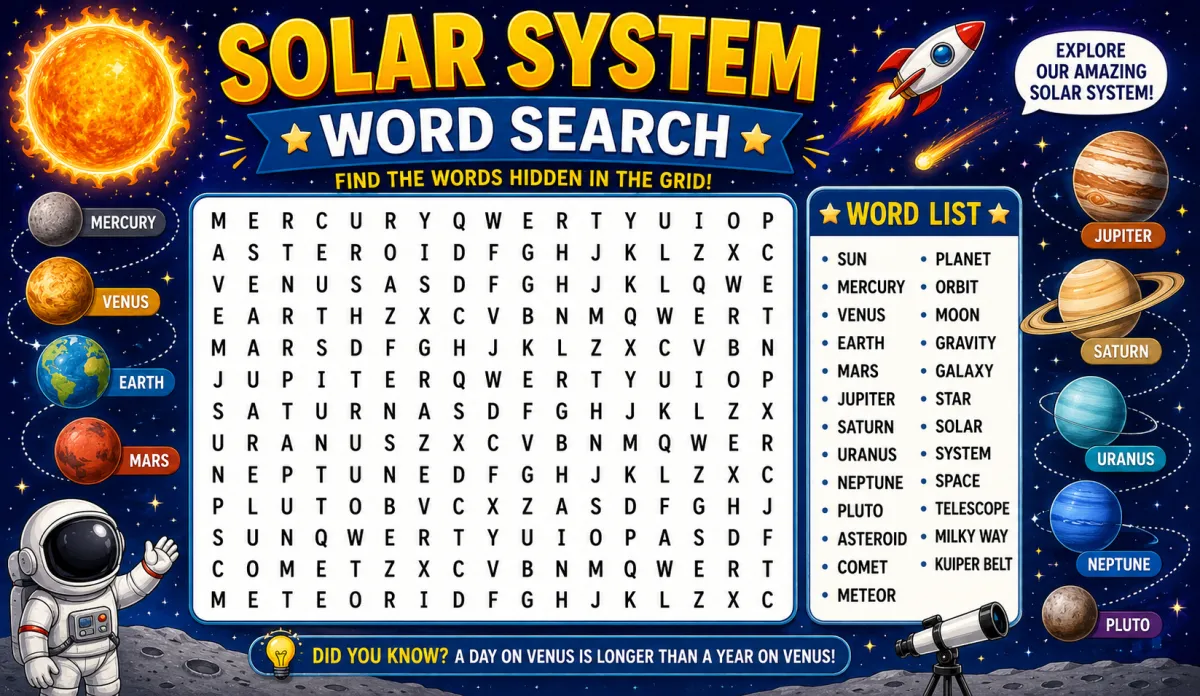
There's something almost dizzying about the scale of our solar system. A single trip from the Sun to Neptune would take a spacecraft years to complete, yet a solar system word search can shrink that entire journey down to a single sheet of paper, turning planets, moons, and cosmic phenomena into something you can hold in your hands and explore letter by letter. It's a small format carrying an enormous subject, and that contrast is part of what makes it such an enjoyable and effective learning tool.
This article takes you through what a solar system word search actually involves, walks through the kind of vocabulary these puzzles tend to include by touring the solar system itself, and looks at how the format is used, scaled for different ages, and built from scratch.
What Exactly Is a Solar System Word Search?
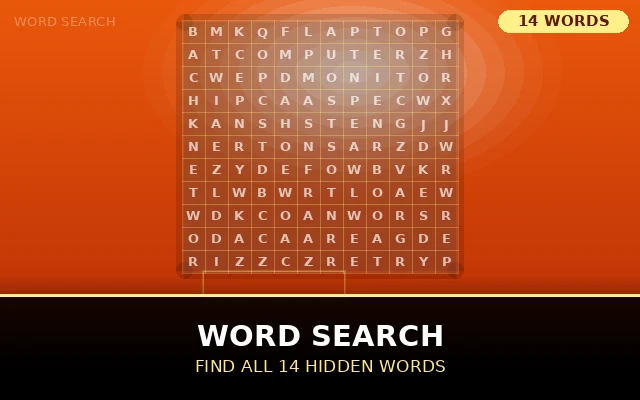
Like any classic word-find puzzle, a solar system word search presents solvers with a grid of letters and a list of target words to locate within it, searching in any direction the puzzle allows, whether that's across, up and down, diagonally, or reversed. The subject matter is what sets it apart. Every hidden word connects back to our cosmic neighborhood, drawing from planet names, moons, and the broader vocabulary of astronomy.
Because the solar system is such a well-defined and familiar subject, even for those with only a passing interest in space, these puzzles tend to strike a comfortable balance between accessibility and depth, making them popular in classrooms, science centers, and casual puzzle collections alike.
A Guided Tour: The Words Hidden Inside the Puzzle
Rather than sorting solar system vocabulary into rigid categories, it helps to imagine the puzzle as a journey outward from the center of our solar system, picking up new words at every stop along the way.
The journey naturally begins at the Sun, the star at the center of everything, often accompanied by related words like solar flare, corona, and sunspot in more advanced puzzles. From here, most word searches move outward to the four rocky inner planets: Mercury, Venus, Earth, and Mars. These names are usually the easiest for solvers to recognize, making them common anchors in beginner-friendly puzzles.
Continuing outward, the puzzle often passes through the asteroid belt, introducing words like asteroid and occasionally Ceres, the largest object in that region and technically classified as a dwarf planet. This stretch of the solar system tends to appear in slightly more advanced puzzles, since it requires solvers to understand that not everything orbiting the Sun is a full-sized planet.
From there, the tour reaches the outer gas giants: Jupiter, Saturn, Uranus, and Neptune. These planets often bring along their own supporting vocabulary, such as rings, referencing Saturn's famous feature, or Great Red Spot, the massive storm associated with Jupiter. Puzzles aimed at older students sometimes include these more specific details to add depth beyond simple planet names.
Beyond Neptune, the journey often continues into the outer reaches of the solar system, where words like Pluto, dwarf planet, and Kuiper Belt frequently appear. This region introduces solvers to the ongoing scientific debate around planetary classification, since Pluto's reclassification from planet to dwarf planet remains a widely discussed topic in astronomy education.
Alongside this outward journey, many puzzles weave in a parallel thread of moons, featuring well-known examples like Luna, Earth's own moon, along with Titan, Saturn's largest moon, and Europa, one of Jupiter's moons frequently discussed for its potential to harbor life beneath an icy surface.
Finally, no solar system word search feels complete without a handful of broader phenomena and structural terms, such as orbit, gravity, axis, rotation, comet, meteor, and eclipse. These words tie the entire journey together, reinforcing the physical forces and events that govern how the solar system behaves as a whole.
Why This Journey-Based Vocabulary Works So Well for Learning
Framing the solar system as a journey rather than a static list mirrors how many students first encounter the subject in school, often through diagrams or models that travel outward from the Sun. A word search that follows this same outward progression reinforces the spatial relationships between planets, rather than presenting their names as an arbitrary jumble to memorize.
This approach also naturally builds in a sense of scale and progression. Solvers searching for "Mercury" early in their exploration and "Neptune" much later absorb, even if only subconsciously, the sense that these two planets sit at opposite ends of an enormous distance. Pairing this spatial awareness with the simple, repetitive act of scanning a grid creates a learning experience that feels far less like memorization and more like exploration.
For younger students in particular, this format offers an approachable way to become familiar with planet order and names before diving into more complex astronomy lessons involving orbital mechanics or planetary composition. For older students, the inclusion of moons, phenomena, and classification terms like "dwarf planet" adds enough depth to keep the puzzle intellectually engaging rather than overly simple.
Adjusting the Puzzle for Different Ages and Skill Levels
The flexibility of the word search format makes it easy to scale a solar system puzzle for a wide range of ages. For younger children just learning the names of the planets, a compact grid, often 10x10 or smaller, paired with a short list limited to the eight major planets and perhaps the Sun and Moon, keeps the activity simple and encouraging.
For older students, expanding the grid to 15x15 or 20x20 allows room for a longer word list that includes moons, dwarf planets, and phenomena like eclipses or comets. Increasing the number of directions in which words can be hidden, including diagonal and backward placements, further raises the challenge for solvers who are ready for something more demanding.
Some puzzle designers also introduce difficulty by mixing in less obvious vocabulary, such as "Kuiper Belt" or "corona," alongside the more familiar planet names, ensuring that even solvers who already know the basics still encounter something new.
How These Puzzles Come Together
Building a solar system word search generally follows the same process as any themed word-find puzzle. It starts with assembling a word list, ideally structured as a journey outward from the Sun as described above, to keep the puzzle both organized and educational.
From there, an appropriate grid size is chosen based on the intended audience, followed by placing each word into the grid across a mix of directions. The remaining empty spaces are filled with random letters to disguise the hidden terms and add an appropriate level of challenge.
Free online word search generator tools can automate much of this process, allowing teachers, parents, and space enthusiasts to input a word list and receive a properly formatted, printable puzzle without needing any design experience.
Where These Puzzles Show Up
Solar system word searches are a staple of elementary and middle school science classrooms, often distributed alongside lessons on planetary order, gravity, or the difference between planets and dwarf planets. Science museums and planetariums frequently include them as takeaway activities following a space-themed exhibit or show, giving young visitors a way to reinforce what they just learned.
Beyond formal education, these puzzles also appear in space-themed birthday party activity bags, summer camp workbooks, and even outreach materials designed to make astronomy approachable for families. Because the solar system is such a universally recognized subject, the puzzle format translates easily across age groups, classrooms, and casual settings alike.
Beyond print, some versions of the puzzle have also moved into digital form, appearing as interactive apps or browser-based games that let solvers tap and drag across a touchscreen instead of circling words with a pencil. This shift has helped the format reach a new generation of learners who are more accustomed to screens than printed worksheets, while still preserving the same core appeal of hunting for hidden vocabulary within a grid.
Homeschooling parents have also embraced solar system word searches as an easy way to supplement science curricula without needing additional textbooks or expensive materials. A single printed puzzle can reinforce an entire unit's worth of planet names and vocabulary, making it a practical addition to lesson plans that already cover a wide range of subjects. Similarly, libraries running summer reading programs with a space theme often include these puzzles in activity packets, giving children something engaging to do between borrowing books about astronauts and telescopes.
Final Thoughts
A solar system word search in Heavens Crossword Puzzle takes one of the largest subjects imaginable and reshapes it into something approachable, playful, and genuinely educational. By following the natural outward journey from the Sun through the inner planets, the asteroid belt, the outer gas giants, and finally into the distant reaches of the Kuiper Belt, these puzzles quietly reinforce both vocabulary and spatial understanding of our cosmic neighborhood. Whether used in a classroom, handed out at a planetarium, or simply enjoyed as a quiet afternoon activity, a solar system word search proves that even the vastness of space can fit neatly into a single, satisfying puzzle.