Mythology Word Search: Explore Gods, Legends, and Mythical Creatures Through Puzzles
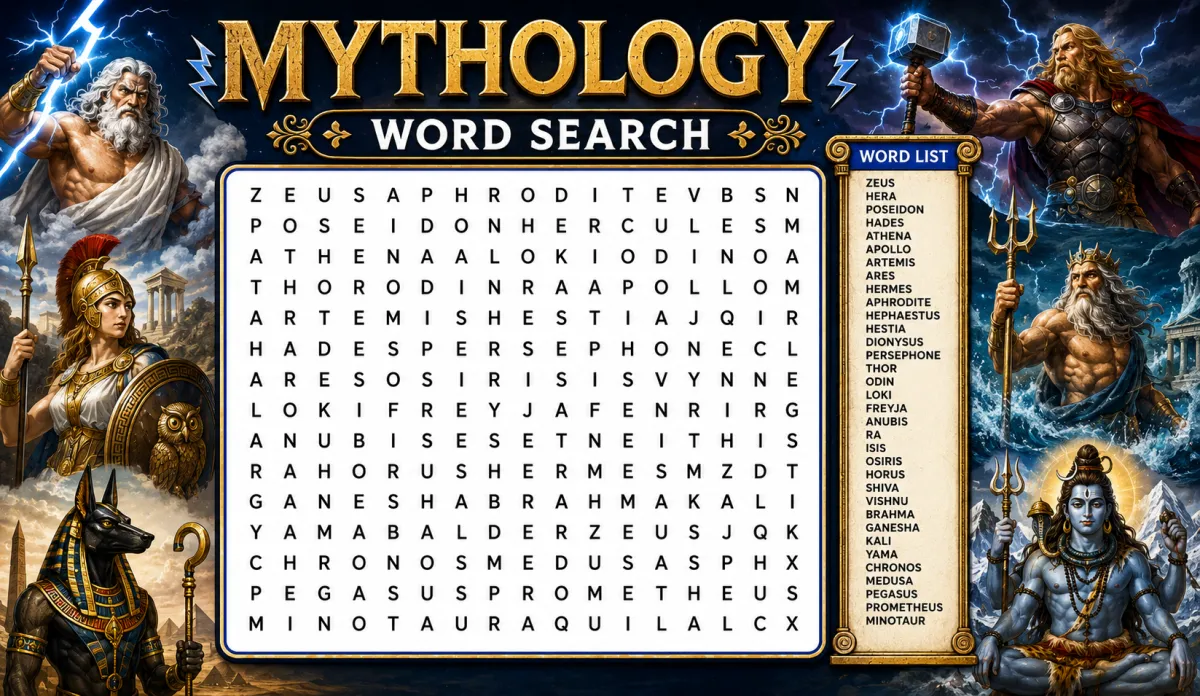
Long before superheroes and fantasy franchises dominated pop culture, ancient civilizations told stories of gods, monsters, and legendary heroes that still shape storytelling today. A mythology word search brings that ancient world into a modern puzzle format, letting solvers rediscover names like Zeus, Odin, and Anubis one hidden word at a time.
Whether you are a student working through a mythology unit, a fan of fantasy books and games rediscovering the original source material, or simply someone who enjoys a themed puzzle, mythology offers one of the richest and most flexible subjects a word search can be built around.
What Is a Mythology Word Search?
A mythology word search is a themed puzzle built around the vocabulary of ancient myths gods, goddesses, legendary creatures, and key figures from cultures around the world. Instead of generic vocabulary, every hidden word connects to a story, giving the puzzle a narrative pull that keeps solvers curious about what they will find next.
The puzzle mechanics stay the same as any classic word search letters arranged in a grid, words hidden horizontally, vertically, diagonally, or backward but the mythology theme adds an extra layer of intrigue, since many solvers already have some familiarity with these names from books, films, or games.
Why Mythology Word Search Puzzles Are More Popular Than Ever
Interest in mythology has surged thanks to popular books, films, and video games drawing heavily on ancient legends. Readers who grew up following demigod adventures or players exploring Norse-inspired game worlds often want to go deeper into the source material, and a themed word search offers an approachable entry point — no textbook required.
- What Is a Mythology Word Search?
- Why Mythology Word Search Puzzles Are More Popular Than Ever
- Categories Commonly Found in a Mythology Word Search
- Greek Mythology Word Search Terms
- Norse Mythology Word Search Terms
- Egyptian Mythology Terms
- Mythical Creatures Word Search Terms
- Legendary Heroes and Sacred Objects
- Educational Benefits of a Mythology Word Search
- How Mythology Word Search Puzzles Are Designed
- Tips for Solving a Mythology Word Search
- Mythology Word Search for All Ages
- Mythology Word Search Puzzles Beyond the Classroom
- Mythology Word Search and Modern Pop Culture
- Conclusion
This renewed interest spans generations. Younger readers are often introduced to mythology through fiction aimed at middle-grade and young adult audiences, while older audiences frequently rediscover the subject through prestige television, epic film franchises, and narrative-driven video games. A mythology word search sits comfortably at the intersection of all these audiences, since the core vocabulary gods, monsters, legendary weapons, and sacred places remains consistent across every format.
Categories Commonly Found in a Mythology Word Search
Greek Mythology Word Search Terms
Names like Zeus, Athena, Poseidon, and Hades appear frequently, alongside legendary locations such as Olympus and the Underworld. These puzzles are a classroom favorite for introducing classical mythology units, since Greek mythology is one of the most widely taught systems in schools around the world.
Norse Mythology Word Search Terms
Odin, Thor, Loki, and Valhalla are staples of Norse-themed puzzles, appealing to fans of Viking history as well as modern retellings in film and gaming. Norse mythology puzzles often include vocabulary tied to the nine realms, giving solvers a broader sense of the mythological universe beyond just the major gods.
Egyptian Mythology Terms
Words like Anubis, Ra, and pharaoh introduce solvers to a mythology system distinct from Greek and Norse traditions, often used alongside ancient history lessons. Because Egyptian mythology is closely tied to real archaeological history, these puzzles frequently overlap with broader ancient civilization units in the classroom.
Mythical Creatures Word Search Terms
Dragons, sphinxes, centaurs, and phoenixes cross cultural boundaries and appear in almost every mythology-themed puzzle, since these creatures capture imagination regardless of their origin story. A mythical creatures word search is often the most accessible entry point for younger solvers, since these figures are widely recognized through children's books, animated films, and fantasy games.
Legendary Heroes and Sacred Objects
Beyond gods and monsters, many mythology word search puzzles include the names of legendary heroes figures like Hercules, Perseus, or Sigurd along with sacred objects tied to their stories, such as legendary swords, shields, or magical items. These terms add narrative depth to a puzzle, rewarding solvers who already know the myths behind the words they are hunting for.
Educational Benefits of a Mythology Word Search
Mythology units often introduce dozens of unfamiliar names in a short period, which can overwhelm students encountering them for the first time. A themed word search breaks that vocabulary into a manageable, engaging activity, helping names and terms stick before students move into deeper reading or writing assignments. Teachers frequently pair these puzzles with a short discussion connecting each god or creature to their role in mythology, reinforcing both spelling and meaning at once.
Beyond spelling and recall, mythology puzzles also encourage cross-cultural awareness. A single word search that blends Greek, Norse, and Egyptian terms — or a set of puzzles covering each system separately gives students a broader appreciation for how different ancient cultures explained the world through story, even when the specific gods and creatures differ.
How Mythology Word Search Puzzles Are Designed
Puzzle designers usually build mythology word searches around a single tradition rather than mixing systems together, which keeps the theme focused and avoids confusing solvers who are still learning the difference between, say, Norse and Greek deities. Grid size and difficulty typically scale with the intended audience — a mythical creatures puzzle aimed at younger children tends to use a smaller grid with straightforward word placement, while a puzzle covering detailed Greek or Norse vocabulary for older students often uses a larger grid with diagonal and backward words included.
- Dog Breeds Word Search
- Space Exploration Word Search
- Stars and Galaxies Word Search
- Solar System Word Search
- Gaming Word Search
- Music Word Search
Tips for Solving a Mythology Word Search
- Group names by mythology system before scanning Greek, Norse, and Egyptian names have distinct letter patterns that become easier to spot once you know which culture you are looking for.
- Watch for shorter names like "Ra" or "Pan," which are easy to overlook in a busy grid.
- If the puzzle mixes creatures and deities, scan for creature names first, since they tend to be longer and more distinctive.
- Read through the entire word list before starting, since recognizing a name in advance often makes it easier to spot once you begin scanning the grid.
- Pay attention to recurring letter combinations common in a specific mythology, such as endings frequently found in Greek or Norse names.
Mythology Word Search for All Ages
Younger solvers often enjoy puzzles built around mythical creatures, since dragons and unicorns require no background reading to recognize. Older students and mythology enthusiasts, meanwhile, gravitate toward deity-focused puzzles that test recall of specific gods, goddesses, and their domains. This range makes mythology one of the more flexible puzzle themes available, suitable for a classroom of any age or a family puzzle night.
Mythology Word Search Puzzles Beyond the Classroom
Mythology-themed puzzles are not limited to schools. Fantasy book clubs, tabletop gaming groups, and fans of mythology-inspired video games often use themed word searches as a lighthearted way to celebrate their shared interest, whether at a convention, a book club meeting, or simply as a solo activity between chapters of a favorite series.
Mythology Word Search and Modern Pop Culture
Much of the renewed enthusiasm for mythology-themed puzzles comes from their connection to modern storytelling. Films, television series, and video games regularly borrow characters and settings from Greek, Norse, and Egyptian legend, giving audiences a reason to revisit the original myths behind names they already recognize. A themed puzzle offers a natural next step for anyone who finishes a mythology-inspired story and wants to explore the source material in a low-pressure, engaging way.
Conclusion
A mythology word search turns ancient stories into an engaging modern puzzle, connecting solvers to gods, legends, and mythical creatures across cultures. Whether the interest comes from a classroom unit, a favorite book series, or simple curiosity about ancient myths, these puzzles offer a fun and memorable way to explore legendary vocabulary one hidden word at a time.