Stars and Galaxies Word Search: Exploring the Cosmos One Hidden Word at a Time
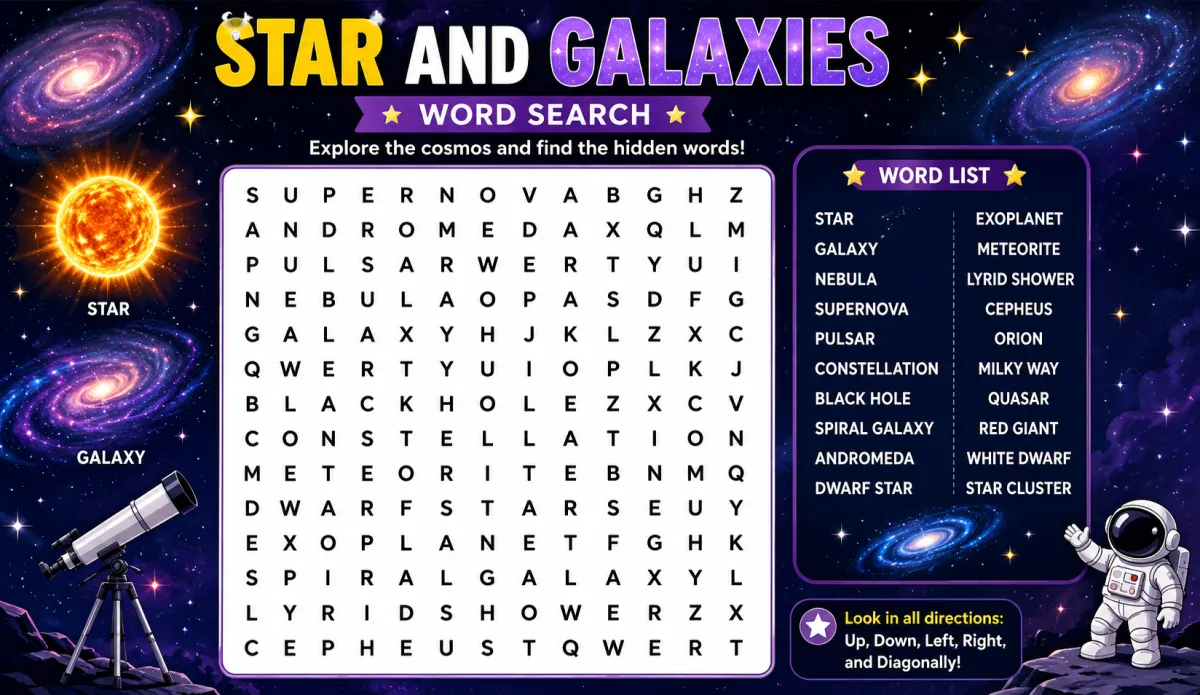
Look up on a clear night, far from city lights, and you're seeing two completely different scales of the universe at once. Individual stars twinkle close enough to feel personal, while entire galaxies, each containing billions of stars of their own, sit so far away that their light takes millions of years to reach us. A stars and galaxies word search takes this enormous contrast and turns it into something approachable, hiding the vocabulary of both scales within a single, satisfying grid of letters.
This article looks at what makes a combined stars and galaxies word search different from a puzzle focused on just one subject, breaks down the kind of vocabulary typically hidden inside, and explores why this format has become such a popular tool for learning, teaching, and simply enjoying astronomy as a hobby.
Two Cosmic Scales in a Single Puzzle
Most space-themed It wordsearch tend to focus narrowly, covering either planets, constellations, or general astronomy terms. A stars and galaxies word search is unique because it deliberately spans two very different scales of the universe within the same puzzle.
On one end, star-focused vocabulary covers the individual points of light we can actually observe with the naked eye or a backyard telescope, along with the science behind how stars form, live, and eventually die. On the other end, galaxy-focused vocabulary zooms out dramatically, covering entire star systems that contain hundreds of billions of stars, along with the broader structures that group galaxies together across unimaginable distances.
Combining these two scales into one puzzle mirrors how astronomy itself is often taught, starting with what's visible and familiar before expanding outward into the vast, almost incomprehensible scale of galaxies and galaxy clusters. This makes a stars and galaxies word search a particularly effective bridge between beginner-level space vocabulary and more advanced astronomical concepts.
What Makes This Puzzle Different From a Typical Space Word Search
While a general space word search or a solar system word search tends to stay grounded within our own cosmic neighborhood, a stars and galaxies word search deliberately reaches further, touching on deep-sky vocabulary that goes well beyond our own Sun and planets. This makes it a natural next step for solvers who have already worked through simpler astronomy or constellation word search puzzles and are ready for something broader in scope.
- Two Cosmic Scales in a Single Puzzle
- What Makes This Puzzle Different From a Typical Space Word Search
- The Word Bank: What You'll Find Hidden in the Grid
- Why This Kind of Puzzle Sticks With You
- Scaling Difficulty for Every Age
- Crafting Your Own Stars and Galaxies Word Search
- Where You'll Encounter This Puzzle in Real Life
- Conclusion
The format also tends to appeal to a slightly older or more curious audience, since understanding terms like "supernova" or "spiral galaxy" typically requires a bit more background than recognizing planet names. As a result, this type of puzzle is often positioned as an intermediate step between beginner space vocabulary and the more technical language used in serious astronomy education.
The Word Bank: What You'll Find Hidden in the Grid
A well-built stars and galaxies word search usually draws from several overlapping pools of vocabulary, blending star-related science with galaxy-scale terminology.
On the star side, solvers commonly encounter words describing different types of stars and their life stages, such as supergiant, dwarf star, neutron star, supernova, nebula, and binary star. These terms introduce the idea that stars aren't static points of light but objects that change dramatically over billions of years, eventually ending their lives in dramatic and sometimes explosive ways.
On the galaxy side, the puzzle typically shifts scale entirely, introducing words like spiral galaxy, elliptical galaxy, Milky Way, Andromeda, galactic core, and galaxy cluster. These terms help solvers understand that galaxies themselves come in different shapes and structures, and that our own galaxy, the Milky Way, is just one of billions scattered across the observable universe.
Many puzzles also include a middle layer of vocabulary that connects both scales, such as star cluster, light-year, cosmic dust, black hole, and observable universe. These bridging terms help tie the puzzle together, reinforcing the idea that stars and galaxies aren't separate topics but different levels of the same interconnected cosmic story.
Why This Kind of Puzzle Sticks With You
Unlike a worksheet full of definitions, a word search asks solvers to physically scan and recognize each term repeatedly, which tends to reinforce spelling and recognition far more naturally than straightforward memorization. This is especially useful for space vocabulary, since many terms, such as "supernova" or "elliptical galaxy," aren't part of everyday conversation and benefit from this kind of playful repetition.
Because a stars and galaxies word search spans two distinct scales, it also gently trains solvers to hold both perspectives in mind at once, appreciating individual stars as fascinating objects in their own right while also understanding their place within the almost incomprehensible scale of galaxies and galaxy clusters. This dual awareness is a genuinely valuable takeaway for anyone building a foundational understanding of astronomy.
Teachers often lean on this format specifically because it works well as a bridge activity, following an introductory lesson on stars with a puzzle that also plants the seeds for a future lesson on galaxies, all within a single, low-pressure activity that doesn't require any additional classroom time to explain.
Scaling Difficulty for Every Age
Like most themed word searches, a stars and galaxies puzzle can be adjusted to suit a wide range of ages and experience levels. For younger students or complete beginners, a smaller grid paired with a short list of widely recognized terms like "star," "Milky Way," and "galaxy" keeps the activity approachable without overwhelming new learners.
For older students or dedicated space enthusiasts, expanding the grid size and word count allows for more advanced vocabulary such as "neutron star," "elliptical galaxy," or "galactic core" to be included alongside the basics. Increasing the number of directions words can be hidden in, including backward and diagonal placements, adds an additional layer of challenge for solvers who want more of a workout.
Some versions of the puzzle further increase difficulty by mixing star vocabulary and galaxy vocabulary together without separating them into clearly labeled sections, requiring solvers to draw on a broader working knowledge of both subjects rather than searching within an obvious category.
Crafting Your Own Stars and Galaxies Word Search
Building a personalized version of this puzzle follows a fairly straightforward process. It begins with assembling a balanced word list that pulls from both star-related and galaxy-related vocabulary, ideally including a handful of bridging terms like "light-year" or "black hole" to tie the two halves together.
From there, selecting an appropriate grid size depends on the intended audience, with smaller grids suited to younger children and larger grids offering more challenge for older students or hobbyists. Once the word list and grid size are set, the chosen words are placed into the grid across multiple directions, and the remaining empty spaces are filled with random letters to conceal the hidden terms.
Free word search generator tools available online can handle much of this layout automatically, allowing teachers, parents, and astronomy enthusiasts to simply input a word list and receive a properly formatted, printable puzzle in return.
Where You'll Encounter This Puzzle in Real Life
Stars and galaxies word searches show up frequently in middle and high school science classrooms, often following lessons on stellar life cycles or the structure of the universe. Science museums and planetariums also use this format as a takeaway activity after shows covering deep-space topics, giving visitors a fun way to reinforce what they just learned about stars, galaxies, or black holes.
Beyond formal education, astronomy clubs and stargazing communities often include these puzzles in newsletters or event handouts, offering members a lighthearted way to engage with vocabulary they might encounter during a telescope session or a discussion about recent space discoveries. Space-themed puzzle books aimed at both children and adults frequently include a stars and galaxies word search as a slightly more advanced companion to simpler solar system or constellation puzzles.
Digital versions of this puzzle have also grown in popularity, appearing in educational apps and browser-based astronomy games that let solvers tap directly on a screen instead of circling words by hand. This has made the format easy to share online, whether embedded in a science blog, sent home as a digital worksheet, or included as bonus content alongside articles and videos about space exploration. Because the puzzle requires no special software or equipment to enjoy, it remains just as accessible in a printed classroom handout as it does in a fully interactive app.
Conclusion
A stars and galaxies word search manages something genuinely impressive: it takes two of the most awe-inspiring scales in the entire universe and makes them approachable enough to explore with nothing more than a pencil and a grid of letters. By blending the science of individual stars with the almost unimaginable scale of galaxies and galaxy clusters, this puzzle format offers a satisfying mix of familiar and challenging vocabulary suited to curious minds of nearly any age. Whether used as a classroom supplement, a planetarium takeaway, or simply a relaxing solo activity, a stars and galaxies word search proves that even the vastness of the cosmos can be explored one hidden word at a time.